


 France to Release 10 Million Barrels of Diesel to Ease Fuel Prices
  Asian Currencies Mixed as Yen Weakens, Dollar Holds Firm
  US Dollar Hits 18-Month High as Fed Signals More Rate Hikes
  Fed Minutes Signal Another Rate Hike by Year-End
  BOJ Raises Interest Rate to 31-Year High as Yen Weakens
  JPMorgan CEO Jamie Dimon Warns Mythos AI Raises Cyber Risk Tenfold
  Fed’s Hammack Says Bond Yield Surge Is Not Driven by Inflation Fears
  Cardano Price Eyes $0.30 as ADA Whale Activity Surges
  RBI Raises Repo Rate to 5.50% in Hawkish Shift on Inflation Risks
  Oil Prices Rise as Hormuz Attacks Fuel Supply Fears
  UK House Prices Flat in September as Mortgage Rates Weigh
  Australia Consumer Confidence Plunges as RBA Rate Hike Hits Households
  Circle Stock Falls 4% as Crypto Selloff Overshadows SAP Pay Expansion
  US Treasury Yields Ease After Strong 10-Year Auction as Global Bonds Struggle


 Add as a preferred source on Google
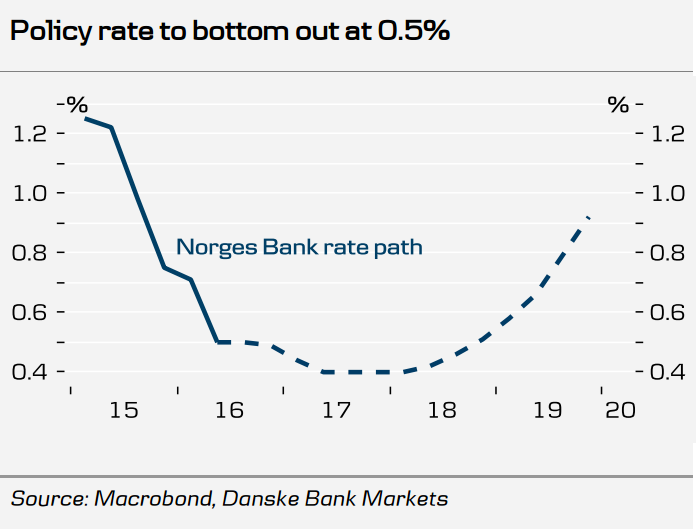
Norges Bank earlier this week left the key policy rate unchanged and revised higher the interest rate path in line with market expectations. Rate path was raised by 24bps in Q4 2016 and 12-19 bps in 2017-19. The rate path now indicates about 20 percent probability for 25bp cut by 15 Dec 2016 and another 20 percent in March 2017. Rates were gradually forecast increasing to 0.92 percent by end 2019.
Key economic indicators have signaled that the worst may be over for Norway’s economy, which bore the brunt of a slump in oil prices earlier. Unemployment has risen to 5 percent, the highest in about two decades, but the pace of rise in registered unemployed has been slowing and house prices are surging. The bank predicts that unemployment will head lower, reaching about 4.7 percent next year and 4.4 percent in 2018.
“The central bank has handled the downturn relatively well. It has gradually cut rates and along with falling oil prices contributed to keeping the krone low, which has been an important factor in reviving the economy,” said Erik Bruce, a senior economist at Nordea in Oslo.
Oil markets are seeing signs of recovery as OPEC officials are meeting in Vienna this week, in order to work out the shape of a possible output deal. Norway's oil investment is still falling and having negative effects on parts of the manufacturing sector, but the headwinds clearly seem to be easing.
It seems that growth outside the oil sector is accelerating. Norges Bank predicts mainland gross domestic product excluding oil and gas will expand 1.8 percent next year and 2.1 percent in 2018, after 0.9 percent growth in 2015. It predicts the plunge in petroleum investments will come to an end in 2018. The central bank has successfully managed to the krone lower which has helped steer the economy out of trouble.
Inflation has risen much further than expected over the past three months. But is expected to slow gradually as the effects of the krone’s depreciation fade, and along with a stronger labour market this will provide more support for private consumption.
"Norges Bank will now keep rates unchanged at 0.5% throughout 2017. As we see it, only a significant strengthening of the NOK could trigger a further rate cut." said Danske Bank in a report.
EUR/NOK slumped over 1.65 percent after the Norges Bank policy decision to lows of 9.0877 on Thursday. The pair was consolidating downside on the day, trading 0.11 percent lower at 9.1030 at around 12:00 GMT. Technical indicators indicate downside. Strong support seen at 9.088 levels. Break below could see a drag upto 8.9566.







