When talking about space, one might think about the stars one sees at night or a good sci-fi film. But space is also crowded with satellites, spacecrafts and astronauts, whose missions can last anywhere from several days to months. Meanwhile, 8,216 unmanned satellites revolve around Earth’s orbits to improve our daily lives. Communication satellites contribute to enhancing Internet access in regions deprived of infrastructure (so-called “white areas”); meteorology satellites have become essential for weather forecasts, while navigation satellites (including GPS) are crucial for current and future transportation needs such as automatic driving vehicles.
Technological advances in the sector have unlocked many new business opportunities. The industry can now launch constellations of thousand satellites to reach corners of the earth as it had never before (e.g., Starlink), while new markets such as space mining and space tourism are steadily growing. National champions (including the United States and France) have also framed the space sector as a top economic priority. It is thought the technological benefits accrued by companies such as SpaceX, Blue Origin or OneWeb, launched by billionaires such as Elon Musk, will also be able to trickle down to non-space sectors such as the energy or freight industries.
Issues for sustainable space
For all these benefits, civil society appears increasingly concerned about the sector’s ecological footprint.
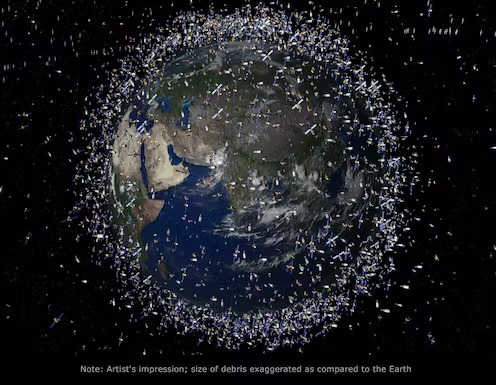
The first main issue to tackle is space debris which are defunct human-made objects in Earth orbit that no longer serve a useful function. These objects include non-operating satellites, abandoned parts of launch vehicles, which carry satellites or spacecraft into space, decommissioned satellites, and even debris resulting from the collision between space objects. In practice, this means more than 30,000 harmful space debris and 3,364 non-operating satellites could collide into an estimated 4,859 active operating satellites, with catastrophic implications for our daily lives in sectors spanning transport and security to finance.
Some space activities could also impact the Earth’s environment, including air, water and soil pollution, and outer-space contaminations. Take, for example, the rising popularity of space tourism. Given soot from spacecrafts currently warms up the Earth at a rate that is 500 times greater than that released by planes, there is growing anxiety over the sector’s associated greenhouse gas emissions and toxic substances. As a result, the debate over space activities cannot be the prerogative of the space community alone.
In an attempt to resolve these issues, our recent research has identified three promising working avenues:
-
Collaboration
-
Green space technology
-
Policies aiming at sustainable development
Tailor solutions for sustainable space
The collaboration needs to be carried out between five key parties: governments, academia, the industry, civil society, and environmental players such as NGOs. Nevertheless, while the industry has already developed an awareness of the issues at stake, the input of academic institutions has yet to be clarified. In particular, academia could provide new ideas in the areas of debris identification and removal, space traffic management, space situational awareness, and in-orbit servicing.
The second solution consists in developing green space technology that would emit less greenhouse gas emissions and other hazardous chemical substances. According to the European Space Agency, these green technologies could minimise the energy consumption throughout the entire life-cycle of a space mission, save up on resources, while also minimising toxic substances to protect human well-being and biodiversity.
Green space solutions to investigate include space traffic management, in-orbit servicing and active debris removal on the one hand. When it comes to the spacecrafts themselves, scientists should also start to imagine greener propulsion, cleaner fuels, and alternatives to toxic material. For example, following the path of SpaceX, all launch vehicle manufacturers are also considering reusable launchers that will reduce CO2 gas emission in a life cycle.
The final solution consists in developing policies that can at once encourage space commercialisation and enhance sustainable policy regime. One instance of this are green innovation policies assisting low-carbon small and medium enterprises. It will be important to align these policies with the 17 pillars of Sustainable Development Goals (SDGs) established by the United Nations. To achieve this agenda, some indicators are emerging such as space sustainability rating and ESG (environment, social and governance).
We think that we are still on time to solve the two main issues in sustainable space: space debris and the sector’s overall ecological impact on Earth. However, space organisations cannot remain idle awaiting that “space shame” – a space version of flight shame (from the original Swedish concept of flygskam) in the aviation sector – propels them into action.