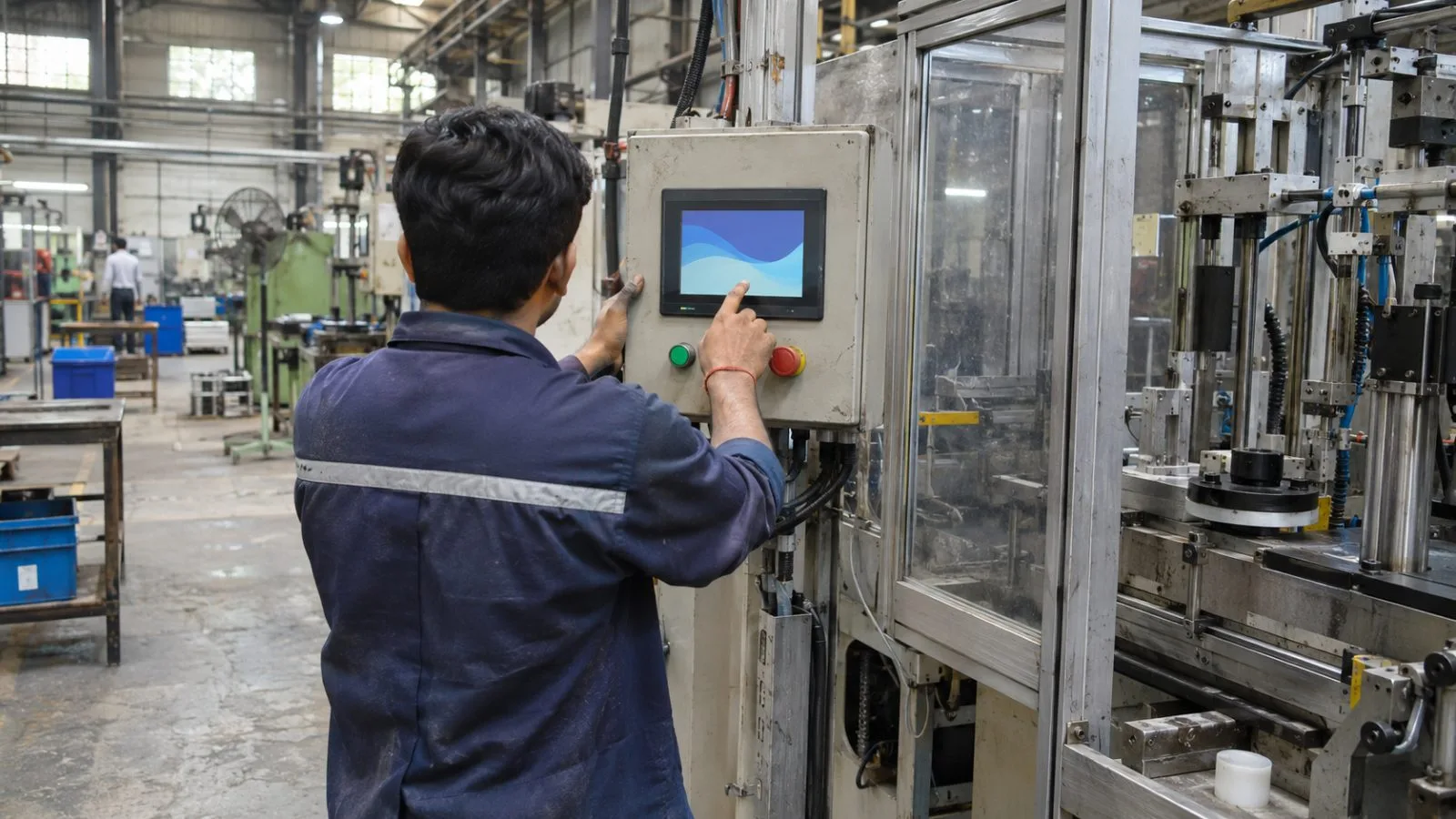
Dun & Bradstreet reported that only 4% of surveyed Indian businesses said their enterprise data was fully ready for AI at scale, while India separately pursues AI adoption in manufacturing.
Dun & Bradstreet's quarterly survey covered 10,000 businesses in 32 countries, but its release did not disclose the size or industry breakdown of the India sample. The figures therefore cannot establish factory-specific adoption rates. Dun & Bradstreet said all surveyed Indian businesses had AI-related projects underway: 44% were in the planning or piloting stage, 30% were scaling AI into production, 19% had operationalized AI across multiple core processes and 7% were deploying agentic AI workflows.
The findings highlight a difference among surveyed Indian businesses between having AI projects underway and having data ready to scale them, but they do not show how widely manufacturers have adopted the technology.
A PwC survey of 51 Indian industrial manufacturers found 59% selected AI among the top three technologies expected to help achieve strategic goals over the next five years. The figure was 52% among respondents outside India. The survey measured expectations, not deployment. Siemens said in March that it had more than 700 digital references in India and 25 ecosystem partners; it did not give an AI-specific count.
India's Ministry of Electronics and Information Technology (MeitY) said a study will cover more than 350 manufacturing factories in the micro, small and medium-size enterprise (MSME) sector, including textiles, pharmaceuticals and electronics. The study aims to develop a practical AI-adoption roadmap. MeitY said the findings would inform adoption pathways and government interventions affecting manufacturing output, export competitiveness and employment, and could help improve MSME unit economics and market access.
India's 2025-26 Economic Survey recommended practical AI applications that account for constraints including capital, energy, institutional capacity and market depth.
Siemens' Eigen Engineering Agent connects with its TIA Portal automation software. Siemens says the agent can generate or adapt programmable logic controller (PLC) code, generate test logic, support automated testing and assist with human-machine interface development. Its product page advertises execution two to five times faster, solution quality up to 80% higher and efficiency up to 50% higher; these are Siemens' claims.
Siemens expects more than 500 executives, industry leaders and ecosystem partners at its Transform event. The agenda covers connected factories, digital twins, AI infrastructure, autonomous buildings and rail, and describes planned demonstrations rather than evidence of widespread factory adoption. The event is scheduled for Wednesday, Nov. 18, in Delhi.