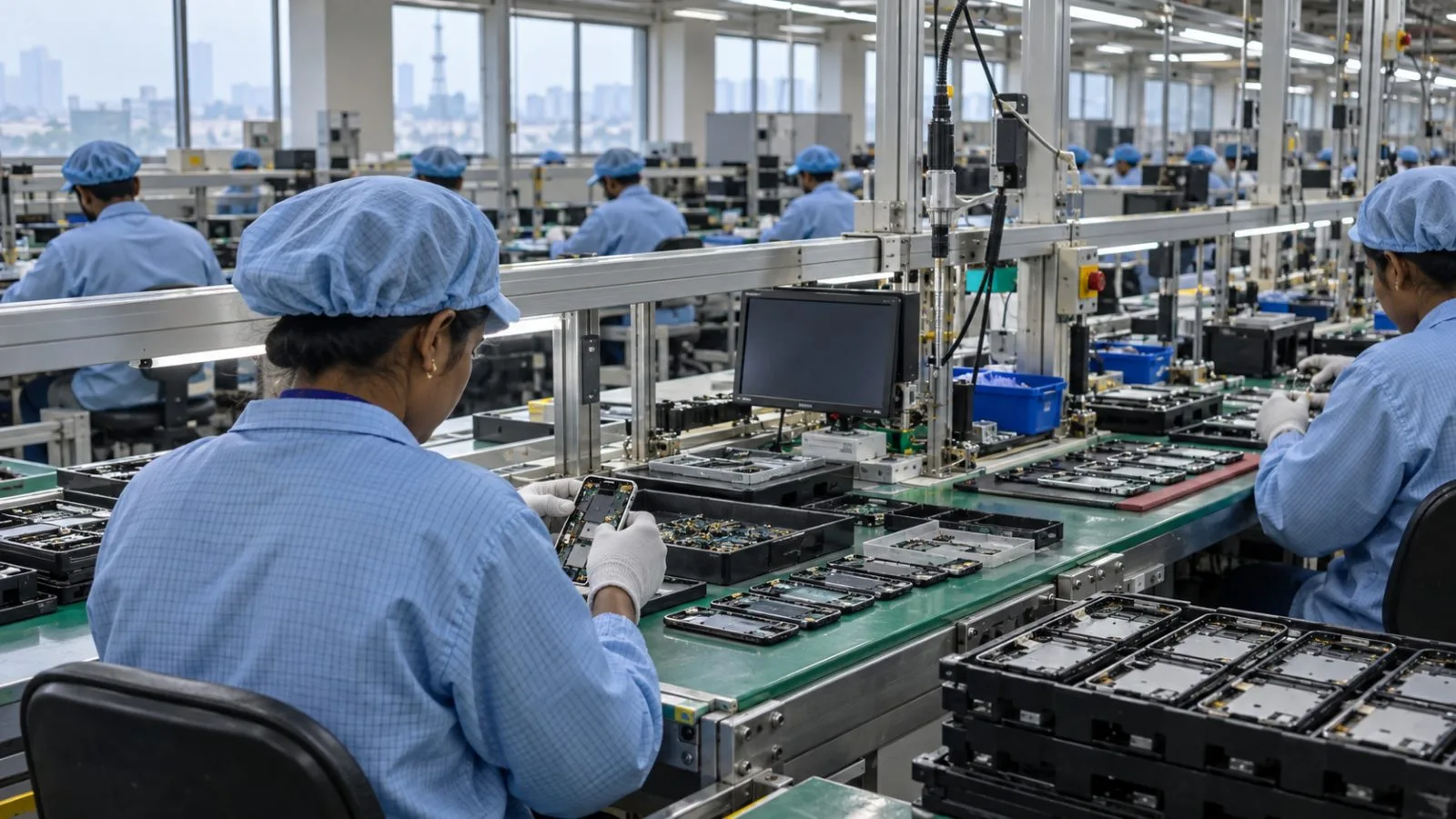
India’s new Mobile Phone Manufacturing Scheme ties an additional incentive to local components as finished-phone exports rise, while a separate measure shows the country’s wider electronics trade remains in deficit.
Notified Aug. 21, the scheme offers eligible mobile-phone manufacturers an additional incentive of up to 1.5% if qualifying components sourced locally are used in at least 25% of units produced during a financial year. The earlier Production Linked Incentive Scheme for Large Scale Electronics Manufacturing, which offered eligible firms 4% to 6% of incremental sales, ended March 31, 2026.
India’s Ministry of Electronics and Information Technology said mobile-phone exports reached ₹2 lakh crore in fiscal 2024-25, compared with ₹1,500 crore in fiscal 2014-15. It also reported that imported phones fell from 75% of domestic demand to 0.02% over those periods. These figures track finished phones. Separately, the ministry reported 185,175 direct jobs under the earlier mobile PLI scheme through February 2026; the figure is a scheme-reported tally.
Bloomberg News, citing people familiar with the figures, estimated that India assembled about 55 million iPhones in 2025. The tally was 36 million in 2024, and India made about one-quarter of Apple’s global production, the outlet reported.
The broader trade picture includes more than phones. Government policy body NITI Aayog, using ITC Trade Map data, put India’s 2024 electronics exports at $42.1 billion and imports at $100.6 billion, a $58.5 billion deficit. Integrated circuits made up 23.7% of the import basket, while mobile phones and telecom equipment accounted for 17.5%. The figures cover electronics categories overall, not only phone components.
A 2023 paper by researchers Rahul Chauhan, Rohit Lamba and Raghuram Rajan estimated finished-phone exports of nearly $11 billion and imports of $1.6 billion in fiscal 2022-23. They also assessed imports of semiconductors, printed circuit board assemblies (PCBAs), batteries and display boards, some of which serve other industries, under different allocations to phone production. Their combined trade balance turned positive only when 40% or less of those selected category imports were assigned to phones; at higher allocations, it remained negative.
The government said an external evaluation of the earlier large-scale electronics scheme put domestic value addition at 23% in fiscal 2023-24. It reported ₹15,554 crore in incentives paid by Dec. 31, 2025, under combined large-scale electronics and IT hardware programs, without separating payments for mobile phones. Separately, Bloomberg Opinion columnist Andy Mukherjee argued in a column published Wednesday that subsidy costs may exceed the gains going to workers.
The Mobile Phone Manufacturing Scheme is intended to encourage domestic sourcing and value addition, and its incentive period runs from fiscal 2026-27 through fiscal 2030-31.