
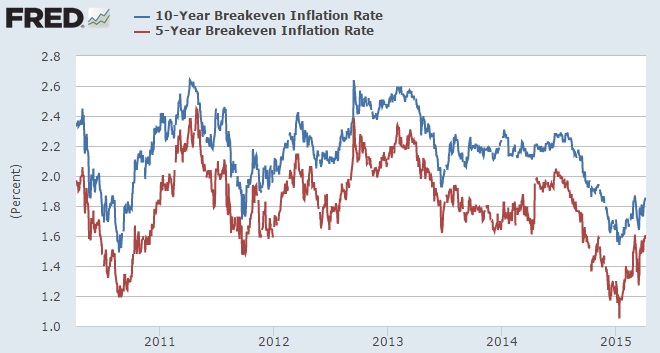
Recent statistics suggest that breakeven inflation has been gaining grounds this year. Above chart represents 5 year and 10 year break even inflation rate as measured from market. This is the yield differential investors are demanding to a conventional 10 year treasury compared to inflation protected one. Chart is prepared in St. Louis FRED dash board.
Trend shows, inflation expectation as measured from 5y5y swap rates and breakeven inflation are gathering pace since making low in January.
- 5 year breakeven inflation rate is now hovering around 1.58% up from 1.16% in January.
- 10 year breakeven inflation, now stands at 1.84%, up from 1.57% in January.
Important note -
- Weaker data and dovish FOMC comments lead to a drop in expectation March, however recovered its trajectory soon enough. 5 Year and 10 year break even rates dropped 1.34% and 1.64% respectively on March 17th.
- Expectation differential has narrowed between 5 year and 10 year. It now stands around 0.26% from 0.41% in January.
Impact -
- Recent trade shows, yield are getting heated up once again, after fall over dovish FOMC comments. Rising yields along with inflation expectation would continue to provide support for Dollar.
- Short term yields might outperform longer end of the curve as expectation narrows.
Dollar index is trading at 99.4, up 2.7% this week so far.


