


 Bank of America Predicts Yen Rebound as USD/JPY Faces Risks
  Oil Prices Trim Gains After Trump Rules Out Iran Strikes Before Midterms
  Wall Street Ends Mixed as Investors Await CPI and Bank Earnings
  Gold Prices Hit One-Week High as Oil Falls, Fed Rate Outlook Weighed
  S&P 500 Rally Masks Losses for Over 40% of Stocks in 2026
  Gold Prices Fall Amid Rate Jitters; Copper Steady as China Stimulus Eyed


 Add as a preferred source on Google
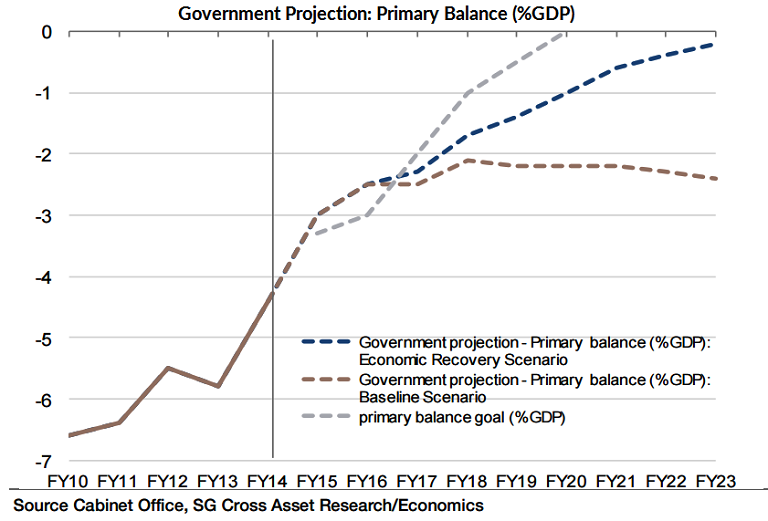
Japan's 2015 fiscal plan is different from the previous fiscal plan in which improving the primary balance to a surplus was the main objective. The key principle underlying in the new Japan's Economic and Fiscal plan 2015 is "There is no fiscal soundness without economic recovery". The primary objective now is to exit deflation as soon as possible, while achieving a primary balance surplus is only secondary.
In the previous fiscal plan in order to achieve a primary balance surplus by FY2020, a large fiscal austerity plan or an increase in taxes was necessary. The government expected that once the fiscal austerity plan as well as tax hike are promoted, fiscal stability can be expected, and this should reduce anxiety in the future. However, the outcome was different: this "relief effect" did not work. On the contrary, households' financial burden increased due to the consumption tax hike in April 2014 and consumption weakened.
In fact, according to the latest "Comprehensive Survey of Living Conditions" survey by the Ministry of Health, Labour and Welfare, the percentage of households feeling difficulty in living increased to 62.4%, the highest level since the survey started in 1986.
Against this backdrop, the government has in the new fiscal plan set up a soft fiscal guideline which is in line with achieving economic growth. Strong GDP growth rate being the main objective in the new fiscal plan, the GDP growth rate target of of 2% real GDP growth and 3% nominal GDP growth is definitely not an underlying assumption.
This time, an exit from deflation is highly expected in the foreseeable future, and there are clear developments regarding economic recovery. In addition, it is also highly likely that reducing the primary balance (as of % of GDP) to half of the level seen in 2010 is achievable.
Critical inflation figures from Japan are also due tomorrow. USD/JPY is extending yesterday's upbeat momentum, currently trading at 124.36, looking to consolidate the recent break above the 124.00 handle.

- News

- Economy

- Central Banks
- Investing
- Research
- Roundups
- Digital Currency
- Insights
- Technical Analysis
- Technology
- Business
- Law
- Health
- Nature
- Fintech
- Science
- Topic
- Opinions
- ©Econometrics LLC . All Rights Reserved.
Japan's new fiscal plan signals possiblity of complete exit from deflation
Thursday, July 30, 2015 11:28 AM UTC
Editor's Picks



- Market Data
Most Popular




