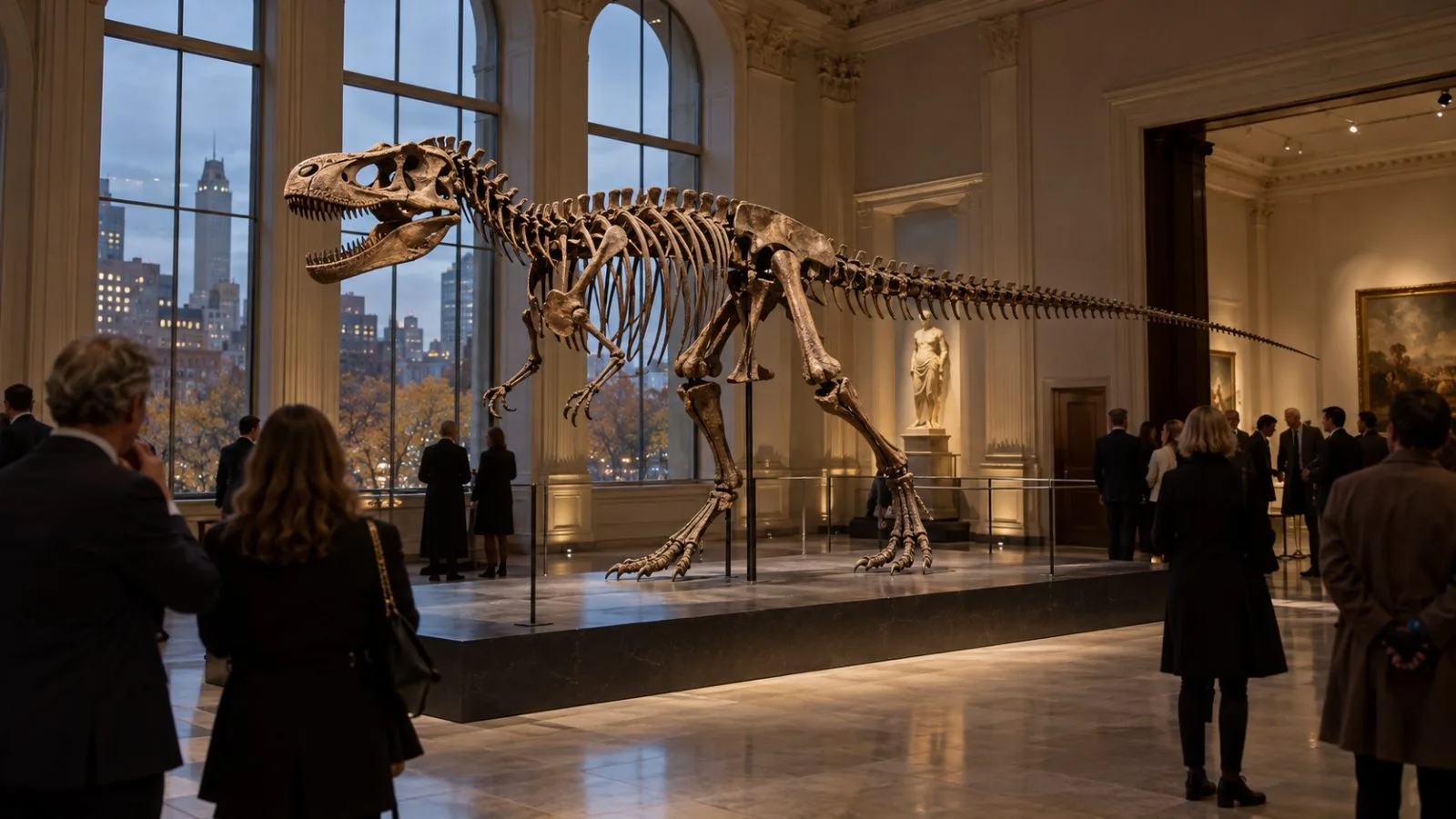
Jodi’s sale at Sotheby’s New York auction Tuesday, Oct. 27, brought $47.3 million, the second-highest auction result for a dinosaur fossil, the auction house said. The sale spotlights a specimen not directly examined by the research used to support Nanotyrannus as a separate genus.
The price includes buyer’s and overhead premiums, Sotheby’s said. Its presale estimate of $6 million to $9 million excluded them, so the figures use different pricing bases. The sale ranks behind Tyrannosaurus rex skeleton Gus, which Sotheby’s says sold for $50.1 million in July 2026. The house also cites the $44.6 million sale of Stegosaurus Apex in 2024 as part of its recent auction history. CNN reported that the scarcity of comparable fossils may have contributed to Jodi’s price.
Sotheby’s says it knows of only two other substantial Nanotyrannus skeletons besides Jodi. Its catalog lists about 191 fossil elements, including 53 skull bones and roughly 50 teeth. The specimen dates to about 67 million years ago, measures 19.6 feet long and stands nine feet six inches tall on its mount. Sotheby’s describes it as an adult based on its size and bone development.
Research on other specimens has supported treating Nanotyrannus as distinct from T. rex. A 2025 Nature paper examined the “Dueling Dinosaurs” tyrannosaur, while a Science study published online Dec. 4, 2025, analyzed the Nanotyrannus holotype. Neither study examined Jodi. Sotheby’s catalog gives Jodi the qualified identification Nanotyrannus cf. lancensis.
Montana rancher Jodi Pierson found the fossil on her land in the Hell Creek Formation in 2019. Commercial paleontologist Clayton Phipps led its excavation, according to Sotheby’s catalog. The auction house says the fossil was exhibited in London in 2023 as “Chomper,” a juvenile T. rex.
The sale also highlights concerns about access to significant fossils. The Society of Vertebrate Paleontology’s code treats researcher access as a core condition for registered public collections. Thomas R. Holtz Jr., a University of Maryland author and principal lecturer on vertebrate paleontology, told The Guardian that potentially scientifically significant fossils “can be lost to research and the public when they are in private hands.” Holtz also argued that similar spending could support several museums.