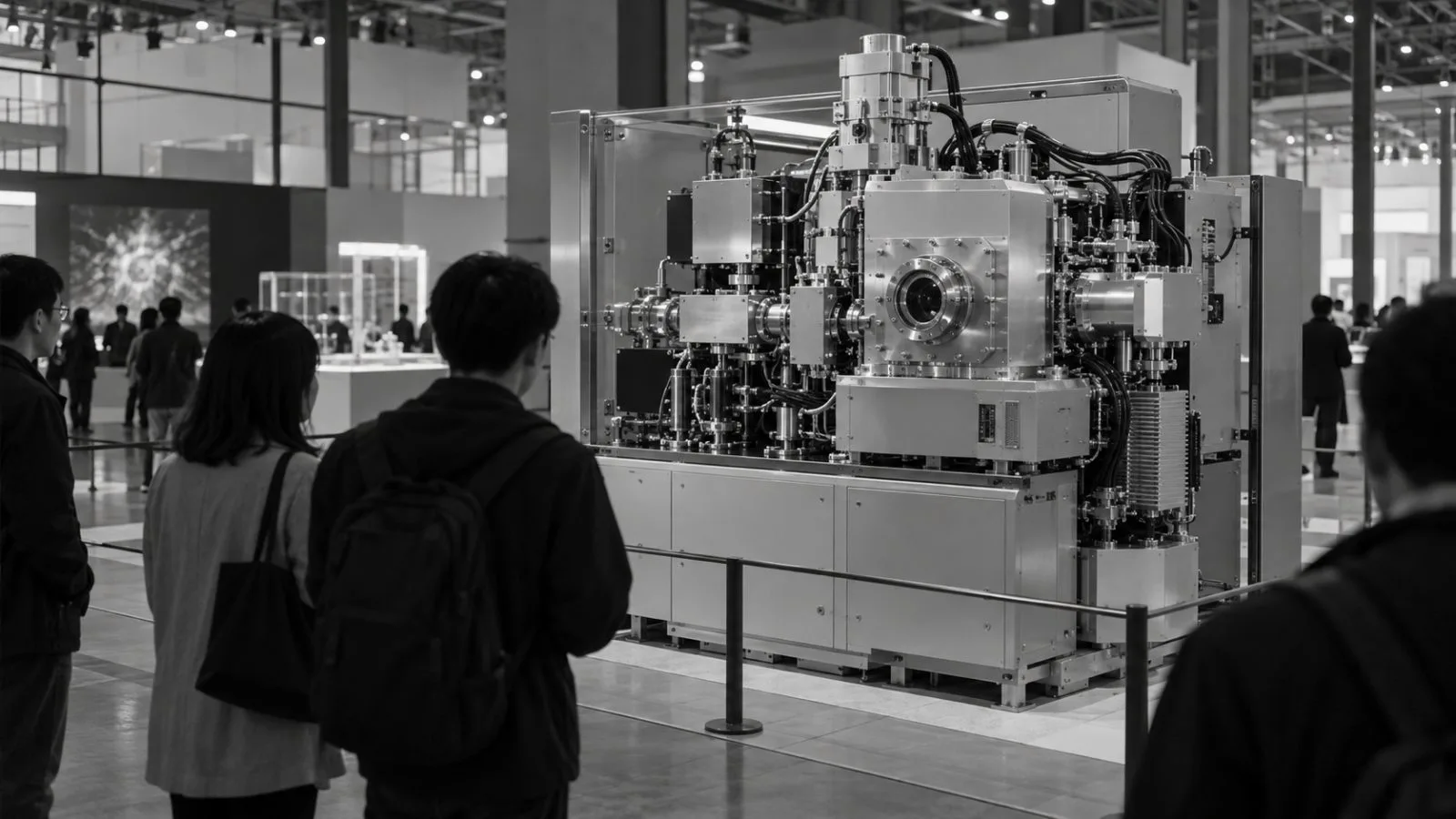
Langdao Silex displayed an extreme ultraviolet light-source prototype in Shanghai, a component used in advanced lithography.
Langdao’s product page identifies the FlintNano LPP-OXXO as a low-power EUV source and lists a 1,000-watt driving laser, EUV output above 15 watts and continuous operation beyond 100 hours. Whether that model was the system displayed in Shanghai is unverified. The figures are company specifications, and the page does not state where the EUV output was measured.
Exhibition staff estimated a 90% domestic localization rate for the displayed light-source system and told Jiefang Daily that mass production could be three to five years away. That estimate concerns the source, not a complete lithography scanner.
ASML says a 250-watt source supported volume production at 125 wafers per hour in 2018. The company reported having a 500-watt prototype by 2022 and demonstrating a 1,000-watt EUV source in April 2025. Langdao’s figure is a lower bound, and the measurement point is not stated, so the figures do not establish a direct performance comparison.
A light source is only one part of EUV lithography equipment. ASML says its systems keep the light’s path under vacuum and use specialized mirrors developed with ZEISS because EUV does not pass through most materials. The company says developing EUV took more than two decades, including more than €6 billion in research and development over 17 years.
The U.S. Commerce Department introduced export controls in October 2022 covering certain advanced-computing chips and semiconductor-manufacturing items destined for China. Ahn Jin-ho, a materials science and engineering professor at Hanyang University, told The Korea Herald he did not know where Langdao’s output had been measured and said key details were unverified. He also said prototype announcements could signal that China can pursue the technology despite restrictions, the outlet reported.
The Korea Herald reported that Seoul National University emeritus professor Kim Hyung-joon said publicizing prototypes can help state-backed projects attract funding and raise China’s technology profile. The outlet also reported Ahn’s comparison with earlier Chinese claims about an ArF lithography machine; he said he had not heard of it being used in mass production. Jiefang Daily’s report gives the only stated timetable here: three to five years for mass production of the light source.