Longyearbyen Local Council is maintaining its advice against drinking tap water after September testing found three substances above listed limits, while a study examines possible effects of permafrost thaw.
A clean-water sample collected at a Longyearbyen school on Sept. 9 showed sulfate at 568 mg/L, above the council’s listed limit of 250 mg/L. Manganese measured 0.15 mg/L, versus a 0.05 mg/L limit, and nickel reached 41 micrograms per liter, compared with 20 micrograms per liter. The laboratory report, dated Sept. 25, cautioned that the results describe only the samples tested.
The council’s analysis page, updated Oct. 7, says a Sept. 10 update retained the recommendation because the three substances exceeded listed limits. The council’s annual report says the advisory began in September 2025, after manganese levels rose further and the Norwegian Institute of Public Health advised the council. Levels had already been unusually high in autumn 2024, the report says.
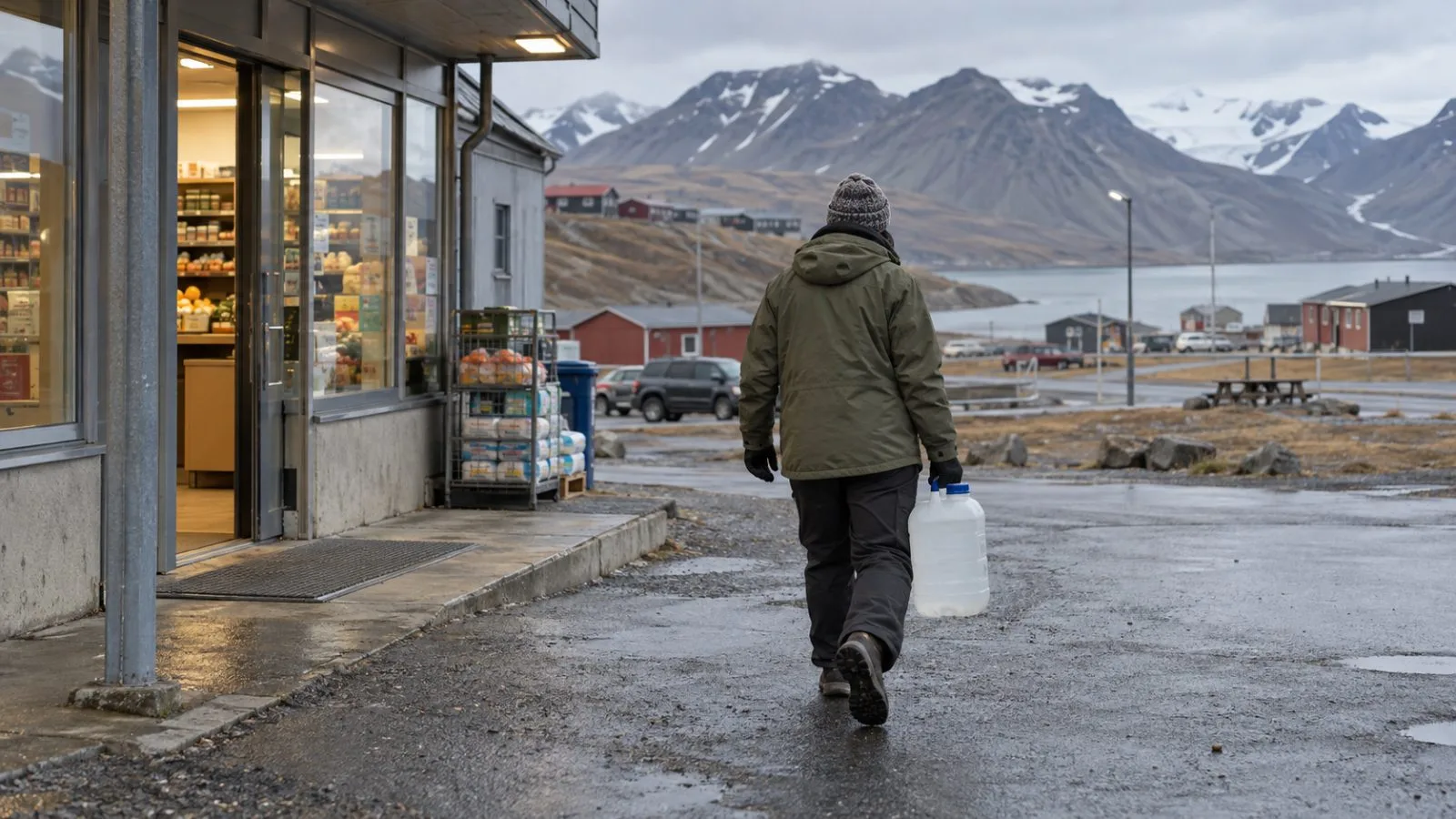
Residents can get free emergency drinking water at Svalbard Store, the council says. A May notice said the supply comes from Svalbard Brewery’s reverse-osmosis treatment plant and meets drinking-water standards; the council’s latest analysis says distribution is continuing.
SINTEF is studying Longyearbyen’s water quality and supply, the dam’s condition and how thawing permafrost may affect water flows. The project began in 2025 with the University Centre in Svalbard and the University of Bergen, and the council is funding it.
Research manager Hanne Kvitsand said the team has not determined how thawing may change water channels or quality. “We need to investigate this thoroughly,” she said.
The Guardian reported that Marjolaine Verret, an associate professor in Arctic geology at the University Centre in Svalbard, attributed contamination to thawing permafrost interacting with pyrite-bearing shale. SINTEF’s public update says researchers do not yet know how thaw will affect water channels or quality, leaving Verret’s explanation unconfirmed by the study.
The Guardian also reported that council chair Terje Aunevik was weighing filtration at Isdammen and desalination as a backup, or the reverse, with the choice still under consideration. Aunevik called the options extremely expensive, the outlet reported, but gave no cost estimate.
SINTEF expects to deliver its report in the second quarter of 2027.