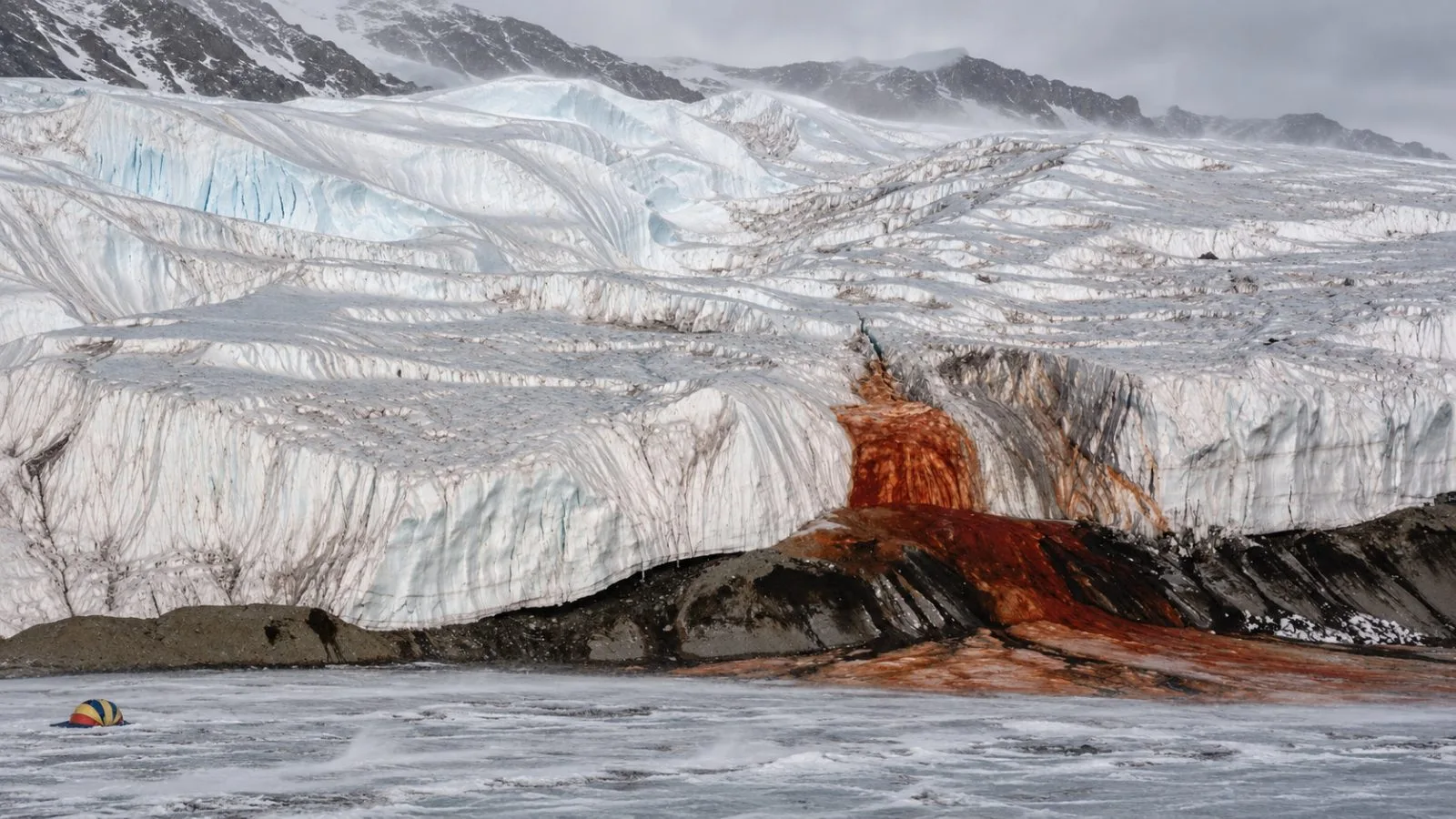
A study of Antarctic samples found marine-associated microscopic eukaryotes in red material beside Blood Falls, adding evidence of a marine connection while researchers have not detected eukaryotes in the brine beneath Taylor Glacier.
Marine lineages accounted for more than 60% of the diatoms in red mud and sediment collected at the glacier’s terminus, the study reported. Published Aug. 3 in Nature Geoscience, the paper describes Blood Falls as an iron-rich brine outflow at Taylor Glacier.
Researchers assessed 167 samples from the McMurdo Dry Valleys, including aquatic settings, sediment and material carried by air, along with marine reference samples. They identified diatoms, haptophytes, dinoflagellates and ciliates. RNA profiles indicated that some photosynthetic organisms were active, with gene activity associated with photosynthesis, osmotic stress responses and cellular repair.
The team compared genetic sequence variants from the glacier terminus with those from McMurdo Sound and other Dry Valleys aquatic communities. Variants also found in the sound represented 9.34% of eukaryotic variants at the terminus, compared with 1.15% in the other communities; the study reported a difference of P < 0.03. Shared marine diatom variants made up 20.4% of diatom variants at the terminus, versus 1.5% in other Dry Valleys aquatic communities.
Modern wind samples contained few marine signals. The authors said present-day wind alone was unlikely to account for the pattern, while noting that wind could have carried marine material there in the past.
The new findings add to earlier chemical research and studies of bacteria from the brine that also pointed to a possible marine source. The eukaryotes in this study came from red-hued ice, mud and sediment near the outflow, where brine meets surface water; none has yet been detected in the brine itself.
Angela Zoumplis, the study’s first author, said the site may preserve “traces of an older connection” between the Dry Valleys and the sea. The results support a marine link to the brine-fed area, but do not establish when seawater entered Taylor Valley or when it became isolated beneath the glacier. The study also discusses both ancient seawater incursions and wind transport as possible routes for marine material to reach inland Antarctica.