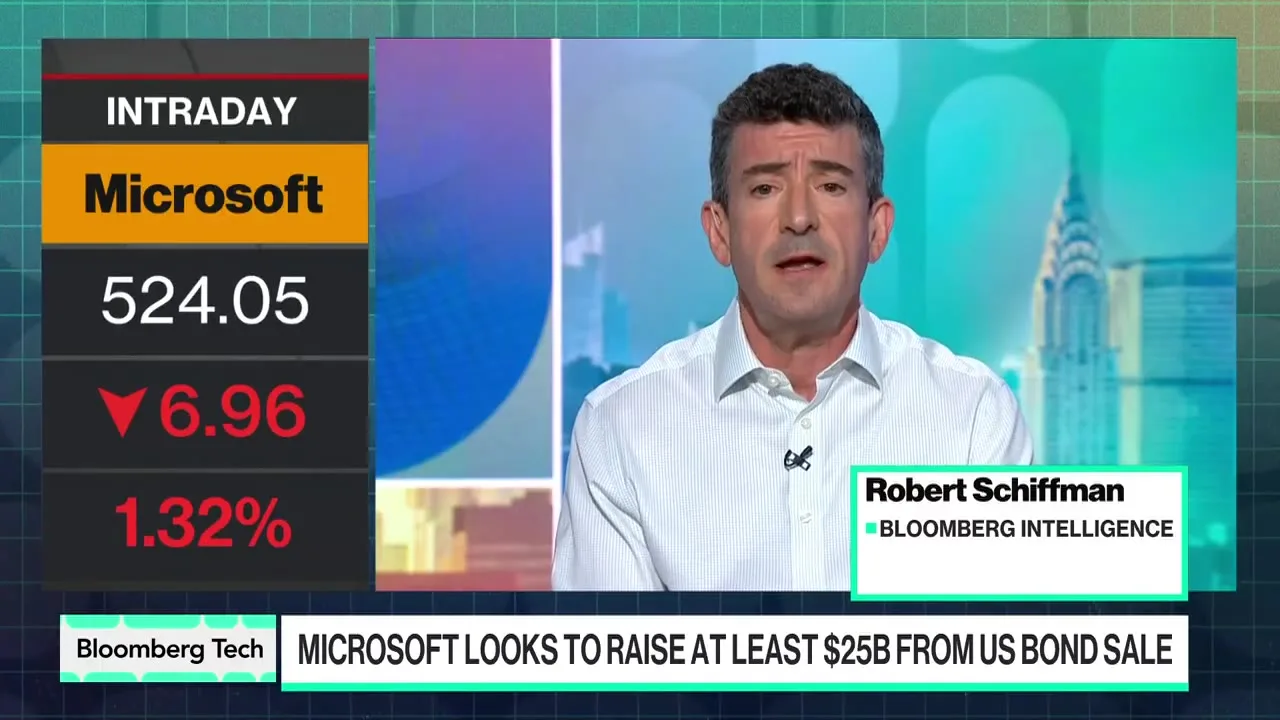
Microsoft can borrow at least $25 billion while sustaining artificial intelligence investment and shareholder payouts, Bloomberg Intelligence senior credit analyst Robert Schiffman said after Bloomberg reported the company's fundraising plans.
The proposed borrowing would be Microsoft's first US debt sale since 2017, Bloomberg reported, citing sources. Schiffman discussed its borrowing capacity on Bloomberg Technology, published Oct. 29.
Schiffman said Microsoft's financial position allows it to keep spending on computing infrastructure while buying back shares. He linked the borrowing plans to continued growth in spending by the largest cloud computing companies.
“Why have a triple-A balance sheet if you're not gonna use it?” he said. Microsoft has a higher credit rating than the US government, giving it access to borrowing on favorable terms.
He contrasted Microsoft's continuing stock buybacks with equity issuance by peers, naming Meta, Alphabet, SpaceX and Oracle. He said Microsoft's free cash flow, the cash left after operating and investment spending, looks better than its peers'.
That gives Microsoft capacity both to invest and to return money to shareholders. He also attributed its stronger stock and debt performance to its financial position and lower debt burden.
“I think they could issue $100 billion today if they wanted to,” Schiffman said, predicting exceptionally strong demand. That was his assessment of borrowing capacity, rather than an announced financing commitment.
Microsoft holds triple-A ratings from both Moody's and S&P, he said. Those ratings put its debt among the alternatives available to investors who would otherwise buy government bonds.
Turning to the relationship between corporate borrowing and government debt, he described the prospect of earning an extra 120 basis points, or a 1.2-percentage-point premium, on longer-term corporate bonds compared with Treasuries.
Investors buying corporate debt also sell Treasuries to hedge, or offset, some of their investment risk, he said. Those sales can put pressure on government bonds as investors position for corporate borrowing.
Schiffman put Alphabet's cash at about $240 billion at the end of the quarter, compared with roughly $60 billion for Microsoft. He said Microsoft's smaller cash holdings help explain why borrowing offers financial flexibility.
“You borrow cash when you can, not when you have to,” he said. Microsoft has not been borrowing, leaving it room to increase debt.
He put Microsoft's average cost of debt close to zero and its cost of equity at around 14%. Borrowing could fund cash returns to shareholders and allow the company to benefit from that difference.
The discussion left the eventual size and terms of any bond sale open. Schiffman's estimate of Microsoft's capacity to borrow did not establish how much the company would ultimately raise.