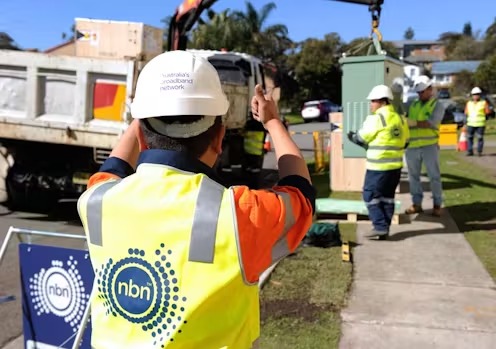
The National Broadband Network may offer a significant speed boost to many users, if a plan from NBN Co, the operator of the network, is implemented. NBN Co’s proposed upgrade would provide download speeds up to five times faster for users on its three fastest home services (Home Fast, Home Superfast and Home Ultrafast).
The speed boost would come at no extra wholesale cost to retailers. On its face, this is an exciting announcement that aims to meet consumer demand for higher speed broadband connections to the internet.
NBN Co has highlighted the rationale for this move. The average Australian household now has around 22 internet-connected devices, and this is expected to grow to 33 by 2026. Data usage per household has doubled in the past five years, and now averages 443 gigabytes per month.
Why do people want more data?
Higher data usage is being driven by new applications, entertainment and online gaming. For example, game updates can be as large as 30 or more gigabytes today. If games update regularly, the amount of data used each month increases quickly.
Entertainment too is using more data. Most streaming video today is provided in a 720p format, but newer televisions can display content at the higher-resolution 4K format. With faster broadband speeds becoming more common, consumers should anticipate more 4K content becoming available.
Likewise, virtual reality and augmented reality are relatively new technologies that are slowly becoming integrated with gaming and business systems. These high data usage technologies are likely to become more present in our daily lives over the next decade.

When would the upgrades happen?
NBN Co has indicated it would like to start providing the new higher speed products later this year, or early next year. The upgrade would be achieved by increasing the overall capacity of the NBN, which could then be “shared out” to consumers.
The NBN Co announcement is something the service providers should have expected at some point soon.
NBN Co’s announcement, coming only months after the Australian Competition and Consumer Commission (ACCC) approved a proposal for major annual price increases, may not be welcomed by all broadband retailers.
A spokesperson for the second largest broadband retailer, TPG Telecom, told CommsDay yesterday:
It took more than two years to finalise [the new pricing approved by the ACCC] and only three months for NBN Co to undermine the certainty it was supposed to create. We will always welcome opportunities to deliver greater service and speed to our customers, but NBN’s monopolistic whims make genuine collaboration with them very difficult.
Retailers understandably want certainty in wholesale pricing. One difficulty in achieving this is the high cost of “backhaul” in Australia: this is an intermediate connection between service providers and the NBN itself. Larger retailers have their own backhaul infrastructure, but smaller retailers must pay a third party.
If the NBN offers higher speed broadband connections, smaller retailers may end up paying more for backhaul – and will be faced with a dilemma over whether to pass these extra costs to consumers.
Telstra and Optus have broadly supported the plan by NBN Co to move to new technologies that offer the higher speed capabilities.
A faster network may entice consumers
Aussie Broadband Group managing director Phillip Britt told Gizmodo Australia:
Aussie Broadband is still understanding the detail of NBN Co’s speed proposal, but on the face of it, it could represent one of the most exciting steps in technology adoption for Australian households and businesses.
For NBN Co, the boost for the higher-speed plans may entice consumers to move from basic 50 Mbps plans to the upgraded Home Fast plan (which will offer download speeds of 500 Mbps, up from the current 100 Mbps).
NBN Co may also hope this encourages the remaining consumers with copper “fibre to the node” connections to move to “fibre to the premises” by taking advantage of one of the low or no cost upgrade offers available through retailers.
NBN Co has issued a consultation paper to retailers, asking for their feedback on the proposed changes to the high speed products by April 19 2024.