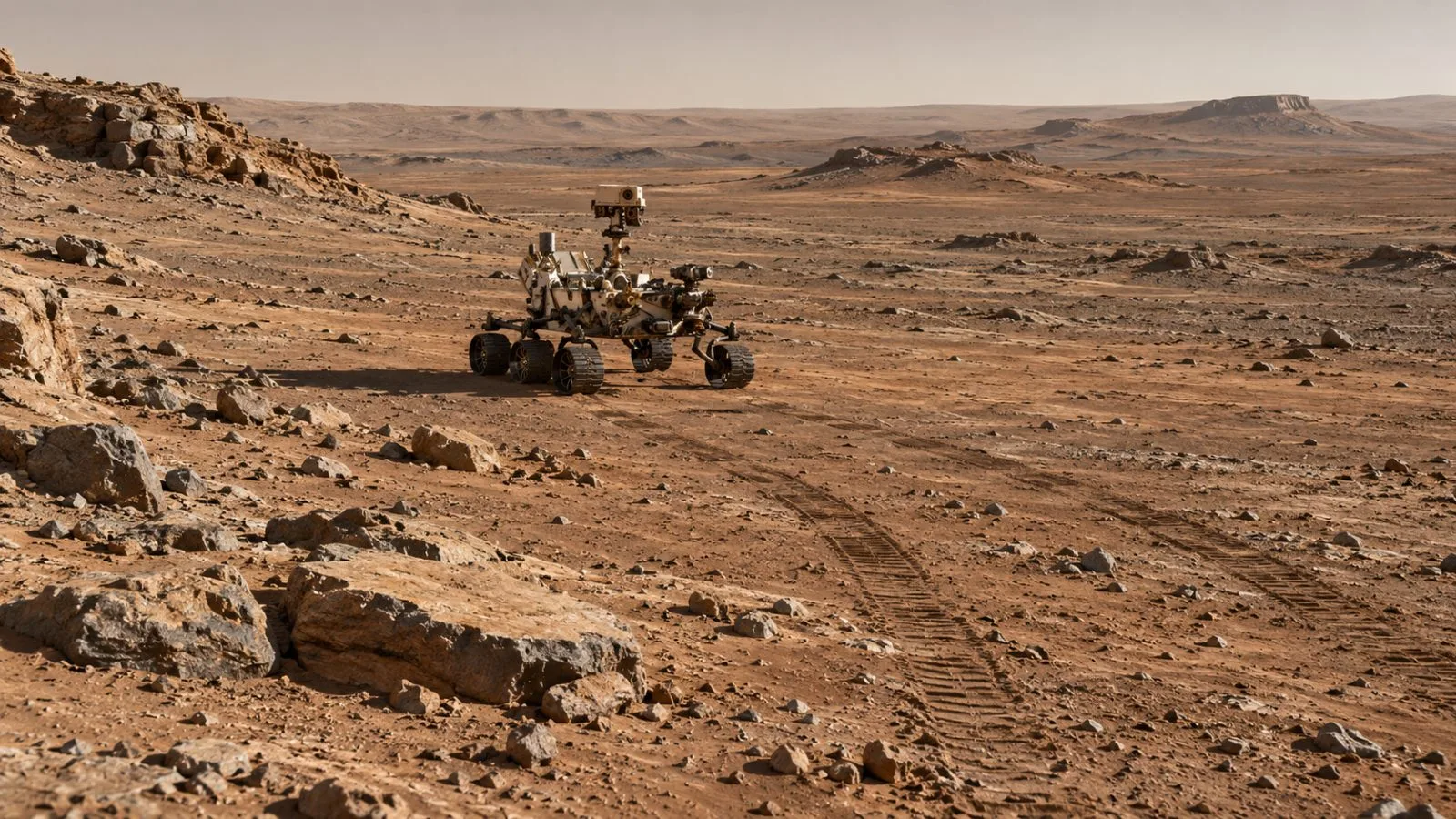
NASA’s Perseverance rover has set a new distance record for vehicles on another world, reaching 45.22 kilometers on Mars as autonomous navigation handles most of its driving.
On Oct. 11, a 91.31-meter drive raised Perseverance’s total to 45.22 kilometers (28.10 miles), moving it beyond the 45.16-kilometer (28.06-mile) mark recorded by NASA’s Opportunity rover. NASA said the milestone came on Perseverance’s 2,006th Martian day, known as a sol. Opportunity was active from 2004 to 2018 and spent almost 15 years building its total; Perseverance passed that benchmark about five and a half years into its mission.
NASA credits much of Perseverance’s progress to Autonomous Navigation, or AutoNav. The system has guided more than 90% of the rover’s total distance, checking nearby terrain for hazards while it moves and allowing it to cover as much as 412 meters in one sol. NASA says an earlier version of AutoNav accounted for about 5% of the driving by the Spirit and Opportunity rovers.
A separate capability, Global Localization, helps determine the rover’s position after a drive. A NASA mission update says the system compares ground-level images with orbital views to estimate Perseverance’s coordinates. Its processing runs on a unit in the Ingenuity Helicopter Base Station and supports longer trips with less human intervention.
The record came as Perseverance crossed the Lac de Charmes area near Jezero Crater’s western rim, heading toward Idubi. NASA’s science team hopes to find signs of ancient hydrothermal systems there. The Jet Propulsion Laboratory (JPL) said the rover’s range lets scientists consider a wider variety of geological sites during the crater-rim campaign. Mark Maimone, deputy team chief for robotic operations on Perseverance, called the rover “a better driver than the one that landed.”
NASA approved the mission’s first extension in October 2026, with crater-rim exploration expected to continue until about late 2028. From Lac de Charmes, Perseverance is expected to travel south toward Rainbow Falls.