
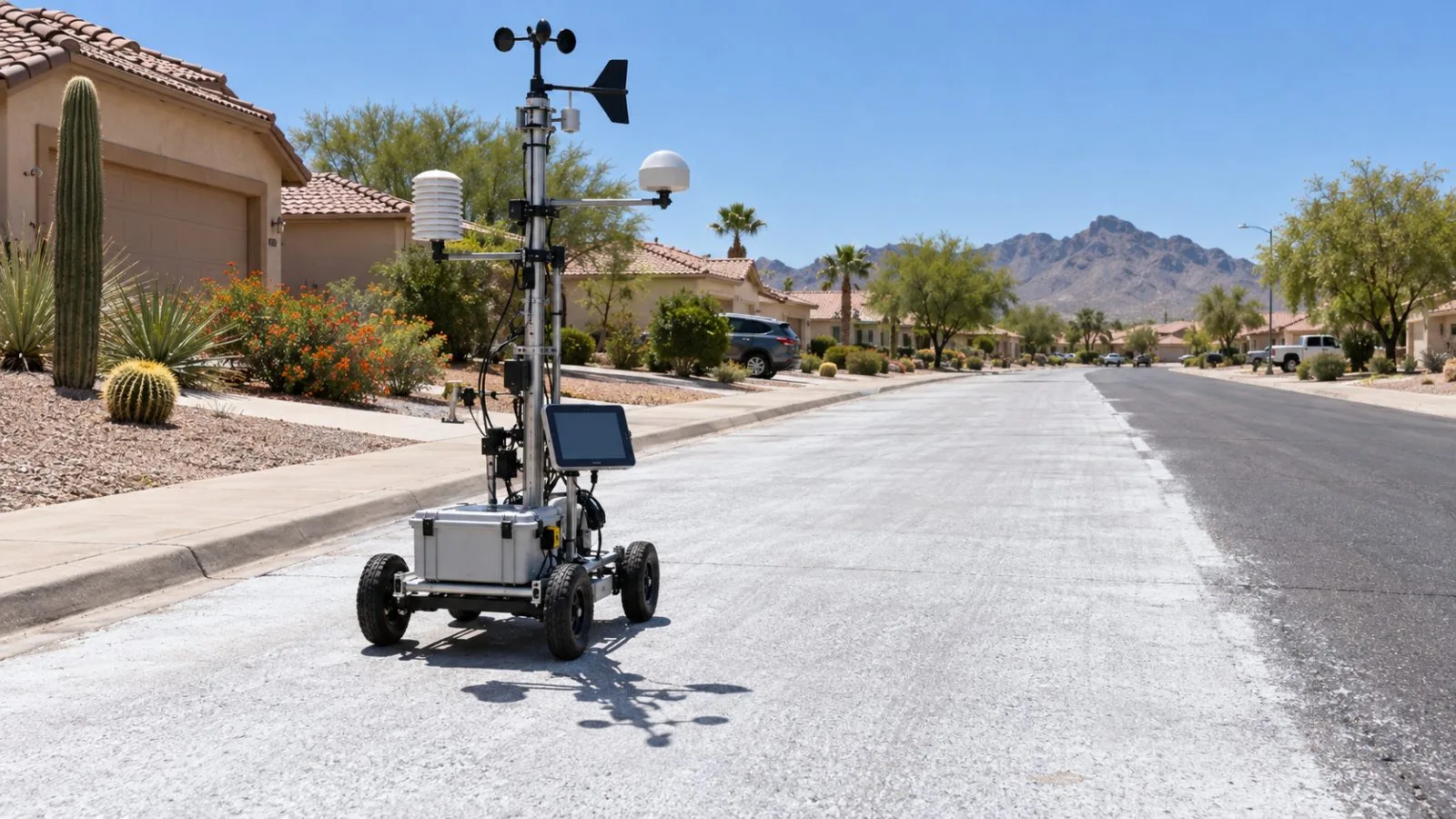
Phoenix’s 2020 cool-pavement evaluation found that reflective treatment lowered road temperatures but raised mean radiant temperature over treated streets at midday and in the afternoon, showing that cooler pavement did not mean lower radiant readings.
A joint report by the city and Arizona State University found that surface readings averaged 12°F (6.7°C) below untreated asphalt at noon and 10.5°F (5.8°C) lower in afternoon measurements. Mean radiant temperature over the treated roads averaged 5.5°F (3.1°C) higher at those times. Before sunrise and after sunset, treated roads averaged 0.5°F lower than untreated asphalt on that measure.
At pedestrian-level measurement points, researchers used MaRTy, a mobile biometeorological cart, to record mean radiant temperature. The metric captures radiation from the sun and nearby surfaces, so it differs from air temperature. Detailed field comparisons covered three neighborhoods; coating reflectivity was monitored across eight.
A peer-reviewed study in Nature Communications, published in 2023, found no significant air-temperature difference at two meters when observations were averaged. It also found no significant mean-radiant-temperature difference on nearby sidewalks; the higher midday readings came from measurements over the road.
Crews applied CoolSeal to residential streets in eight neighborhoods and to a public parking lot, covering 36 miles (58 kilometers). Phoenix chose road sections where pavement-preservation work was already planned. The report found subsurface temperatures averaged 4.8°F (2.7°C) lower beneath treated pavement. Reflectivity fell from 33%–38% at installation to 19%–30% after 10 months, compared with 12% for untreated asphalt.
Separately, Phoenix describes lower long-term maintenance needs and costs as a possible benefit of its program, rather than a result measured in the 2020 evaluation. A 2026 Building and Environment study examined a separate Phoenix installation and found pavement averaged 3°C (5.4°F) cooler than asphalt, while midday mean radiant temperature was 2.4°C to 3°C (4.3°F to 5.4°F) higher. The city’s Street Transportation Department said treated streets reached 200 miles on Sept. 2, 2026.
