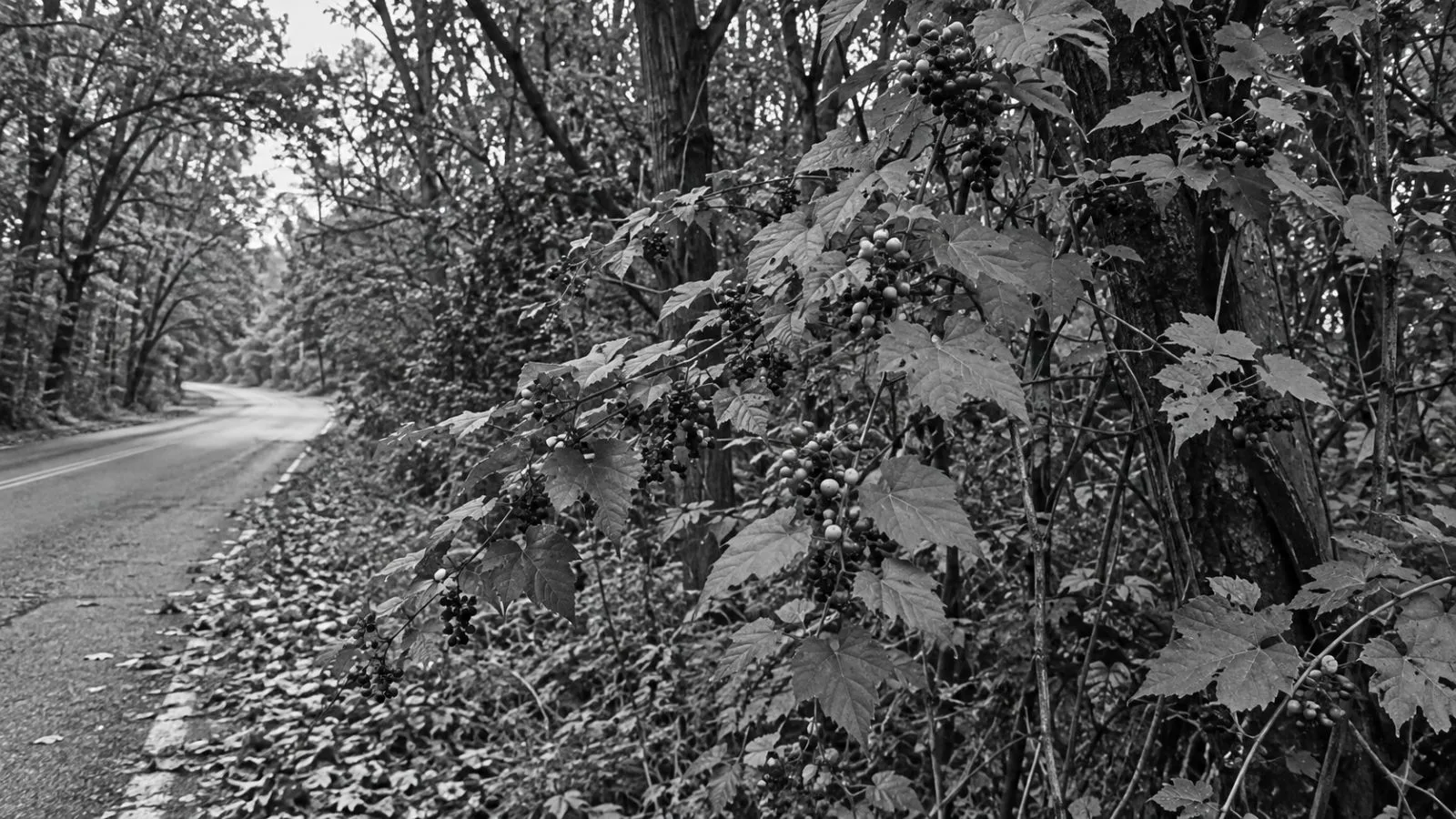
The U.S. Forest Service (USFS) says porcelain berry, introduced to the Northeast as a bedding and landscape plant in 1870, can shade native vegetation and suppress tree-seedling establishment along woodland edges.
The species, Ampelopsis brevipedunculata, is native to Asia and also known as Amur peppervine. Its climbing stems commonly reach 10 to 25 feet (3 to 7.6 meters), sometimes longer; tendrils help them grip nearby plants and other supports. The vine occurs in gaps and at wooded margins, where more daylight reaches the ground, and is likely unable to persist in deep shade, the review says.
The review’s range account, based on information available in 2009, covered much of the eastern United States and the Great Lakes region. It cited Iowa among the western locations, Alabama in the south and New Hampshire in the north, and said the vine was most common along the northeastern Atlantic coast. Each fruit holds one to four seeds. Birds and small animals spread them after feeding on the berries, while floating fruit may also move by water.
The effects vary by site. The USFS review cites NatureServe’s medium-to-low ecological impact assessment, while also reporting that dense infestations can shade native plants, kill vegetation and limit seedling establishment. A University of Maryland Extension update dated April 28, 2026, describes vigorous growth along roadsides and wooded borders. It also notes that the vine resembles wild grapes, making leaf shape alone an unreliable way to identify it.
The March 2013 issue of Invasive Plant Science and Management carried a greenhouse comparison of porcelain berry, native Virginia-creeper and invasive bushkiller. Researchers reported comparable stem growth for porcelain berry and Virginia-creeper; bushkiller grew faster and reached greater height. Because the experiment took place in a greenhouse, it does not show how the plants compete in forests.