


 Moderna Short Sellers Hit With $4.8 Billion Loss as Stock Soars
  Eli Lilly Eyes AtaiBeckley Acquisition to Expand Psychedelic Mental Health Pipeline
  GSK Unveils $2.52 Billion Cost-Cutting Plan to Accelerate Drug Pipeline
  Novartis Shares Plunge After Muscle Drug Fails Phase III Trial
  GLP-1 Weight-Loss Drug Use Surges Among U.S. Children
  U.S. Issues Cuba Health Alert as Illnesses Rise
  Hengrui Shares Rise on $2.6 Billion Novo Nordisk Obesity Drug Deal
  3 clinical-grade skincare creams you really shouldn’t buy online
  Moderna Wins FDA Approval for mFLUSIVA mRNA Flu Vaccine for Adults 50+
  Sanofi, Regeneron Expand Drug Partnership in $8 Billion Deal
  Trump Administration Bars U.S. Travelers From Congo Flights Amid Ebola Outbreak
  New York Declares Measles Disaster Emergency as Cases Surge
  Trump Signs Order to Cut Routine Childhood Vaccines
  SK Biopharmaceuticals Secures Global Rights to Biohaven Epilepsy Drug Opakalim
  FDA Approves Mirum’s Atebrioz for Rare Bone Disorder FOP


 Add as a preferred source on Google
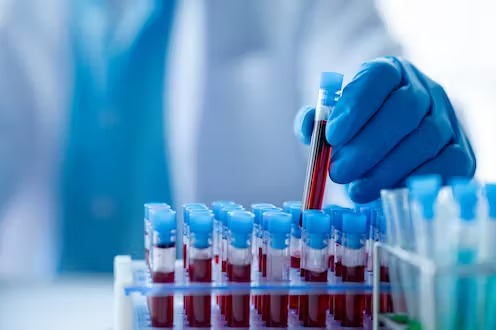

Doctors may someday be able to use bodily fluids to noninvasively detect breast cancer in patients earlier than is possible now.
Breast cancer is the most commonly diagnosed cancer among women in the U.S. and is currently one of the leading causes of cancer deaths. Earlier diagnosis and treatment lead to better prognoses for breast cancer patients. But mammograms have proved to be less effective for those under age 40, as their breast tissue is denser and screening and biopsies can be unpleasant to endure.
in the graphic explainer, make it “U.S.” instead of “US”
In breast milk and blood serum, researchers, including those in my lab group, have identified proteins that are involved in tumor development. Eventually, biochemists like my colleagues and I hope we can use these cancer-related proteins to create a biomarker panel that physicians can use to detect breast cancer earlier, therefore aiding in diagnosis and treatment.
Proteins as biomarkers for what’s happening
Researchers can analyze the proteins present in a variety of tissues, from biopsies of tumors to biological fluids including blood, saliva, urine, tears or breast milk. This technique is an example of studying a sample’s proteome – all the proteins in a particular cell, organism or species. The field is called proteomics.
Proteomics can be a powerful tool when researchers compare the proteomes of individuals from different groups, such as in blood from healthy people versus those with breast cancer. This kind of case-control comparison can identify a single protein or a group of proteins and their variants that are specific to one condition.
That’s what my colleagues and I are looking for: proteins that are present only in the samples from people who have breast cancer. Scientists call them biomarkers because they signal that a patient has a particular condition. Once our candidates are verified by large-scale clinical trials that include many patients, we hope that particular proteins can then be used to assess someone’s future risk of developing the disease.
Doctors can currently use biomarkers for breast cancer to gauge a patient’s response to treatment. For instance, the molecules cancer antigen 15-3 (CA 15-3) and carcinoemybronic antigen (CEA) are elevated in breast cancer patients, so monitoring their levels can let physicians know whether treatment is working.
Inherited variants of the BRCA1/2 genes can increase the likelihood of developing cancer; they can act as biomarkers in screening for cancer risk.
None of these biomarkers aid in diagnosis of breast cancer, though.
Researchers prefer proteins as cancer biomarkers over the genetic materials DNA and RNA because proteins provide a snapshot of what is happening in a patient’s body at the time a sample is collected. DNA and RNA can tell you whether a certain gene is turned on or off, but not the active form of the protein it codes for or the relative abundance of proteins. Protein analysis can also reveal changes the protein has undergone and protein-protein interactions that can alter the way a protein functions.
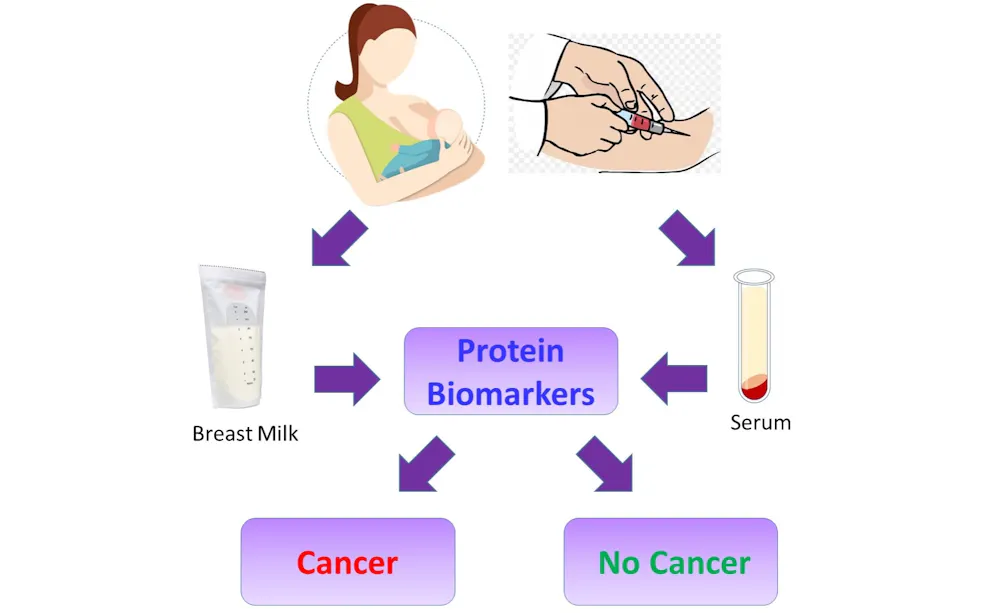
Looking for biomarker proteins in breast milk or blood serum could detect the presence or absence of cancer. Danielle Whitham, CC BY-ND
Benefits of milk and serum biomarkers
Breast milk and blood serum are two bodily fluids that can be collected noninvasively and that give information about what is happening in the body when collected.
Breast milk contains secreted proteins, immune cells and sloughed cells of the milk ducts. During lactation, the breast is actively working to create milk to feed an infant. Any abnormalities in the breast milk reflect the current situation in the body. Some proteins in breast milk also circulate throughout the body and can be found in blood serum as well.
Serum is the liquid part of the blood after red blood cells have been removed. It contains all the same proteins found in the blood, minus the clotting factors, therefore allowing circulating protein levels to be monitored. Narrowing in on a serum-based biomarker would mean it could be used to screen every woman, not just one who is currently lactating.
The proteins we’ve found in breast milk and identified as being out of whack in breast cancer are involved in the cancer cells’ ability to divide, multiply and spread throughout the body. They all promote disease progression.
My colleagues and I currently consider these breast milk proteins to be a draft biomarker for breast cancer. Our group is currently working on using blood serum to identify proteins that could be involved with breast cancer. Moving from breast milk to blood serum would allow people of any age and reproductive status to be screened for the disease, rather than just those who are lactating.







