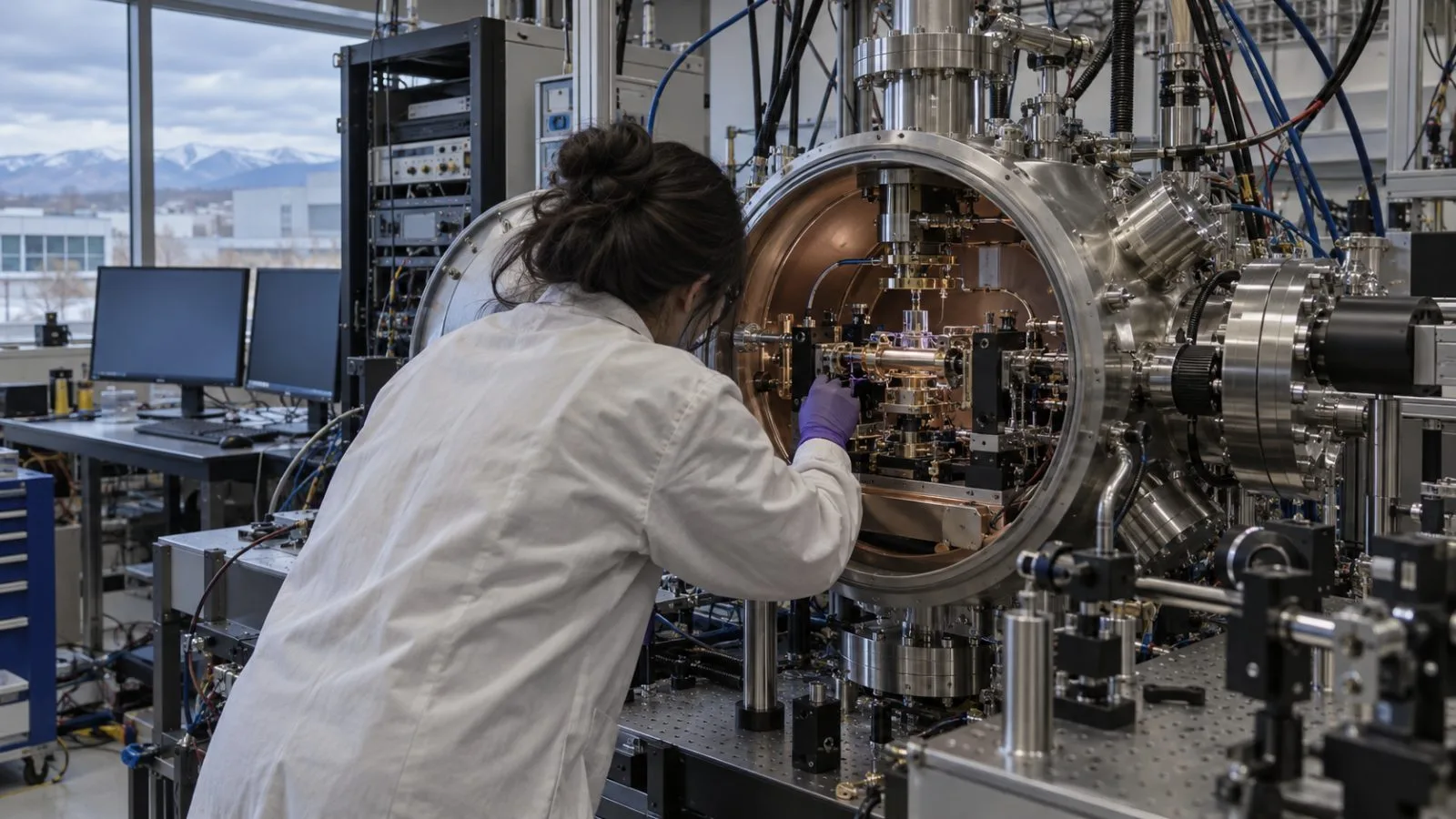
Quantinuum announced Oct. 19 that its Helios quantum computer recorded three failures across 580,000 memory-correction rounds, a result that shows progress in protecting stored quantum information.
The test used 29,000 shots of 20 rounds each. Those observations imply about 5.2 failures per million rounds, rounded to five, and correspond to 99.9995% logical memory fidelity. Researchers did not run a million rounds.
Helios has 98 physical qubits and uses trapped ions. In this test, a color code spread information across physical qubits so repeated checks could identify errors. Each increase in code distance, from three to five and from five to seven, cut the measured memory error rate 12-fold on average. Greater code distance provides more protection but uses more physical qubits in the encoded system.
The benchmark measures how well encoded information persisted through correction rounds. It does not establish performance over a million general-purpose quantum gates or show that Helios can carry out a complete fault-tolerant computation.
A separate test of two-qubit Clifford gates estimated that errors fell ninefold when code distance increased from three to five. That estimate had an uncertainty of +8 and −4.
The latest memory error rate was roughly one-tenth of the rate measured in September with the Helix code on the same Helios hardware. The two results used different error-correction codes.
Robin Blume-Kohout, co-director of the Quantum Performance Lab at Sandia National Laboratories, had no role in the study. He called the result “real, serious performance gains” from quantum error correction.
Below-threshold scaling for magic-state preparation, a further requirement for fault-tolerant computing, has yet to be demonstrated. By 2029, Quantinuum plans to deliver Apollo, a universal fault-tolerant computer.