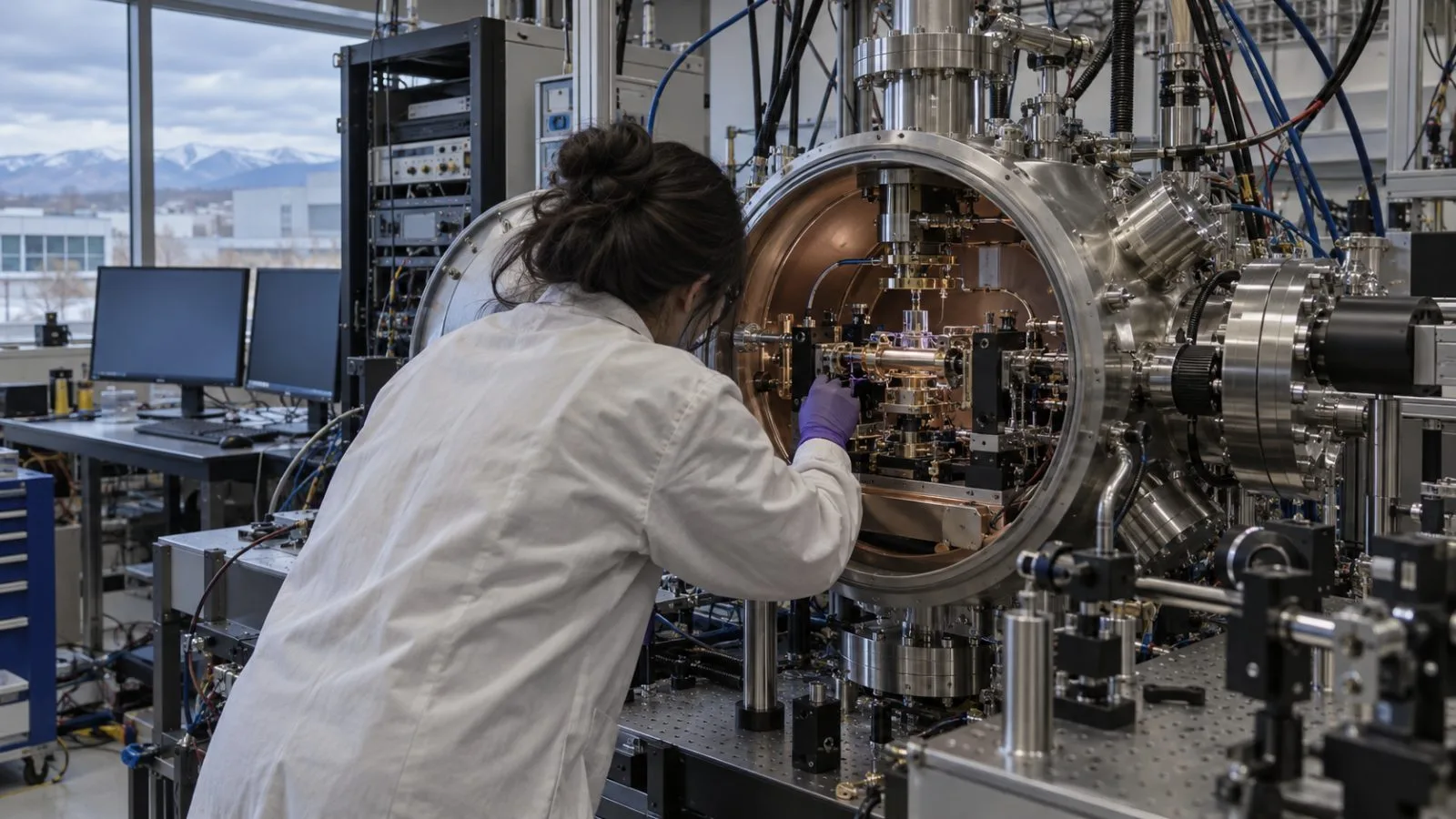
Quantinuum reported a roughly tenfold drop in protected memory errors on its Helios quantum computer in a test that used more qubits per encoded unit, highlighting the hardware cost of reliability.
A logical qubit protects information by spreading it across physical qubits. Quantinuum's September Helix encoding used 10 physical qubits per logical qubit; the newer color-code encoding used as many as 37. Those figures describe the encodings. At code distance seven, the largest size tested, the memory experiment used 73 qubits overall, including qubits supporting the error checks.
The latest paper estimates five memory errors per million correction cycles, equivalent to 99.9995% fidelity per cycle. That rate was calculated from three failures during 29,000 runs, with 20 cycles in each run. The paper gives the estimate a 68% confidence interval of three to nine errors per million cycles. It is a measure of stored information during correction checks, not a result for general-purpose computing operations.
The paper identifies leakage controls and Helios' connectivity as contributors to the improvement. Leakage occurs when a qubit moves outside the states used for computation. In smaller tests, a hardware-level optical leakage repump reduced measured memory error rates fourfold at code distance three and eightfold at distance five, compared with circuit-level leakage reduction alone.
The hardware limit also affected tests of two-qubit Clifford gates. Researchers estimated seven errors per 100,000 gates at distance five but did not test those gates at distance seven because Helios-1 lacked enough qubits.
For the memory experiment, researchers decoded measurements after the runs. The paper says other decoders processed stored measurements fast enough for real-time use, but a complete circuit with live decoding remains to be tested. It also identifies below-threshold scaling of high-fidelity color-code magic-state preparation as an unmet test for universal computation. Quantinuum aims to make its Apollo computer available by 2029.