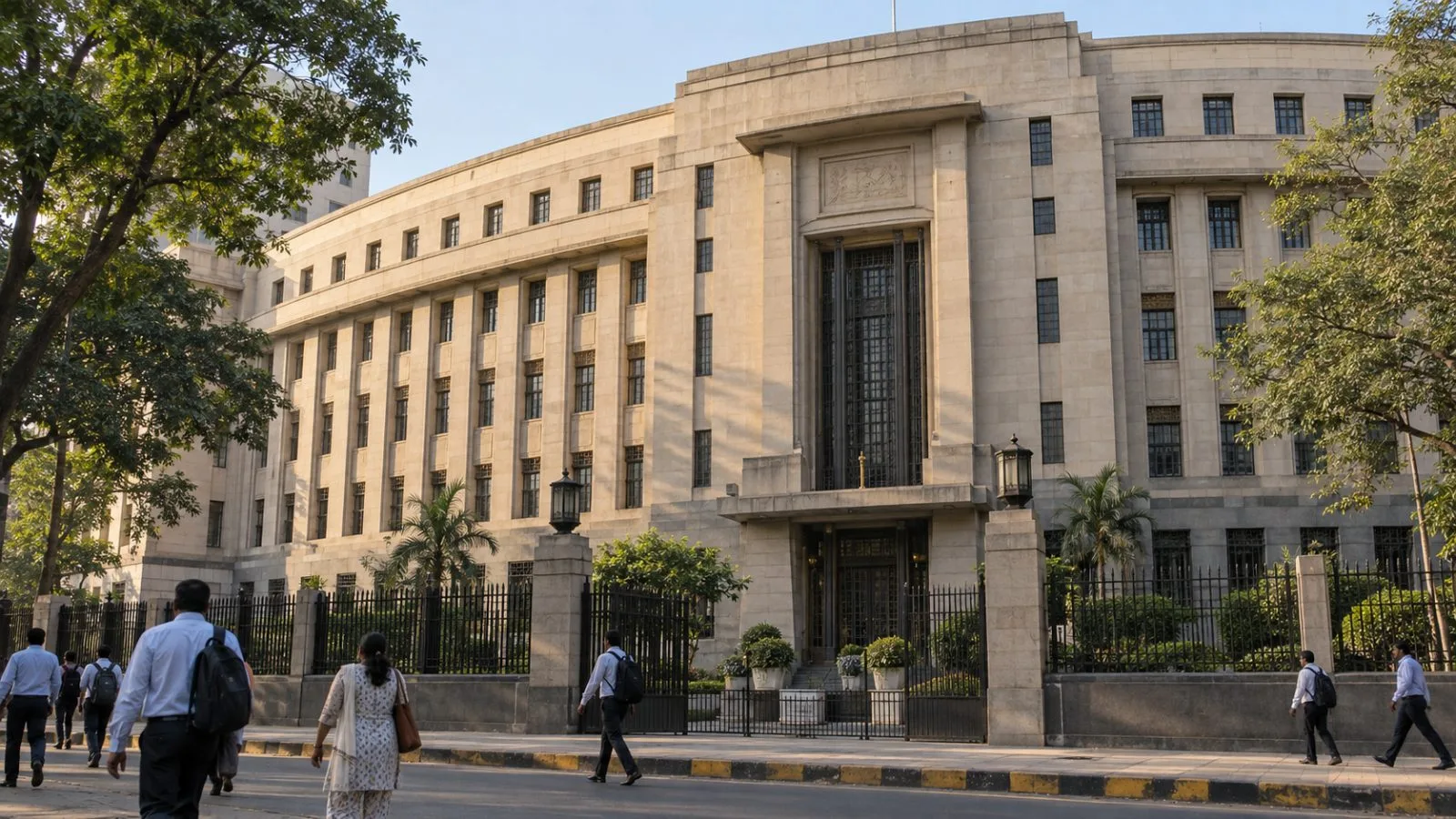
India’s central bank has published research testing whether satellite light levels and Google search activity can provide more timely estimates of state economies while official output figures lag.
The Reserve Bank of India (RBI) included the study in its October Bulletin, announced Oct. 23. It lists Bipul Ghosh, Narendra Singh and Sandhya Kuruganti as the researchers.
The authors’ presentation says state output figures are issued annually and can be 18 months behind. It sets out a method for estimating quarterly growth in Gross State Value Added (GSVA), a state-level measure of economic output. The team chose Maharashtra, Karnataka and Gujarat for their higher industrial activity and data quality.
The Economic Times reported that a model combining satellite-light readings and Google Trends with earlier GSVA growth had lower root mean squared error (RMSE) than a model relying on earlier growth alone. The reported reductions were about 38% in Maharashtra, 54% in Karnataka and 62% in Gujarat. RMSE measures the size of differences between estimates and observed results, so lower values indicate less error in that comparison.
The same presentation also reports correlations between year-over-year night-light growth and GSVA growth: 0.90 in Maharashtra, 0.79 in Karnataka and 0.66 in Gujarat. Correlation shows how two measures move together; it does not by itself establish how accurately one can predict the other.
The presentation describes Google Trends as a Search Volume Index normalized on a 0-to-100 scale and drawn from a sample of searches, rather than a count of every query. It says values can shift slightly between downloads.
The authors call the three-state exercise a proof of concept. They say more frequent estimates could help state decision-makers with disaster planning and infrastructure decisions.