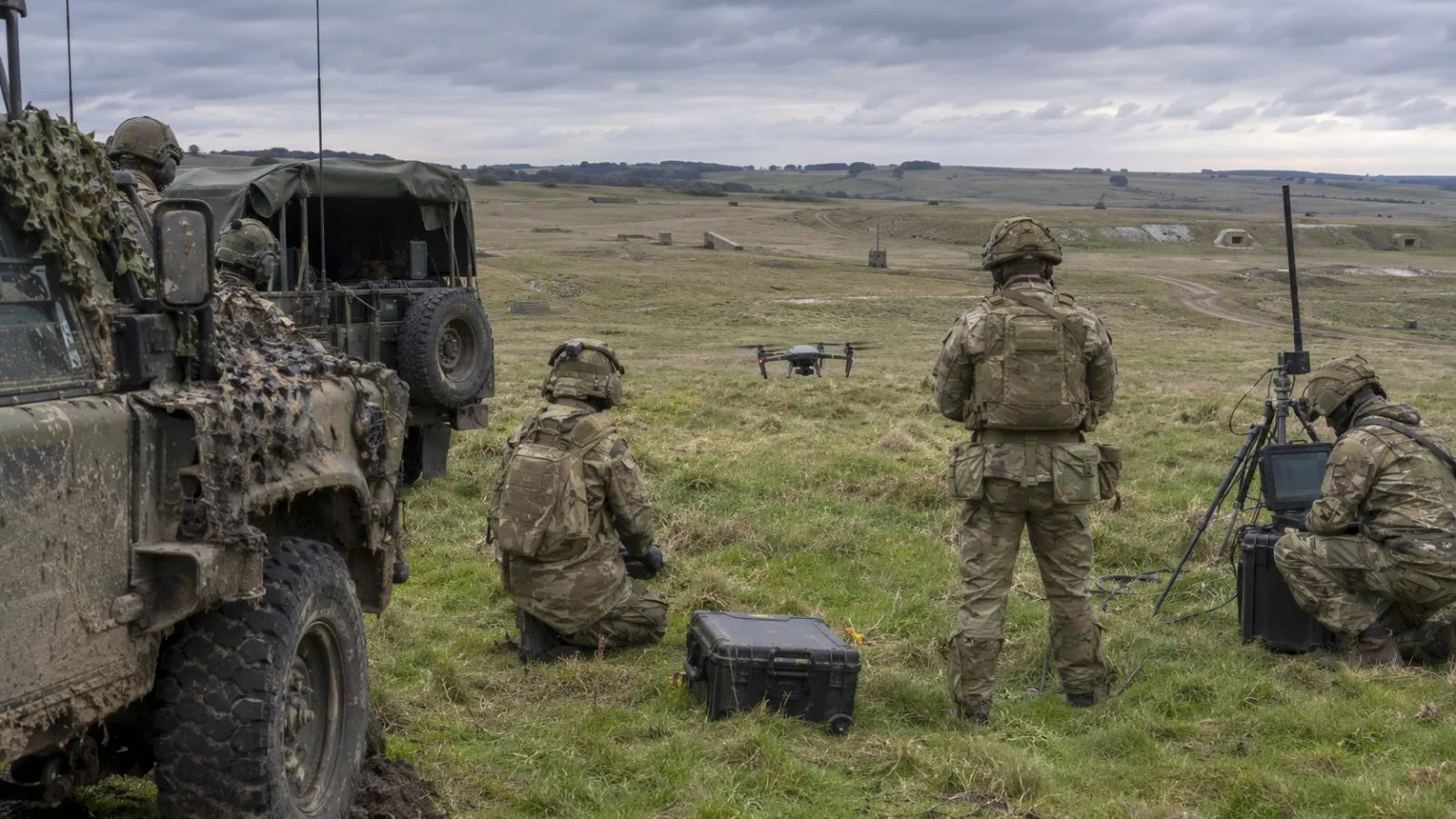
A Royal United Services Institute (RUSI) study estimates that about 45% of a full-strength British light infantry battalion would join the unmanned aerial vehicle (UAV) enterprise if the Army adopted Ukrainian levels of battlefield drone use.
The model applies those operating patterns to a battalion of 561 personnel. RUSI stresses that the percentage is a force-design estimate, not a Ministry of Defence staffing target.
The paper by Jack Watling and Robert Tollast assigns approximately 260 personnel to UAV operations in a Ukrainian battlegroup. The structure includes an 80-person light-lift and maintenance company, an air-defense platoon of about 30 people, a 90-person first-person-view strike company, a 24-person reconnaissance platoon and roughly 36 operators embedded with infantry units.
RUSI says UAVs are intended to augment the battalion’s other arms; troops are still required to seize and hold ground. Drone formations also require maintainers, logistics personnel, protection and communications support.
The paper reports substantial platform losses. A battalion may lose 20 to 60 multicopters in a week, while FPV teams generally have 30 to 50 drones and may use about 500 to 700 FPVs weekly across a battalion, depending on combat activity.
RUSI also cites a Ukrainian brigade that conducted 824 uncrewed resupply missions in one month, carrying 100 to 150 kilograms per mission. With an 80% success rate, a battalion could still lose 10 to 20 utility UAVs or uncrewed ground vehicles each week. The study says planners generally assume that 50% of platforms supporting offensive operations will be lost during an operation.
Britain is expanding its capability as it applies lessons from the Russia-Ukraine war. The Ministry of Defence announced a £25 million package Nov. 17 for forces in Estonia, including hundreds of one-way attack and FPV drones, twice as many intelligence, surveillance and reconnaissance drones, electronic-warfare systems and other battlefield equipment.
The capabilities are scheduled for the 4th Light Brigade by April 2027. Chief of the General Staff Gen. Sir Roly Walker said, “the side which can see first, strike first and protect itself best has a significant advantage in modern war.”
A March parliamentary answer said 127 Army units were training on uncrewed air systems. The Army scheduled 65 centralized courses and 283 distributed courses for the 2026-27 training year, while the ministry said it does not centrally track units training specifically on small UAVs. Separate September announcements covered more than 1,025 small drones in a £16 million deal and a Tekever AR5 surveillance-drone contract worth up to £400 million.