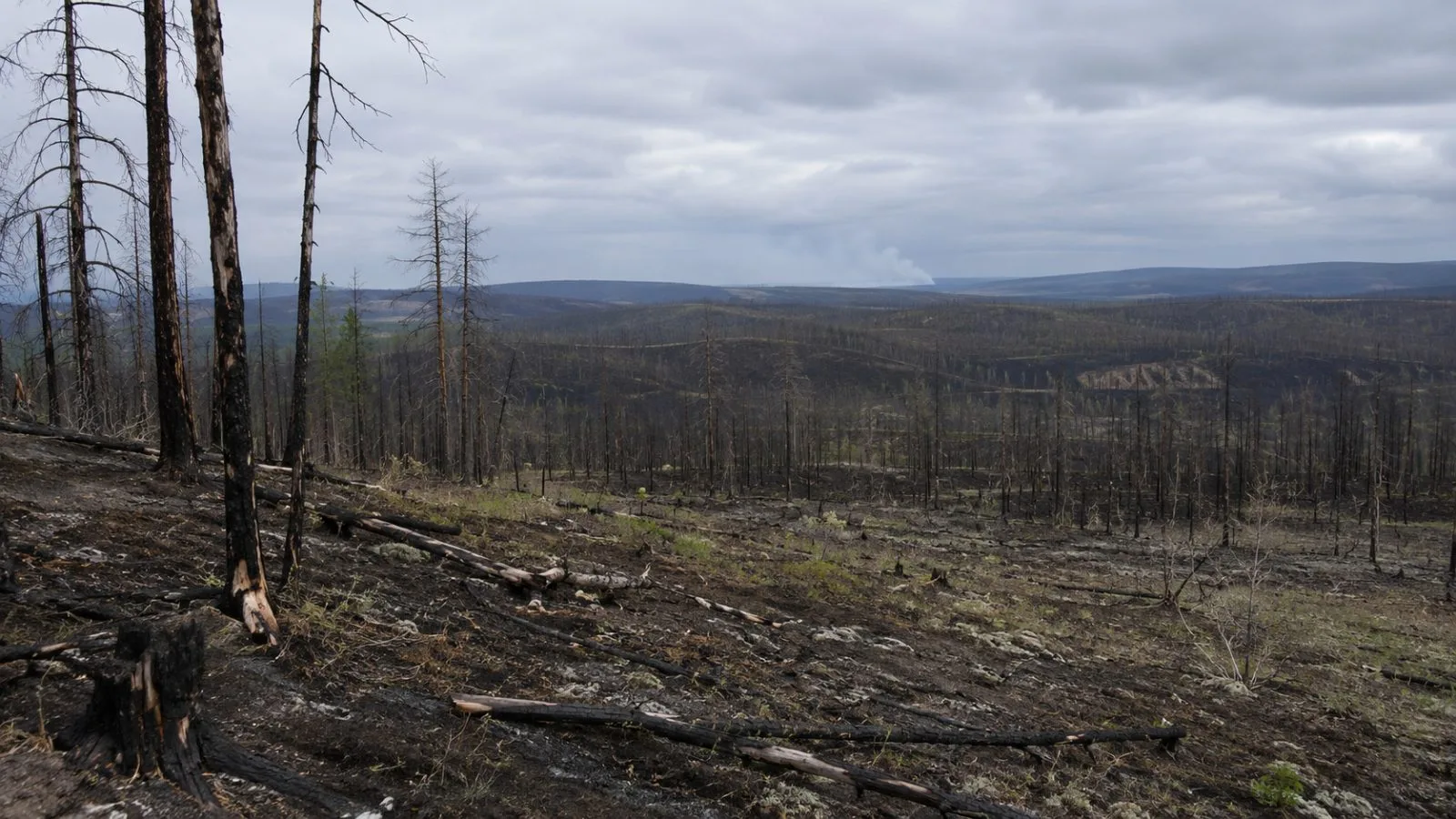
Russia’s forest-fire tally reached nearly 6.5 million hectares through Nov. 14, with the largest recorded areas in Siberia and the Far East, according to the Aerial Forest Protection Service’s latest report.
The service counted 9,038 fires across 6,499,515 hectares nationwide from Jan. 1 through Nov. 14. Sakha (Yakutia) recorded 2,307,527 hectares across 541 fires; Krasnoyarsk, 1,655,551 hectares across 1,836 fires; and Amur, 701,087 hectares across 289 fires.
Buryatia recorded 5,244 hectares burned and Zabaikalsky 5,894 hectares during the period. The Moscow Times reported 2025 totals of 1.3 million hectares in Buryatia and 3.8 million hectares in Zabaikalsky.
The Moscow Times reported a separate estimate of 11.5 million hectares of landscape fires by early November. That figure covers a different fire category and period from the forest-fire tally.
Russia’s Federal Forestry Agency, known as Rosleskhoz, said fires covered 3.3 million hectares in areas designated for active suppression, below its 4.2 million-hectare target and the 5.9 million-hectare long-term average. In remote control zones, the agency counted 1,000 fires across 2.8 million hectares. Rosleskhoz attributed the large remote-zone burned area to extreme climate changes affecting northern and Arctic areas.
A study in Geophysical Research Letters examined eastern Siberia from 2002 to 2023 and found that the fire season ended an average of 1.48 days later each year. The authors linked the shift mainly to fire-weather conditions associated with drought after precipitation deficits in August and September. The study describes a long-term eastern Siberian pattern and does not explain specific fires in 2026.