Trade surplus widens: Singapore recorded a Balance of Trade (BoT) with a surplus of 5911200 Thousand SGD in April of 2015. Singapore economy relies on purchasing of intermediate goods and exporting of high-value added products. Main exports are: machinery and equipment (46% of the total exports), fuel (26%), and chemicals (13%). Main imports are: machinery and equipment (43% of the total exports), fuel (32%), miscellaneous manufactures (7%) and chemical products (7%).
Singapore's Non Oil exports: Non oil exports in Singapore decreased to 2.20% YoY in April of 2015 from 18.50% in March of 2015 as reported by the statistics Singapore. Where oil exports fell 34.9%, following a 22.4% contraction a month ago. The YoY decline of oil exports was mainly due to lower sales to Malaysia (-59.4%), Australia (-51.3%) and Indonesia (-22.0%).
Deflation remains a concern: Singapore consumer prices dropped 0.3% YoY in March of 2015, the same pace as in the previous month and missing market forecasts. It is the longest slide since 2009, mainly due to a fall in cost of transport and housing & utilities.
Technicals & Derivatives Insights: (USD/SGD)
We expect early gains on this pair as an inverted hammer candlestick pattern is spotted out on daily chart. This is in conformity with the slow stochastic evidencing %D line crossover at around levels which is an oversold situation. If it is able to breach 1.3253 on a closing basis then a target could be seen at 1.33 and next 1.3357 levels. RSI shows divergence on falling swings on this pair which is a trend reversal signal.
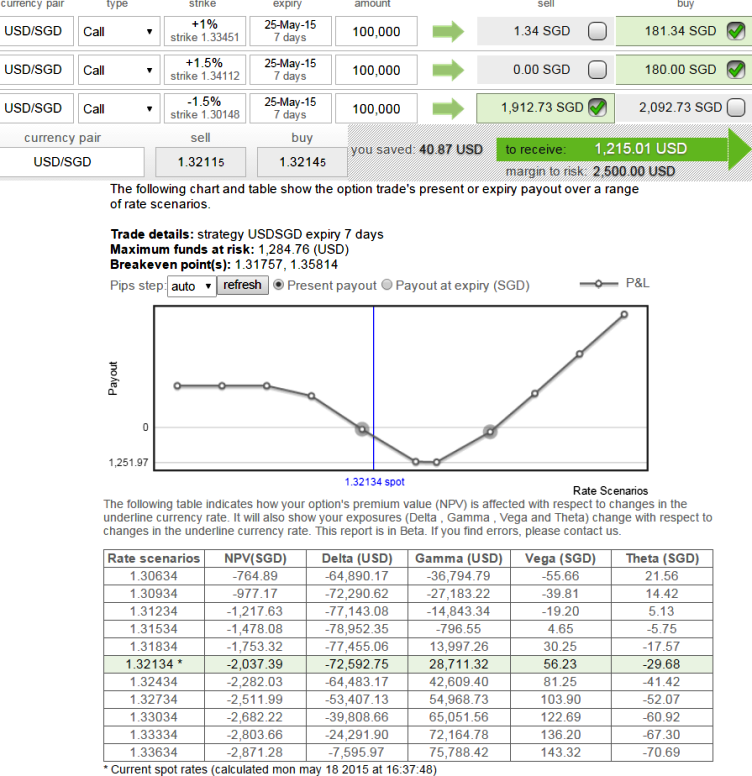
Option hedging strategy: Call Ratio Back Spread
Traders who wish to spare a cost aside for naked hedging can straightway buy naked ATM Call options. Otherwise, Call Ratio Back Spread are advised as we are largely bullish on this pair.
To construct this position, expect the underlying currency to make a large move higher.
Purchase calls and sell fewer calls of a lower strike usually in a ratio of 2:1 or 3:1. The lower strike short calls finances the purchase of the greater number of long calls and the position is entered for no cost or a net credit.
The underlying exchange rate has to make substantial move on the upside for the gains in long calls to overcome the losses in the short calls as the maximum loss is at the long strike.
Give underlying currency a longer time to expiration so as to make a substantial up move.