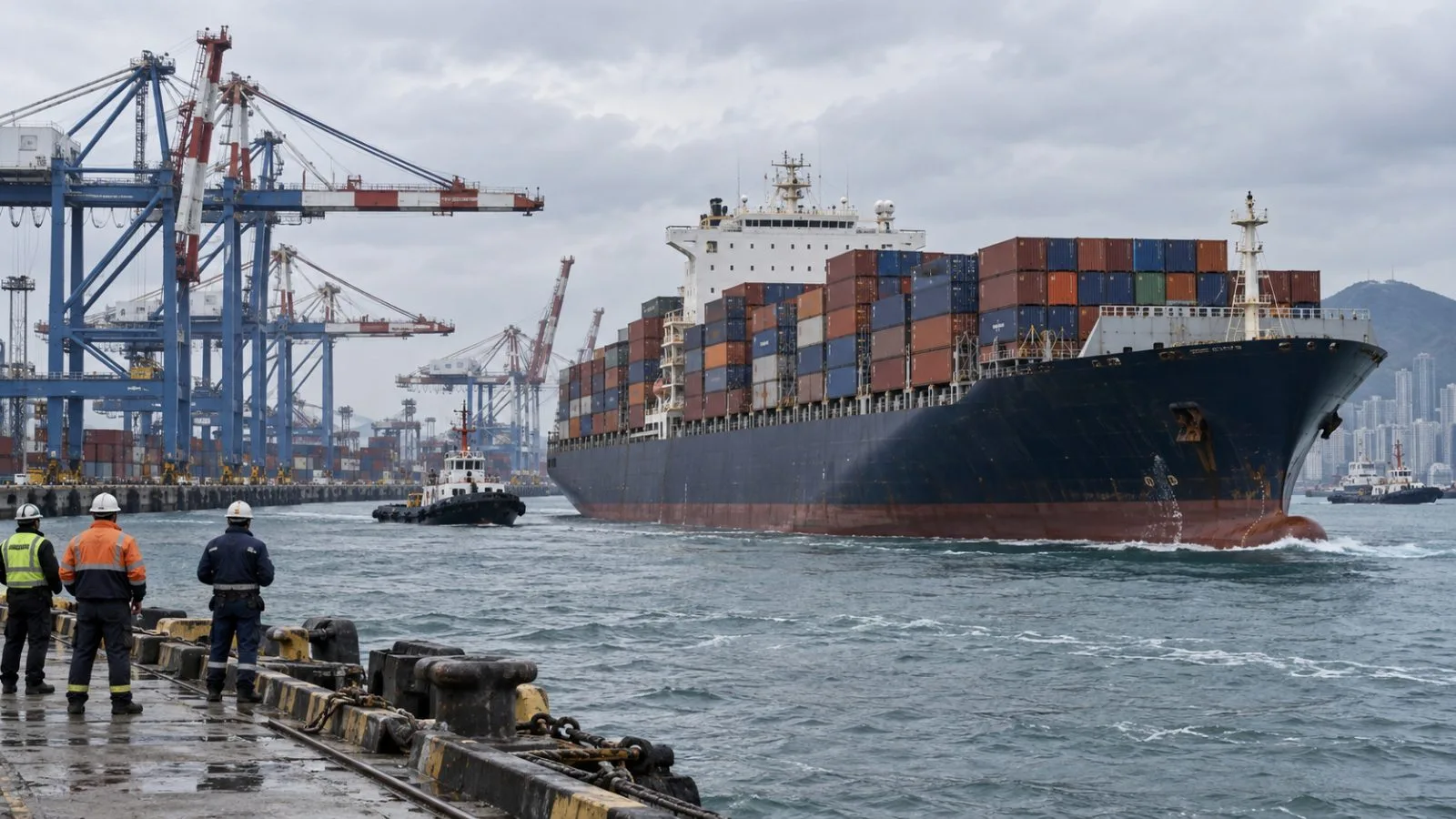
South Korea’s first government-led Arctic shipping trial suggested a shorter Europe route may be feasible, while crew accounts of ice and equipment problems showed the demands facing regular service.
The Ministry of Oceans and Fisheries estimated the Arctic corridor could reduce the distance to Europe by about 35% and trim travel by roughly 10 days compared with a Suez Canal voyage. At a briefing in Busan Thursday, the ministry said Panstar Acro made both Arctic crossings without an icebreaker.
The ship left Busan Aug. 22 and called at Felixstowe, England; Rotterdam, Netherlands; and Gdansk, Poland, before returning Oct. 11. The circuit lasted 49 days and 10 hours. The 2,758-TEU vessel transported 737 TEUs of exports bound for Europe, among them chemicals, used cars, auto parts and cosmetics; it returned with 1,743 TEUs of empty containers for repositioning.
Panstar manager Park Ji-jeong said drifting ice near the Bering Sea and darkness reduced visibility enough that the crew did not trust radar as its only guide. The crew waited for daylight, then moved through a gap at low speed. Participants also said the vessel adjusted course around ice floes near the Vilkitsky Strait.
Low temperatures set off alerts in the fuel and lubricating oil circulation systems, participants said, and crew members used heaters and added insulation. On the return, rough North Pacific seas kept the ship rolling for an extended period. The vessel went inside the Kuril Islands to avoid a typhoon moving north, participants said.
Panstar director Kim Jeong-dal said the trial’s purpose was national rather than profit-driven. He said consistent timetables could make future services commercially viable, while Arctic environmental standards required costlier marine gas oil and kept fuel savings limited.
The ministry plans to review the voyage records and share findings, help operators obtain ice-strengthened ships, and continue developing container ships that can break ice. It is considering further trials with different vessels, routes and cargoes. A separate economic assessment is expected at a briefing in November.