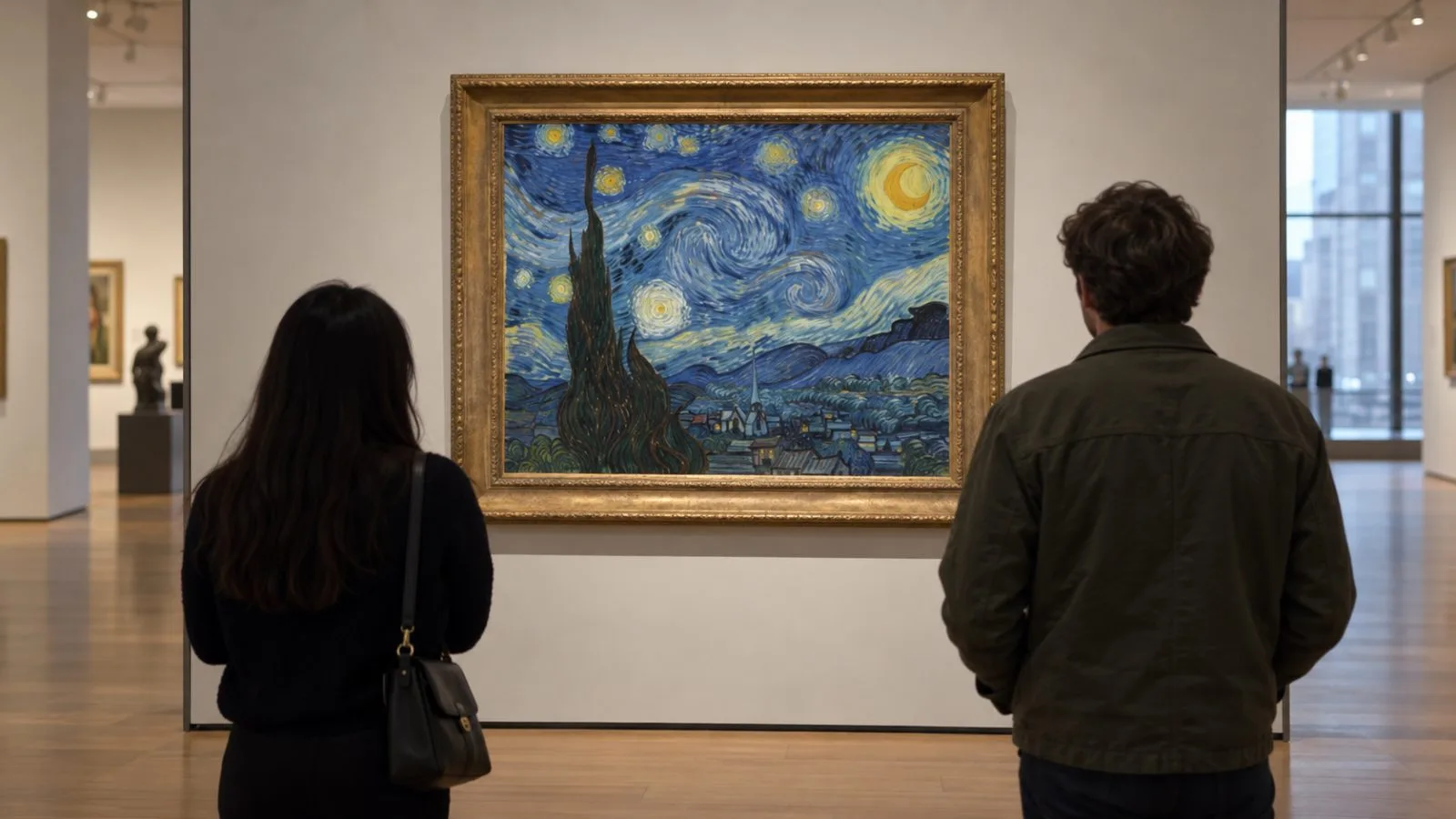
A new reconstruction by South Korean researchers places the celestial pattern in Vincent van Gogh’s The Starry Night under a predawn sky near Saint-Rémy around July 22, 1889, later than the Museum of Modern Art’s catalog date.
The 2026 study in Scientific Reports argues that the five-star grouping at the painting’s center resembles the Hyades, a cluster in Taurus. In the proposed sky, Venus and a waning crescent moon were also near the cluster. The researchers applied Procrustes shape analysis to compare the painted stars’ arrangement with the Hyades.
They say a later pen drawing gave an even closer fit to their reconstructed view. To check the approach, they examined Starry Night over the Rhône and suggested that Café Terrace at Night may include the Summer Triangle.
Those findings concern possible sources for the imagery, not the date Van Gogh completed the canvas. The Museum of Modern Art (MoMA) catalogs it as a June 1889 work and says he painted it over several sessions in daylight. MoMA also describes a composition that blends observation with alteration: celestial forms were changed, and the village came from views other than the one visible from Van Gogh’s window.
In a letter to his brother Theo van Gogh dated around June 18, 1889, the artist referred to “a new study of a starry sky,” without naming a painting.
The timing is disputed. Physicist Jose Luis Aragon of the National Autonomous University of Mexico, who did not take part in the study, told the Associated Press the July date should be treated as a possibility rather than a firm conclusion. Astronomer Donald Olson of Texas State University told Science News that the reconstruction’s limited viewing span would not capture the landscape’s full breadth.
The researchers say the study’s code and data are available on GitHub and Zenodo.