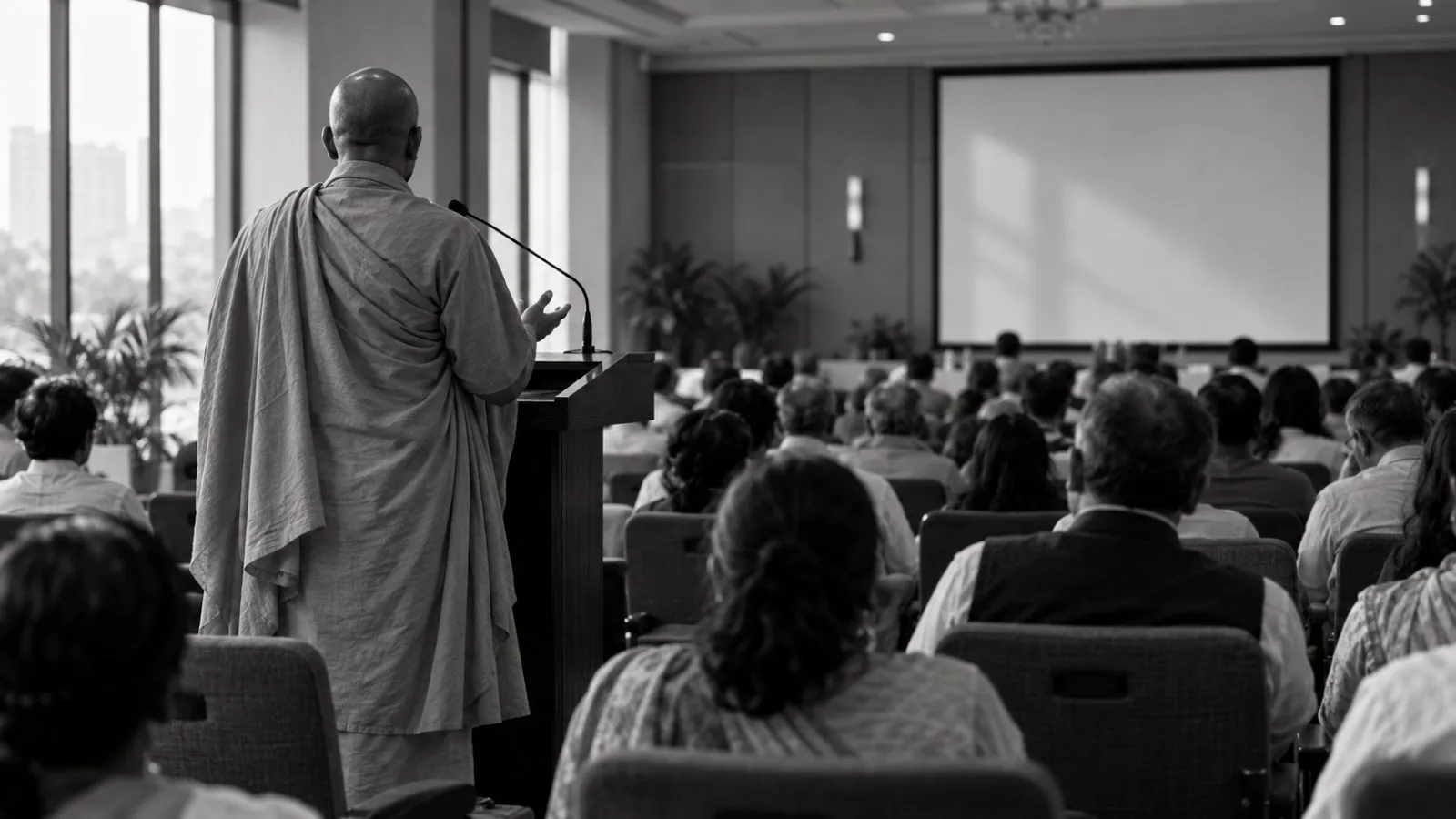
NDTV reported that Swami Sarvapriyananda, resident minister of the Vedanta Society of New York, argued at the Oct. 22 NDTV World Summit that AI’s ability to solve problems does not establish that it has subjective experience. The summit agenda listed him for a session titled “Can Code Be Conscious? Rethinking the Mind in the Age of AI.”
NDTV reported that Sarvapriyananda described consciousness as the observing awareness behind the intellect, distinct from the mind’s reasoning. He summarized the distinction by saying, “Consciousness and mind are literally not the same thing.” In his account, intelligent behavior alone does not show that a system feels anything.
His example, as reported by NDTV, paired Deep Blue’s chess performance with a mouse’s capacity to feel pain. IBM says Deep Blue defeated reigning world chess champion Garry Kasparov in a six-game match in 1997. The comparison focused on the difference between completing a task and experiencing it.
Sarvapriyananda also discussed Anthropic’s work on steering Claude, NDTV reported. In its research, Anthropic says amplifying a feature associated with the Golden Gate Bridge led Claude to return bridge-centered answers even when a prompt concerned something else. The company says its Claude Constitution guides the values and behavior built into model training.
An Oct. 19 Nature commentary by researchers Anil K. Seth, Ned Block and Giulio Tononi reaches a related but bounded assessment. The authors say existing AI systems are not conscious and judge that the way AI is currently being developed is unlikely to produce consciousness. Their argument concerns present systems and development paths; it does not claim machine consciousness is impossible.
The authors say the question has consequences in both directions. If an AI system could suffer, denying it consideration could leave that experience unprotected. The authors warn that mistaking an insentient system for a conscious one could make oversight harder and draw attention away from beings known to have conscious experiences. The commentary points to past harm to nonhuman animals and operations on premature babies without anesthetic as examples of the consequences of misjudging consciousness.