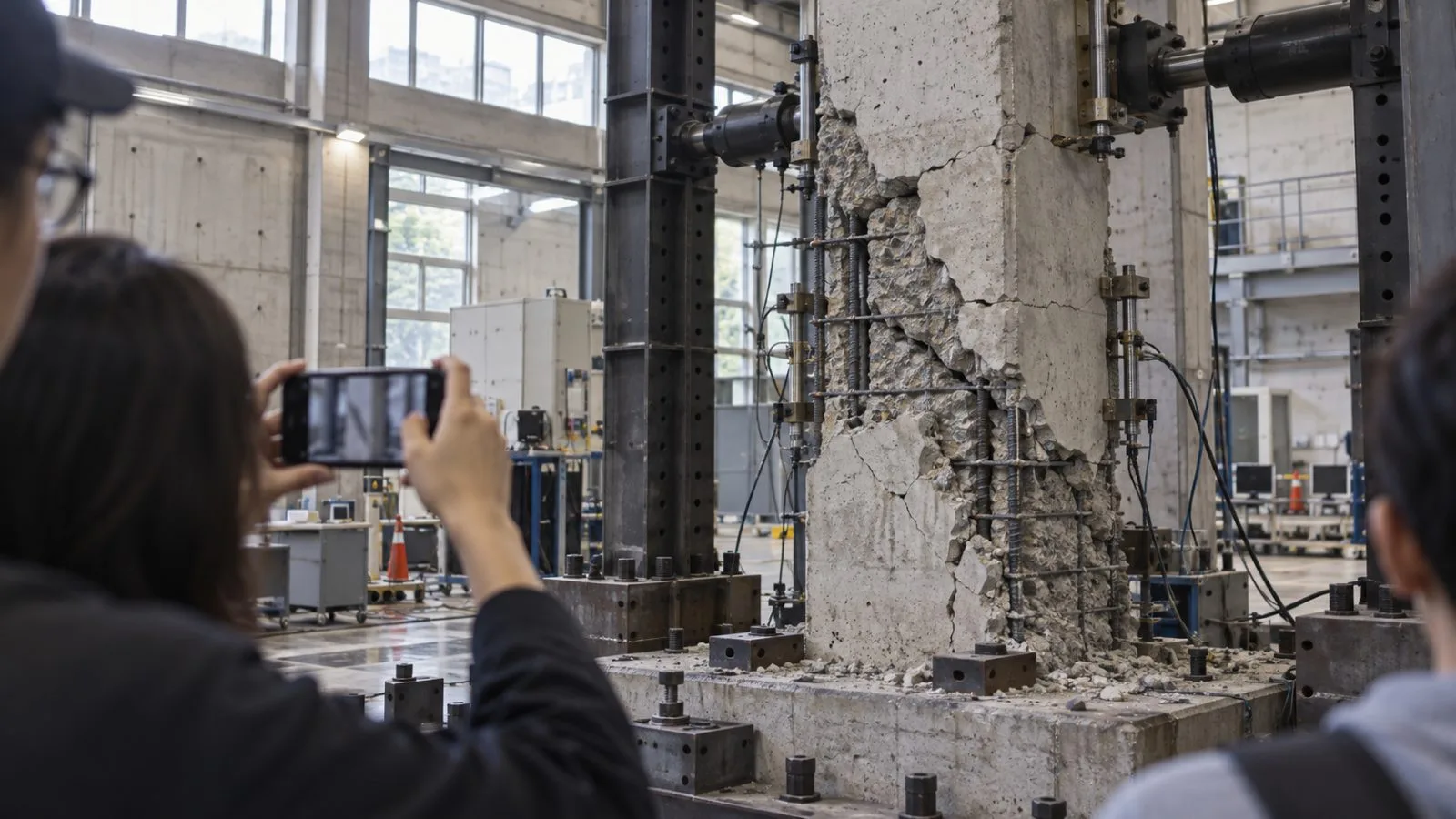
To help residents assess visible damage after earthquakes, Taiwan's National Center for Research on Earthquake Engineering (NCREE) has developed a photo-based AI tool for periods when engineers face large inspection caseloads.
The center, part of the National Institutes of Applied Research (NIAR), built the public version with National Taiwan University's Department of Civil Engineering. NCREE said at an Oct. 20 briefing that public use will be free.
Residents will be able to upload images of a beam, column or wall to a tool called 安全耐震我的AI. Its rating applies only to the part shown in the photo. An A grade flags severe damage and advises against staying inside. B signals moderate damage and warns users to keep clear of areas where material could fall. C covers minor damage or no apparent damage.
NCREE recommends an engineer's assessment after either an A or B result. NIAR said those letter grades are separate from official red and yellow danger notices, which rely on inspections of the full building, neighboring units and the surrounding area.
NIAR cited the scale of past earthquake damage as a reason for faster initial assessments. After a Jan. 21, 2025, quake, 4,291 households in Tainan had reported damage to the city government by Feb. 17, 2025, Taiwan time (UTC+8). NIAR said engineers can need months to assess a caseload of that size.
The public checker draws on a more detailed model for professionals. NIAR said the professional version was trained on 8,000 photographs of damaged components from Taiwan and abroad, covers four component types and 17 damage grades, and classifies a photo in about one second. NCREE is working to introduce that model to Hualien County officials and the Taiwan Residential Earthquake Insurance Fund for damage assessments and insurance claims.
NIAR says the public system is anonymous and does not collect data for third-party use.
CNA reported that NCREE expects the public service to go online by the end of the week beginning Oct. 19, 2026, Taiwan time (UTC+8).