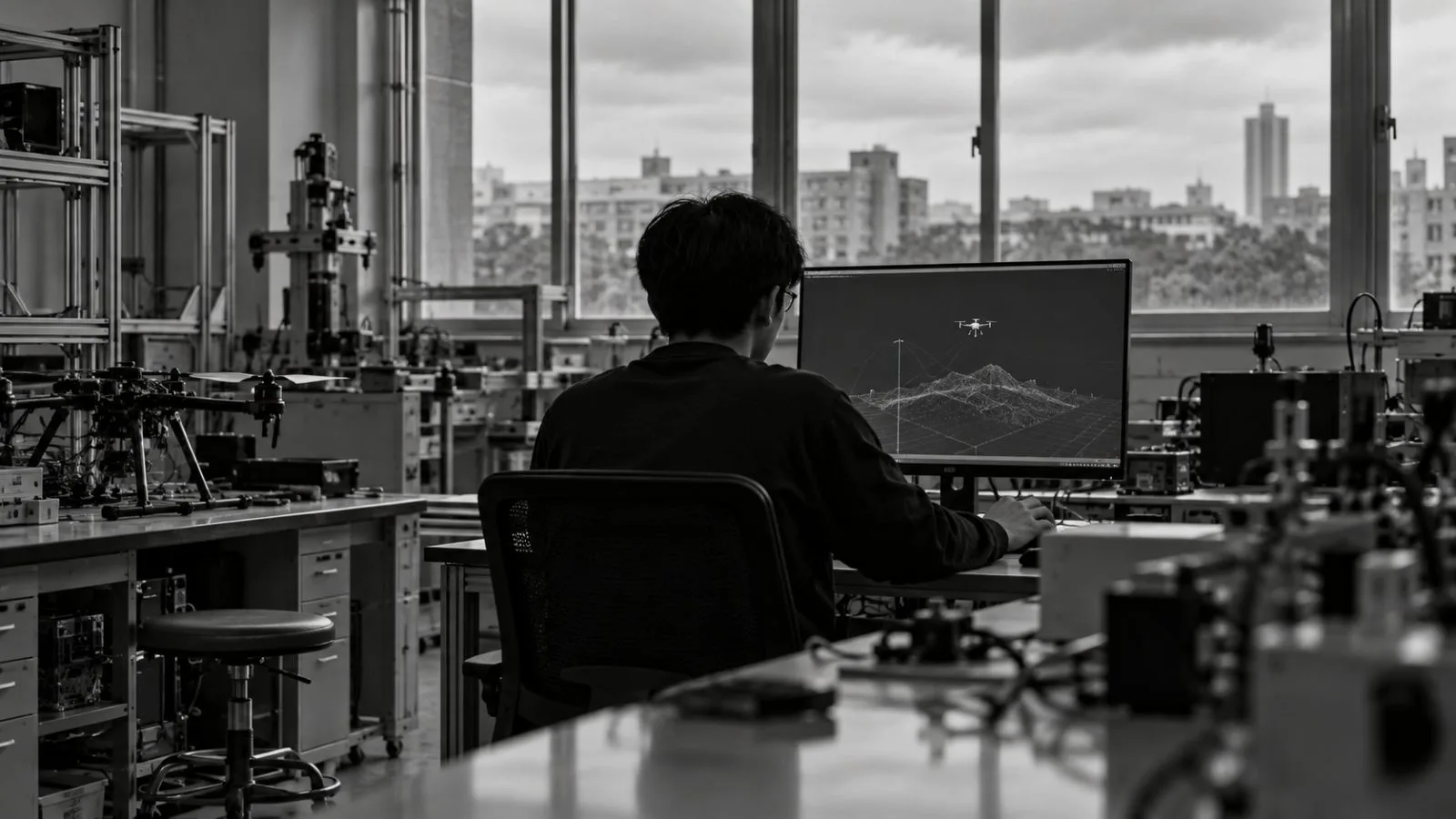
Taiwan is funding research into an artificial intelligence system that could coordinate different drone models for maritime patrols, after a university team simulated 20 aircraft in two groups for proposed coast guard monitoring and search-and-rescue support.
Taiwan’s Ocean Affairs Council (OAC) announced the project Oct. 26. Associate Professor Chih-Che Chueh of National Cheng Kung University leads the work, which appears as entry 12 on the council’s approved list of 2026 marine technology projects. The council described research in development and did not say the aircraft had entered service. It did not disclose a funding amount.
The work covers JUMP-20, V-Bat and Flexrotor, three fixed-wing drone models that can take off and land vertically. Researchers are building flight behavior and control models for each type. The council said the work includes digital aircraft modeling, aerodynamic analysis and simulations spanning six degrees of freedom.
In the reported exercise, the algorithm coordinated a simulated fleet of 20 drones split into two groups. The design uses multi-agent reinforcement learning for assigning tasks and planning routes, alongside formation control and obstacle avoidance. The council said the design measures distance in three dimensions and calls for at least 100 feet (about 30 meters) of vertical spacing. The release did not describe a physical flight involving all 20 aircraft.
The council said maritime patrols must cover wide areas as conditions change, while current operations rely heavily on people and vessels. It cited coast guard monitoring, search and rescue, maritime law enforcement and gray-zone harassment as reasons for the research. The release reported no operational results or measured gains in patrol coverage or rescue performance; those uses remain stated aims.
The next steps are hardware-in-the-loop testing, prototype integration and flights over the sea. The council gave no timetable for those stages or target date for operational deployment.