The word “scapegoat” is being used a lot in discussions about politics in 2016. The new US president-elect, Donald Trump, appealed to some voters with rhetoric that appeared to scapegoat Mexicans and Muslims for various social and economic problems.
Campaigning ahead of the UK’s vote for Brexit also scapegoated immigrants and foreign bureaucrats for many social problems, from violent crime to funding problems for the NHS.
Since both votes were cast, hate crimes against immigrants and ethnic minorities have increased in both countries. There have also been frequent calls for harsh policies, including mass forced deportations of migrant workers and invasive medical examinations for asylum seekers.
What drives this scapegoating? Why do people, whose political grievances might be legitimate in themselves, end up targeting their anger at relatively harmless victims?
It is part of the nature of scapegoating, as the late French theorist of mythology René Girard argued, that the target is not chosen because it is in any way responsible for society’s woes. If the target does happen to be at all responsible, that is an accident. The scapegoat is instead chosen because it is easy to victimise without fear of retaliation.
Origins of the scapegoat
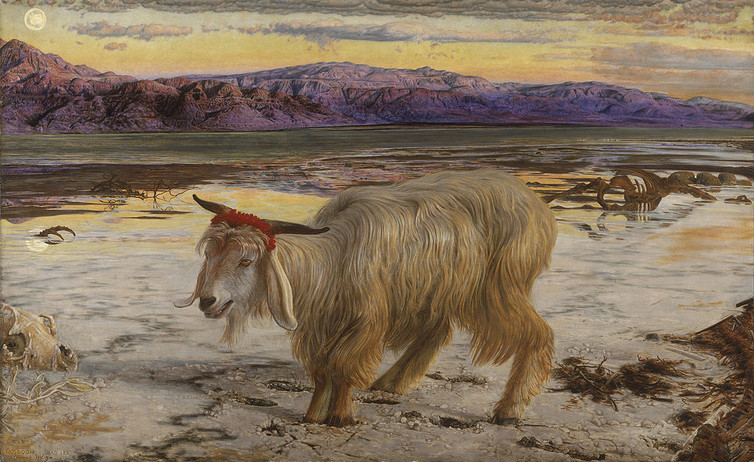
The name “scapegoat” comes from the the Book of Leviticus. In the story it tells, all the sins of Israel are put on the head of a goat, which is then ritualistically driven out. Needless to say, the goat is not really guilty of the sins.
If we want to understand this ritual, we must first understand the nature of human violence. Girard observed how many cultures characterise violence in terms of infection and contagion. In communities without a strong legal system, justice is carried out through private vengeance. But each act of vengeance provokes another, and violence can spread like a plague. “Blood feuds” – chains of violent reprisals – have been known to wipe out entire communities.
In this kind of society, Girard argues, the real purpose of scapegoating is:
To polarise the community’s aggressive impulses and redirect them toward victims that may be actual or figurative, animate or inanimate, but that are always incapable of propagating further violence.
If the community as a whole lashes out against a victim who cannot retaliate, then the community’s resentments and frustrations can be violently vented in a way that does not run the risk of unleashing an uncontrollable plague of violence.
A safe alternative to class war
Girard’s insights can also be applied to modern society. The results of the US election and the UK referendum have been partially explained by the economic anxiety felt within former industrial regions that have been left behind by globalisation.
The blame for this anxiety lies with the political classes, the elites, the Washington and London “insiders”. They put their faith in an economic model and ignored its effects on ordinary lives. They made no visible effort to create new jobs in communities that had been been built around heavy industry. It was as though they hoped the people would rust away alongside the machines.
The rhetoric in both campaigns was nominally directed against these elites: against “the establishment”. But when it came to the crunch, voters in the US gave power to a plutocrat – a direct beneficiary of the new economic model. And in the UK, support remains high for a government that is pure establishment. The British home secretary, Amber Rudd, was described by the Financial Times as:
A born-to-rule Tory with a black book so impressive that she had a gig as “aristocracy co-ordinator” for the party scenes of Four Weddings and a Funeral.
So just when you might expect the economically anxious to hit out at the elites, they instead attack migrants and minorities. The elites cannot be their scapegoat, since a defining feature of a scapegoat is its inability to retaliate. And the “establishment” is very capable of retaliating. To quote a 2009 piece in the The Economist:
When people contemplate class war, they tend to think of hostilities flowing in only one direction – that is, upwards, from the plebs to the toffs, the poor to the rich … Less attention is given to the possibility of a different sort of rancour: when the well-heeled get angry, and take against the plebs.
The “well-heeled” are much too powerful to be scapegoats. The “plebs” might resent them, but a scapegoat is a victim that can be safely attacked. Think of a man yelling at his child because he is angry at his wife. He doesn’t have the energy for a protracted marital conflict, but if he is to resist lashing out at her he must lash out at someone.
In a social sense, scapegoating “works”: it concentrates violence on a small, powerless set of victims and prevents it from triggering a dangerous chain reaction of reprisals. Of course, this is no consolation to the scapegoats. For them there is only the hope that society might one day have less cause for violence altogether.
 Alexander Douglas does not work for, consult, own shares in or receive funding from any company or organisation that would benefit from this article, and has disclosed no relevant affiliations beyond the academic appointment above.
This article was originally published on The Conversation. Read the original article.