Sir Richard Branson wants to bring back supersonic travel. Thirteen years since Concorde ended operations, the Virgin tycoon has revealed the prototype design for a new generation of supersonic business jets developed by the Branson-backed startup company Boom, based in Denver. The firm claims its planes will allow “affordable” journeys from London to New York in just three-and-a-half hours for approximately $5,000 (£4,000) return, the same as current business class tickets.
But there’s still a question over whether Boom can overcome the problems that hindered Concorde. Another supersonic project in the US may already have the edge over Branson’s preferred design. And the success of both projects – and the future of supersonic flight in general – may ultimately depend on the decisions of president-elect Donald Trump.
Boom’s XB-1 will be more efficient than Concorde thanks to lighter, cheaper composite materials and advances in aerodynamics and jet engines. This will be helped by carrying 40 passengers per flight as opposed to Concorde’s 100, despite its ticket price. But ultimately, Boom doesn’t appear to do enough to address one of the key reasons Concorde failed.
Just four years after Concorde’s first flight in 1969, the US effectively banned supersonic travel over its mainland due to concerns of the harmful effects of the sonic boom on the public. This then restricted Concorde’s operations to going supersonic only over the sea, severely limiting the potential routes. Boom is currently not proposing a design that would go far enough to allow flights over land because it doesn’t address the noise pollution issue.

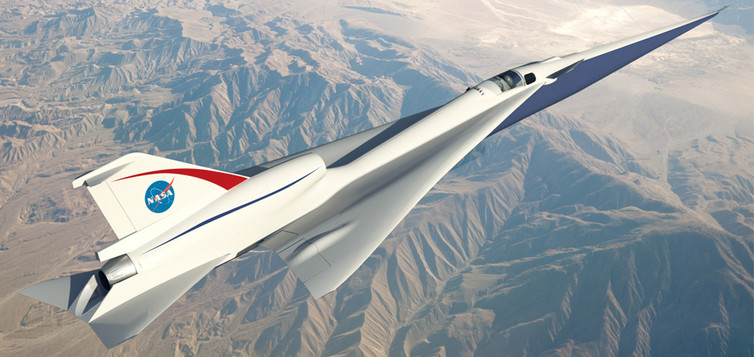
How NASA’s ‘quiet’ supersonic plane might look. NASA
While Boom has gathered publicity with the help of Sir Richard Branson, their small team still needs major investment to demonstrate a working prototype. The real breakthrough, meanwhile, is more likely to come from NASA and Lockheed Martin as part of their Quiet Supersonic Technology (QueSST) programme. Their recently developed low-boom shaping technology is designed to control the shock waves that are generated as the plane crosses the speed of sound barrier. This would drastically reduce the sonic boom to a level that would permit supersonic travel over land. This would open up routes such as California to New York, as well routes across Asia.
Decades of fundamental work at NASA has focused on both the shape of the wings and developing low-noise propulsion systems and shielding to ensure that it can be economically viable. One key difference between Boom and the proposed Lockheed Martin X plane is also its speed. Whilst Boom are proposing an aircraft that will fly faster than Concorde, NASA and Lockheed are opting for slower speeds to achieve optimum sonic boom levels and fuel efficiency.

Charles Bolden announces the X-Plane series. NASA
Time to fly
So when might we see these aircraft in the skies? Well, NASA’s administrator Charles Bolden officially announced a new series of X-Planes in February 2016, which included a supersonic low-boom demonstrator that is set to fly in 2020. This demonstrator, built in collaboration with Lockheed Martin, will validate simulations and conduct real-life tests to measure the sonic boom over land. If these tests are successful, then it is likely that Lockheed Martin or another major aerospace company will use this technology to develop a business jet within the next five to ten years that can fly supersonically over land.
But all of this – including the Boom aircraft, which will likely benefit from the X-plane data – is dependent on the funding for this whole project to be sustained. The election of Donald Trump has caused many at NASA to wonder whether such programmes will be deemed by the incoming president as an inefficient use of US taxpayers’ money. If the programme is cancelled it will likely kill the prospect of supersonic travel just as it is gaining momentum again.
One saving grace may be president-elect Trump’s taste for private jets. Perhaps a supersonic version of Air Force One would be his way of showing that America still leads the world in advanced technologies. The image of a futuristic supersonic jet landing at world summits would certainly be the modern equivalent of the building of grand mansions or castles. For the hundreds of engineers and scientists who have worked on this programme, the first few months of the Trump administration will be a tense time.
 Dr Neil Ashton previously worked for Science & Technologies Corporation (STC) in collaboration with NASA Ames Research Centre.
This article was originally published on The Conversation. Read the original article.