Researchers built a body-wide gene-activity atlas from adult Danionella cerebrum and analyzed telencephalon expression changes after injury, creating a resource for future vertebrate regeneration research.
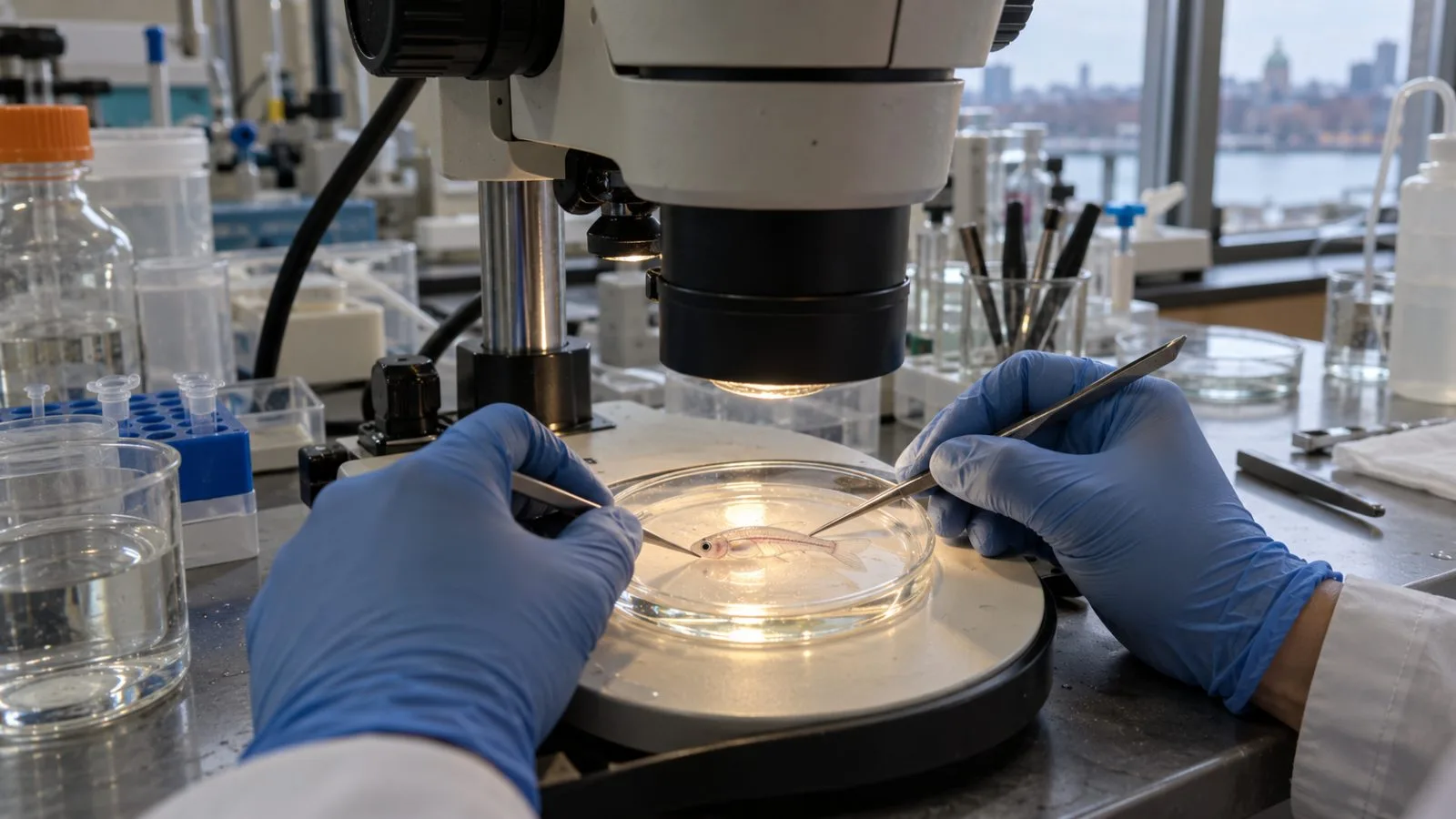
The fish measures about 12 millimeters long. The team collected 12 samples spanning the brain and spinal cord, eyes, internal organs, cranium, fins, and front and rear trunk. After quality checks, 607,370 sampled cells remained in the dataset; that count does not represent every cell in the fish. Researchers grouped the cells into 40 broad tissue classes.
Researchers paired single-cell RNA sequencing with spatial analysis. A 500-gene MERFISH panel mapped selected gene-expression signals to tissue locations, connecting molecular data to the physical arrangement of cells.
The nervous-system portion included 390,222 cells, within which the team identified 95 molecularly defined groups. Among mature neurons, brain region accounted for more observed transcriptomic variation than neurotransmitter class. Researchers also found region-specific expression of genes involved in embryonic patterning in fibroblasts and other cell types. The role of those signals in adult tissue maintenance or repair remains unknown.
A separate analysis focused on telencephalon injury and sampled tissue at 12 hours, three days, seven days, 14 days and 30 days. It covered 127,168 cells across 53 clusters and five time points. The team reported wound and immune responses, radial-glia proliferation, new neuron formation and neuronal maturation. Researchers also observed a distinct response on the uninjured side of the brain. The findings describe responses in the fish and do not demonstrate a treatment for human injury.
Kutay Deniz Atabay, a postdoctoral researcher who led the work, said a spatially resolved atlas shows “you know what cell types exist, but you also know the neighbors of those cell types in this context.”
The atlas is available through DigiFish. Its authors describe it as a resource for future studies of regeneration and other biological processes.