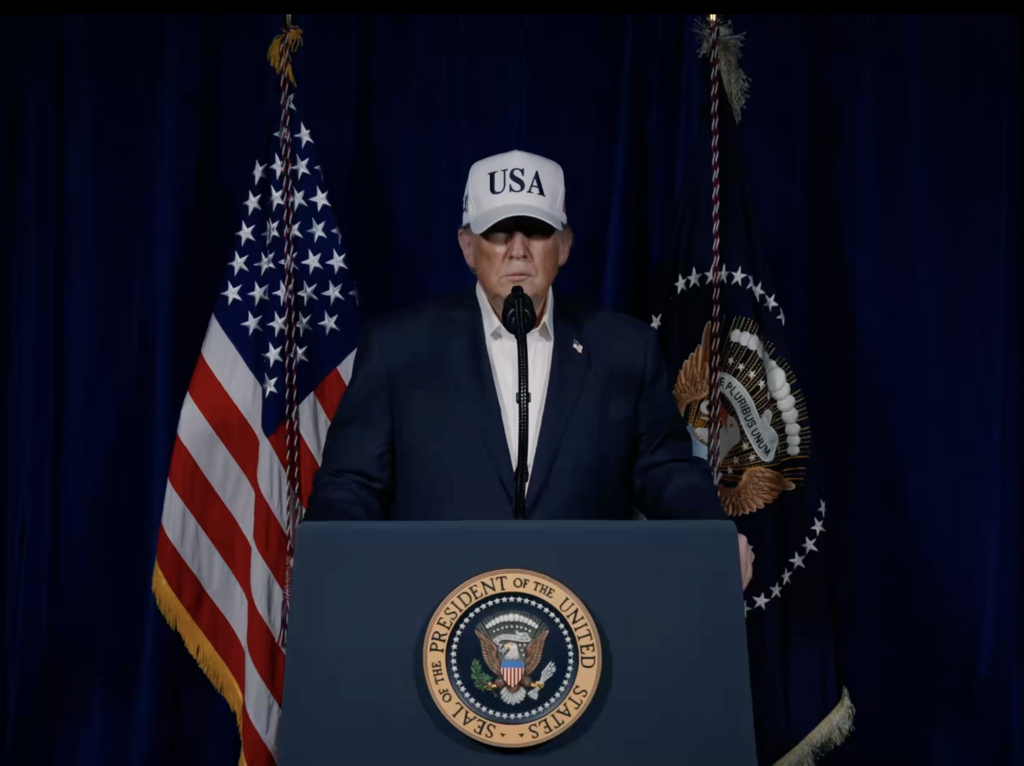
The escalating Iran-Israel war entered its second week Saturday as tensions surged across the Middle East and uncertainty grew over how the conflict might end. U.S. President Donald Trump declared he would only accept Iran’s “unconditional surrender,” signaling a hardline stance that could prolong the regional conflict. The statement came as Israel continued launching airstrikes on Iran and expanded military operations in Lebanon, while Iran responded with missile and drone attacks across the region.
Trump’s remarks, posted on social media, followed reports that several countries had begun quiet mediation efforts aimed at easing tensions between Iran, Israel, and the United States. Iran’s President Masoud Pezeshkian hinted at possible diplomatic initiatives but provided few details about the countries involved in the negotiations.
“There will be no deal with Iran except unconditional surrender,” Trump wrote, adding that after Iran capitulates, the United States and its allies would help rebuild the country’s economy and support the selection of a “great and acceptable leader” to replace Iran’s slain Supreme Leader Ayatollah Ali Khamenei.
The ongoing Israel-Iran conflict has already spread beyond Iran’s borders. Iranian forces have launched missiles and drones toward Israel and Gulf countries hosting U.S. military bases, including Saudi Arabia, Qatar, Kuwait, Bahrain, and the United Arab Emirates. Inside Israel, explosions were heard as air defense systems intercepted incoming Iranian projectiles.
Israel has also intensified strikes against Hezbollah targets in Lebanon, bombing Beirut’s southern suburbs after ordering a mass evacuation. According to humanitarian groups, nearly 300,000 people have fled their homes in Lebanon during the past four days. Israel says its military campaign has destroyed roughly 80% of Iran’s air defense systems and disabled more than 60% of its missile launchers.
The war has caused severe disruption to global markets. European and U.S. stock indexes fell sharply while oil prices surged to multi-year highs as the strategic Strait of Hormuz shipping route faced major disruptions.
Iran’s ambassador to the United Nations insisted the country’s leadership transition would occur through constitutional procedures without foreign interference, rejecting Trump’s suggestion that the United States should influence the selection of Iran’s next leader.
Meanwhile, reports indicate Russia may be assisting Iran by providing intelligence on U.S. military positions in the Middle East, though Russian officials have not confirmed the claim. The conflict has already caused significant casualties, with more than 1,300 people killed in Iran, over 120 deaths reported in Lebanon, and multiple fatalities in Israel and among U.S. forces.
With heavy airstrikes continuing, regional tensions escalating, and diplomacy still uncertain, the Israel-Iran war threatens to evolve into a prolonged and wider Middle East conflict that could further destabilize global markets and international security.