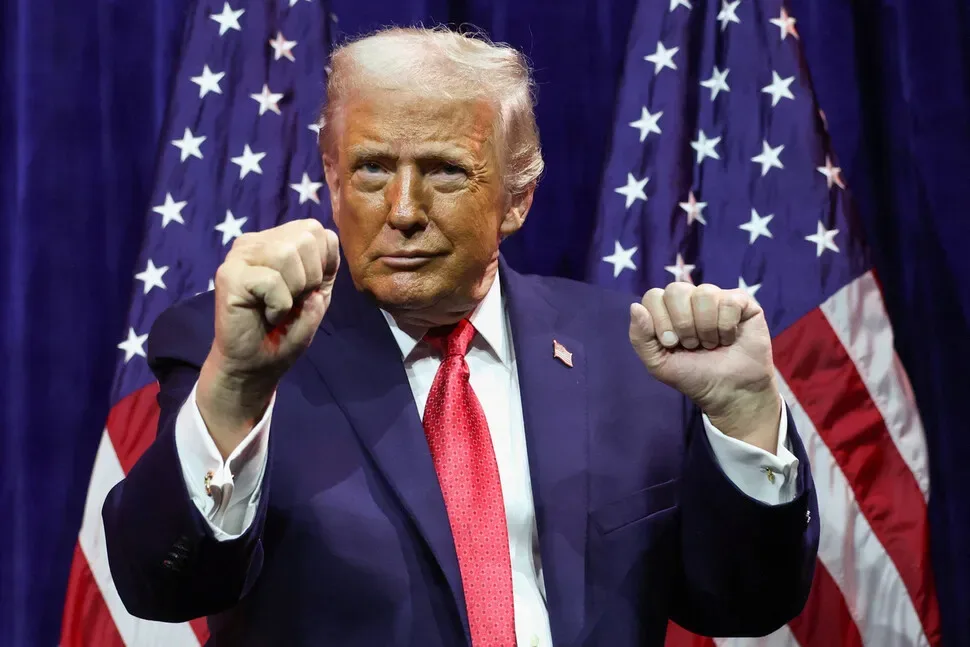
An analysis says U.S. President Donald Trump is continuing his offensive despite losing the congressional majority in the midterm elections. His remaining two years in office are expected to be defined not by a weakened president, but by a president battling Congress for power.
On November 26 local time, Frederick Kempe, president of the U.S. think tank Atlantic Council, wrote in an article titled “Trump Keeps Up Offensive After Midterms…Always on the Attack” that “losing the congressional majority could instead intensify Trump’s appetite for executive power,” adding that “the next two years will be marked less by a weakened presidency than by a presidency in which power collides.”
He cited two of Trump’s moves this week as evidence. One was Trump’s key role in Nvidia CEO Jensen Huang’s dramatic comeback. The other was his announcement on the 25th that new tariffs would be imposed on 14 trading partners, including China, the European Union, Japan and India. The administration said they had harmed U.S. producers through structural oversupply.
Josh Lipsky of the Atlantic Council said the new tariffs appear designed to remain in place for a long time, unlike many of last year’s “Liberation Day” tariffs, which were struck down by the Supreme Court in February this year. Democratic lawmakers are preparing to eliminate the existing tariffs.
Kempe noted that Trump will retain broad discretion, especially in foreign policy, but that the new Congress taking office in January will also have strong checks through its investigative and oversight powers and control over the budget.
A Middle Eastern leader Kempe met just after the midterm elections said Trump would “go from striker to goalkeeper” as he tried to fend off an offensive by a Democratic-majority Congress. Kempe said he had countered that Trump’s striker instincts could become even stronger and that, if necessary, he would leave the goal open and go for the goal himself.
Clashes under divided government
After losing both chambers in the 1946 midterm elections, former President Harry Truman joined forces with internationalist Republican lawmakers, including Senate Foreign Relations Committee Chairman Arthur Vandenberg, to achieve the Marshall Plan, the Berlin Airlift and the North Atlantic Treaty Organization (NATO). Kempe said similar cooperation would be difficult to expect between Trump and Democratic Rep. Chris Coons, who is considered a leading candidate to become the next Senate Foreign Relations Committee chairman. Their views on Ukraine and Iran are far apart, while investigations into alleged conflicts of interest involving the administration are also expanding.
Rep. Jamie Raskin, a leading candidate to chair the House Judiciary Committee, has already requested documents from companies in which 1789 Capital invested. 1789 Capital is the investment firm that Donald Trump Jr., the president’s son, joined as a partner shortly after the 2024 presidential election.
Ukraine and Iran
The Financial Times (FT) reported on the 24th that Secretary of War Pete Hegseth had put on hold the delivery of about 60 U.S.-made Patriot interceptor missiles financed by Western allies. They are effectively the only means of protecting Ukrainian civilian facilities from Russian ballistic-missile attacks.
Kempe warned that Russian President Vladimir Putin could mistakenly see this as an opportunity to escalate with impunity. With Russian forces stalled at the front for months, Putin is likely to increase hybrid attacks against European countries helping Ukraine and try to win Trump’s favor, he said.
Democrats are almost united in criticizing the war with Iran, and opposition has also grown within the Republican Party. Even Vice President JD Vance pointed out that the war was hurting the Republican Party’s political standing. Kempe predicted that Democrats would seek to constrain Trump through the budget and other means. He also expressed concern that Iran’s Islamic Revolutionary Guard Corps, emboldened by its belief that it had changed the balance of power between the United States and Israel, could attack neighboring countries or U.S. forces, prompting further action by Trump.
The illusion of stability among great powers
He also assessed that last week’s trilateral meeting between Trump, Putin and Chinese President Xi Jinping in Shenzhen, China, merely staged stability among the great powers. Putin is targeting Ukraine and Xi is targeting Taiwan, while Trump has taken no clear position on either, increasing the risk of miscalculation. He cited The Economist’s “The World Ahead 2027” analysis, which calls China, Russia, Iran and North Korea an “axis of evil” and says they are helping one another.
He noted that the market’s sharp swings during the Nvidia episode showed how corporate value and national security, as well as technological leadership and financial markets, are intertwined. Kempe concluded, “The next two years, when the artificial-intelligence revolution converges with debt, economic disruption and geopolitical competition, could be the most dangerous period of our lifetimes,” adding that “President Trump and a Democratic Congress preparing for conflict in 2027 must join hands if they are to avoid a major accident.”