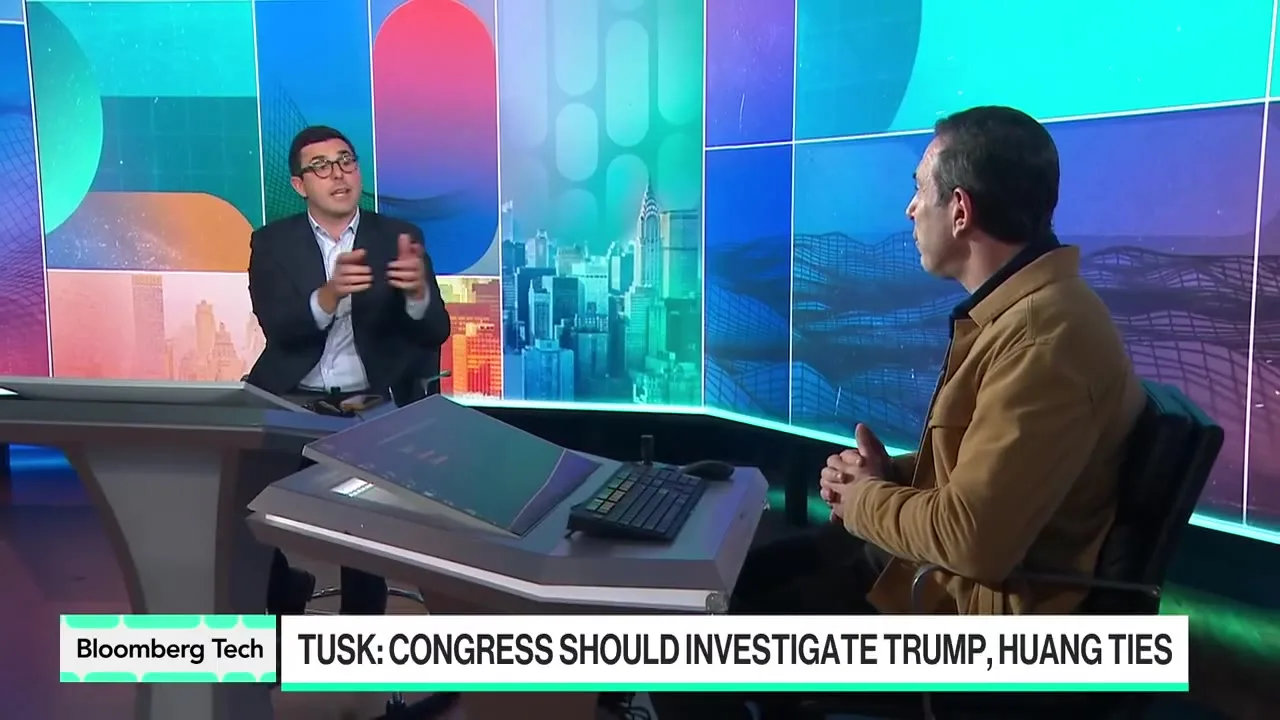
Nvidia should replace Jensen Huang rather than bring him back as chief executive while questions about China ties remain unresolved, Tusk Venture Partners managing partner and cofounder Bradley Tusk said.
Tusk also called for Congress to investigate the relationship between Huang and Commerce Secretary Howard Lutnick. He questioned decisions to permit chip exports to China during an interview on Bloomberg Technology published Nov. 16.
Tusk linked his demand to allegations about Huang's relationship with a woman suspected of spying for China. He acknowledged that he did not know whether Chinese intelligence had compromised Huang or obtained company information.
Bloomberg reported that Nvidia's board had said it had no reason to believe the relationship resulted in a national security breach or disclosure of trade secrets. Huang himself was not a target of the espionage investigation, Bloomberg reported.
Tusk challenged the board's ability to assess national security concerns and said its interest in retaining Huang could conflict with the public interest. He argued that other executives could run the company.
“We have more questions than answers,” Tusk said. He opposed keeping an interim chief executive in place throughout a lengthy investigation and called for Nvidia to appoint a permanent replacement.
Tusk supported broader restrictions on chip exports and remote access to computing services. The US Commerce Department's interim rule expanded controls to Singapore, Malaysia, Thailand, Indonesia and Brazil and restricted banned entities from renting cloud capacity there.
“That should have been our policy all along,” Tusk said. He questioned what the department knew about the alleged activities and criticised Lutnick's handling of disagreements within the administration.
Turning to startups, Tusk said businesses dependent on Nvidia's chip sales to China needed to consider their exposure. He expected the company to continue selling chips despite the investigations.
Tusk said his firm had invested in alternative computing companies because it expected data centres to face the cost of their energy use. He saw opportunities for businesses that could provide more efficient computing.
Those investments included a business developing computing with rat brain neurons. Tusk had considered such companies potential Nvidia acquisition targets but said he did not know whether that prospect had changed.
On Anthropic, Tusk questioned plans to go public and criticised the industry's focus on individual leaders. He argued that enthusiasm about those figures could become detached from business performance.
Tusk cited a roughly $1.5 trillion valuation, almost $900 billion in computing capital commitments and about $60 billion in annualised recurring revenue, a measure that projects recurring sales over a year.
He said public shareholders' demands could increase pressure to release advanced AI models without sufficient safety controls. His objection centred on the conflict he saw between Anthropic's safety commitments and the demands of public ownership.