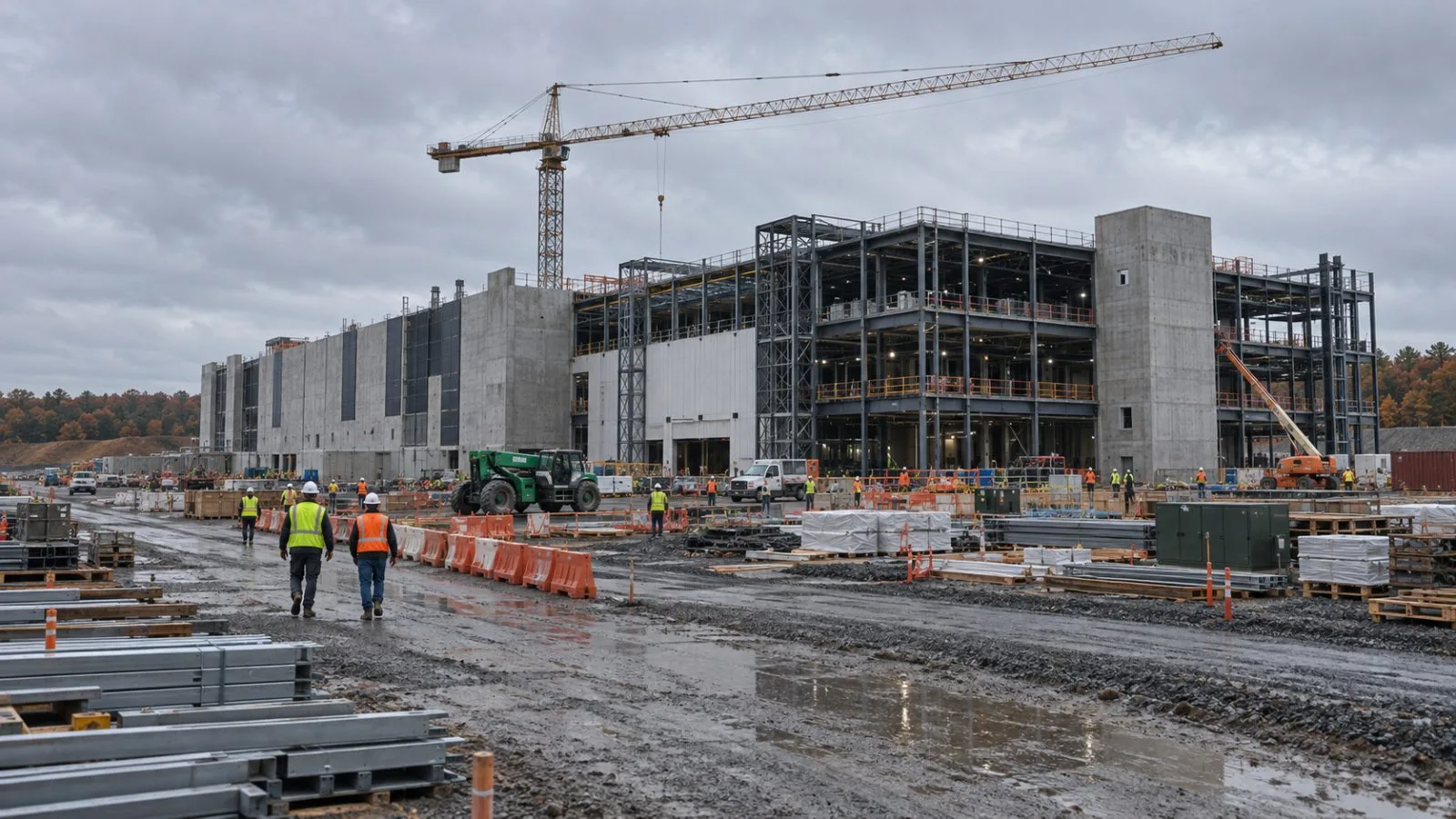
U.S. data center building grew 73.2% over the year to August 2026 as other private construction declined, making the figures part of a debate over whether the technology boom is displacing investment.
The U.S. Census Bureau's preliminary estimate put data center construction at $84.95 billion at a seasonally adjusted annual rate in August, versus $49.05 billion in August 2025. Total private construction was $1.655 trillion at a seasonally adjusted annual rate, down from $1.707 trillion a year before. Removing the data center category from each total leaves other private construction at $1.570 trillion, a decrease of about $88 billion, or 5.3%, over 12 months. That arithmetic describes parallel movements in the Census series, not a cause-and-effect relationship.
Paul Krugman argues that heavy data center investment lifts borrowing costs for other businesses and limits what they can invest. In an Oct. 19 analysis, Alex Tabarrok said these construction comparisons cannot establish what investment would have looked like without the boom; he cited tariffs, uncertainty and fading subsidies as possible reasons for weakness beyond technology. Krugman also compares the episode with the 1990s technology boom, saying foreign capital then helped support investment outside the sector. The construction totals do not resolve the disagreement or establish who benefits and who carries any added financing costs.
Longer-term data provide context on a different timeline. Bureau of Economic Analysis (BEA) figures show real private fixed investment at an annual rate of $4.14 trillion in the second quarter of 2023 and $4.65 trillion in the second quarter of 2026, in chained 2017 dollars. Its information-processing equipment and software measure, a broader category than data centers, increased from $1.21 trillion to $1.76 trillion over those quarters. McKinsey Global Institute found that U.S. private productive investment held flat as a share of gross domestic product during the three years after ChatGPT launched.
The measures use different boundaries. The Census counts data center buildings as office construction and leaves the racks and servers placed inside them outside its construction tally. The BEA equipment-and-software series is broader than data centers, so it cannot be treated as a count of data center spending. The BEA's advance estimate of third-quarter GDP is due Oct. 29 at 8:30 a.m. ET, followed by the Census Bureau's September construction report Nov. 2 at 10 a.m. ET.