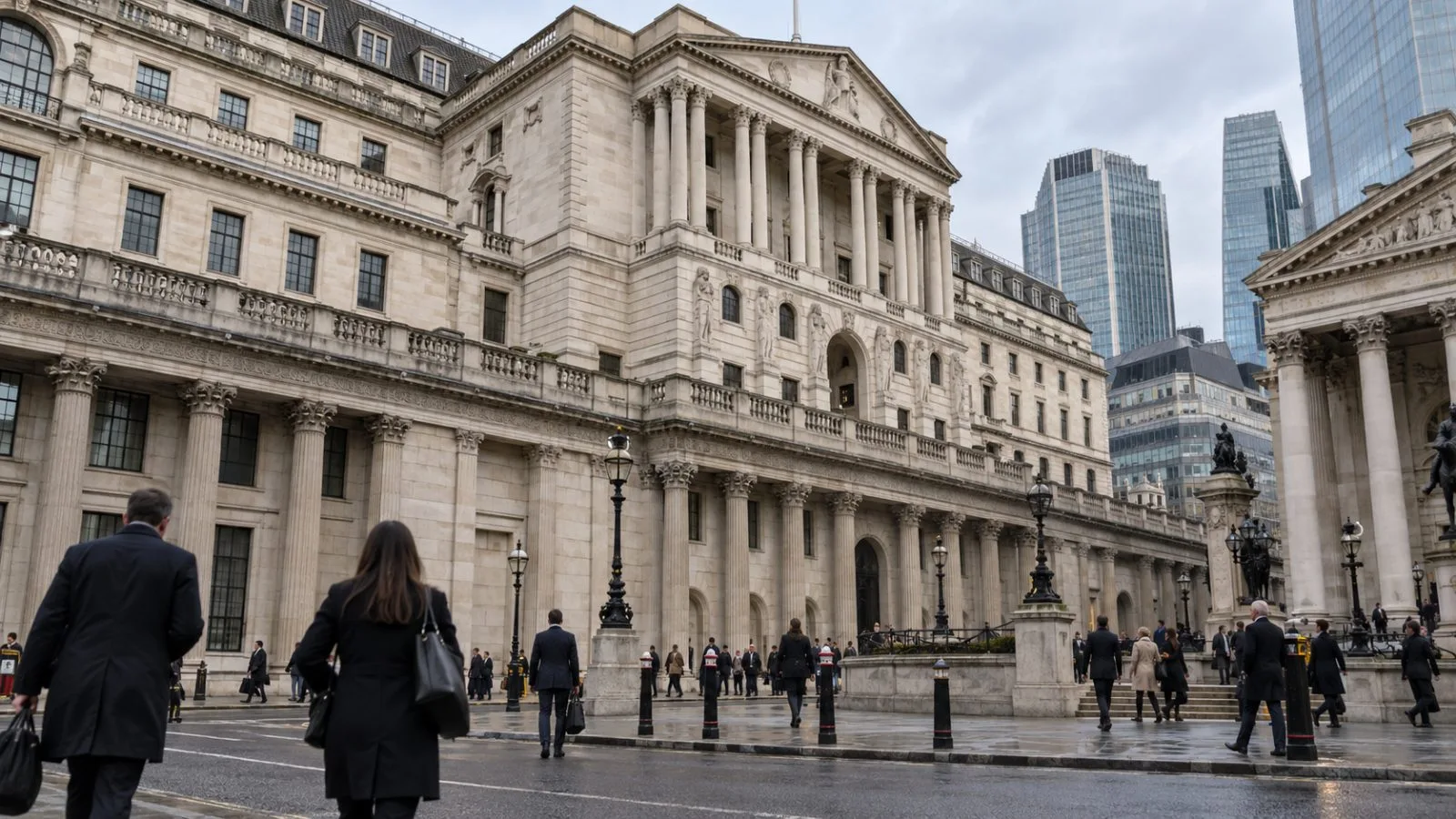
LONDON, Oct. 25 — Several economists expect the Bank of England to raise interest rates less sharply than financial markets currently imply, even as UK inflation accelerates and investors price further increases.
A RateProbability dashboard showed 109.2 basis points of net increases priced over the next 12 months as of Oct. 25, equivalent to about 4.4 quarter-point moves. Market pricing reflects rates traded in financial instruments; it is not a prediction of what the Bank will decide.
Oxford Economics expects two quarter-point increases, in November and February, taking Bank Rate to 4.25%. The Guardian reported that Deutsche Bank’s base case also reaches 4.25% by February, then holds that rate through the end of 2027. The Guardian also quoted ING economist James Smith as saying the Bank could be “sounding the all clear” by next spring.
Bank of England Chief Economist Huw Pill has also questioned whether four quarter-point increases over the coming year will be needed, Reuters reported. At the September policy meeting, the Monetary Policy Committee held Bank Rate at 3.75% in a 6-3 vote, with three members favoring an increase to 4%.
The inflation picture has since changed. The Office for National Statistics said CPI rose 3.5% in the 12 months to September, up from 3.1% in August. Transport, particularly motor fuels, made the largest upward contribution to the annual rate’s increase; services inflation rose to 3.7% from 3.4%.
The Bank’s September minutes said there was little evidence at that point of higher energy costs causing material second-round effects in prices and wages, but warned that risk could grow if energy prices stayed high. The minutes also showed quoted two-year fixed mortgage rates around 95 basis points above their pre-conflict level, adding to borrowers’ costs.
The Bank’s next rate decision is scheduled for Nov. 5, followed by the next inflation report on Nov. 18.