Imogen, a night club owner from London, hopes that COVID-19 “passports” could help with the return of customers to her venue. But the 42-year-old told us she is not happy about subjecting her customers to additional checks, and has concerns over a lack of clear guidance on their use.
Imogen is just one of many business owners in the UK anxiously waiting for extensive lifting of social restrictions. The UK government’s plan is that businesses and large events should use the NHS COVID Pass in “high-risk settings” such as venues with limited ventilation where people spend time in close proximity.
They will not be mandatory. But the hope is that use of the pass might convince more people to complete their course of vaccinations and create a safer environment for indoor events.
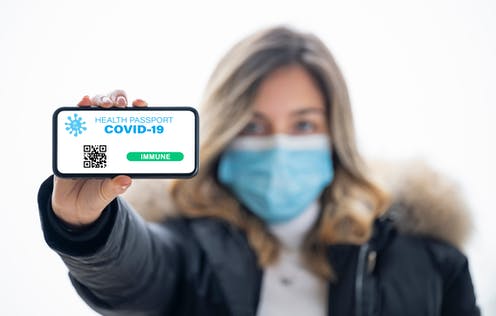
The pass is designed to show the user’s vaccination status or test results and is obtained through the NHS app or via the website. Customers would need to install the app on their phones and generate an individual barcode. They also have the option to download and print a hard copy certificate or order a paper version.
For their part, businesses need to download the NHS COVID Pass Verifier to scan a customer’s pass and check that they have been fully vaccinated, had a negative test, or have recovered from COVID-19. Here are some key points both customers and businesses should be aware of:
1. Data privacy
All data related to immunity status – including results of negative tests – is stored in NHS computers that are encrypted and secure and have been storing private health data for decades. When the business uses its verifier there is no sharing of personal information or data taking place. The verifier only checks the validity of the barcode.
2. Staff training and support
Businesses will need to have staff available to check customers’ immunity status. Training, technical support and updated processes could also be needed but there has been no official guidance about whether businesses would receive financial support to cover implementation costs.
3. Queues
Expect longer queues than usual as the additional checks will take time. Technical issues and glitches could further test the patience of customers.
4. Before the visit
It is important for businesses to communicate clearly whether they are open only to people who have been fully vaccinated or to anyone who can provide proof of a negative test. Customers need to check the requirements with the venue in advance to avoid confusion.
5. After the visit.
Because full vaccination or prior infection does not stop anyone from contracting and spreading the virus, it will be good practice for people (especially the socially active) to keep their COVID-19 health profile updated by taking tests at least twice per week.

‘You’re not on the app, you’re not coming in.’ Shutterstock/Anthony Mooney
In its review of “COVID-status certification” the government explained that the NHS COVID Pass was not made mandatory partly because of the public’s concerns over vaccine passports and the need to protect the right of the businesses to choose how to turn their premises into safe environments.
In fact, some nightclub owners have expressed their concerns about the legality of asking their customers to prove their status, while others are worried they could lead to problems with crowd control. Similar concerns were reported by studies which attempted to understand the use of immunity passports in the UK and across different sectors.
Our work on the design of immunity passports for COVID-19 suggests that a careful consideration of several other areas of interest is needed to guarantee their long-term effective use.
When we asked our study participants about their concerns with COVID-19 passports, almost all mentioned worries about data security and possible discrimination against those who did not have “vaccinated” status.
Their responses highlight the need for the government to work with businesses and customers to build greater trust in the certification process. Officials also need to be mindful of managing (and supporting) change into existing business operations.
Involving businesses and their customers in the design process – not as passive consultants but as active creative partners – is key. A more integrated approach will help untangle the complexity of certification, and make sure the final output is as safe and acceptable for as many businesses and their customers as possible.
 Panagiotis Balatsoukas receives funding from the UKRI Arts and Humanities Research Council for the Immunity Passport Service Design (IMMUNE) project.
Gyuchan Thomas Jun receives funding from UKRI Arts and Humanities Research Council for the IMMUNE project.
Isabel Sassoon receives funding from the UKRI Arts and Humanities Research Council for the Immunity Passport Service Design (IMMUNE) project.