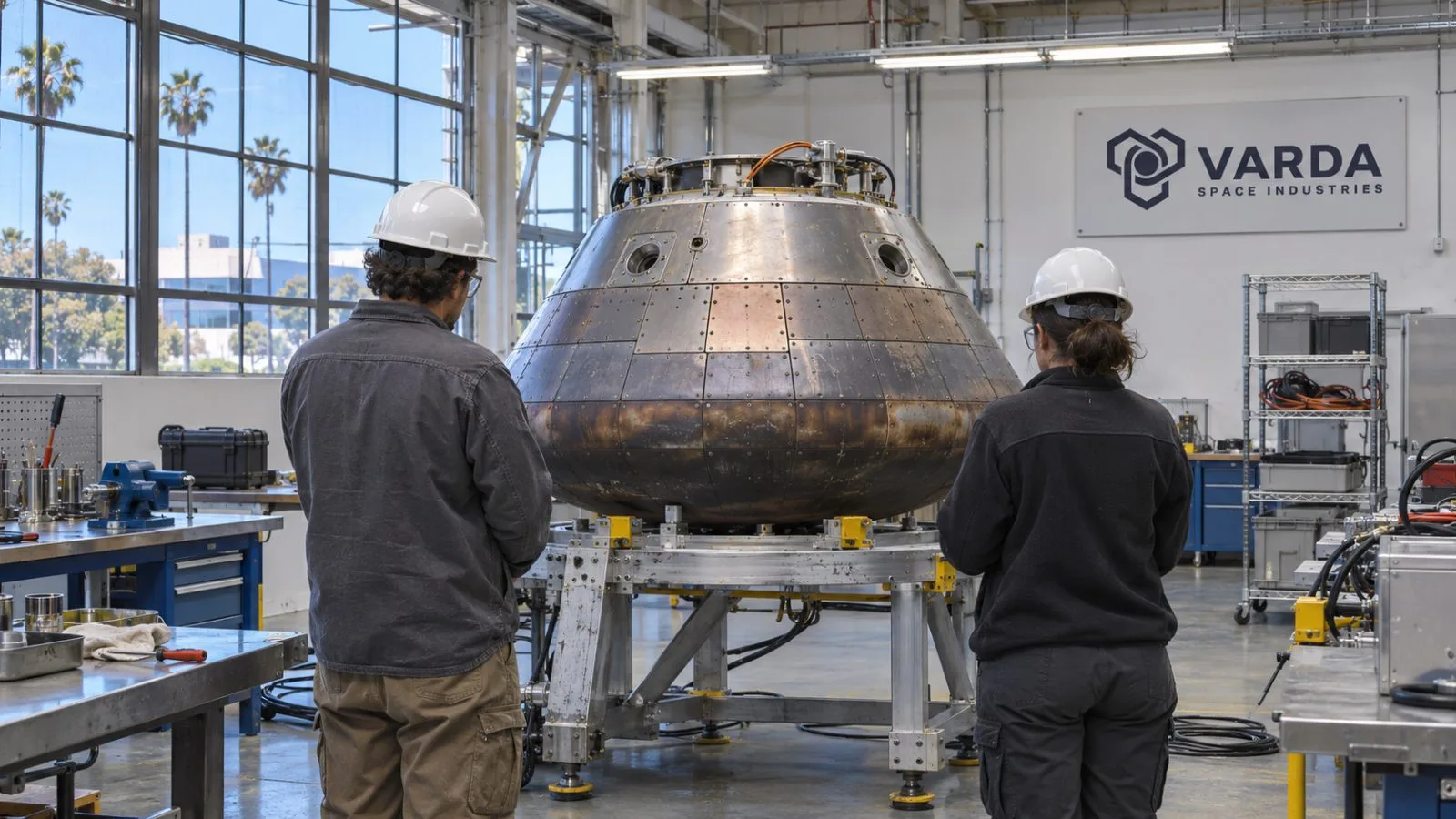
Varda Space Industries is growing crystals of a potential cancer drug in orbit as commercial developers explore whether microgravity can offer benefits that justify the cost of pharmaceutical production in space.
The Guardian reported that three Varda capsules were in orbit after two launched together Oct. 1 and a third followed Oct. 20. One is carrying out the drug-crystal experiment. The other two are testing heat-protection materials and navigation systems for re-entry.
Dr. Meganne Christian, mission manager for in-space manufacturing at the UK-based Satellite Applications Catapult, told the Guardian that reducing the effects of particle settling and fluid movement could help crystals form more orderly structures. The report did not identify the drug or describe a result from the experiment.
A medicine’s crystal characteristics can influence its stability, behavior when dissolved and possible methods of delivery. The Guardian described a potential application in which some medicines now given through intravenous infusions could be reformulated for injection. It did not report that Varda had achieved such a change.
Scientists have studied manufacturing in microgravity for decades, particularly aboard the International Space Station, according to the Guardian. The station is scheduled to retire around 2030. Lower launch costs and more frequent commercial flights have encouraged interest in dedicated production equipment. UK-based BioOrbit has sent a compact laboratory to the station while working toward cancer medicines patients could inject themselves.
The expense of orbital production remains a constraint. Christian said it would need to produce consistent results and would not suit every product. The Guardian reported that Varda plans seven more launches in 2027 and 10 in 2028.
The UK’s Medicines and Healthcare products Regulatory Agency (MHRA) is expected to publish a plan later in 2026 explaining how existing medicines regulations apply to drugs made in orbit, the Guardian reported.