
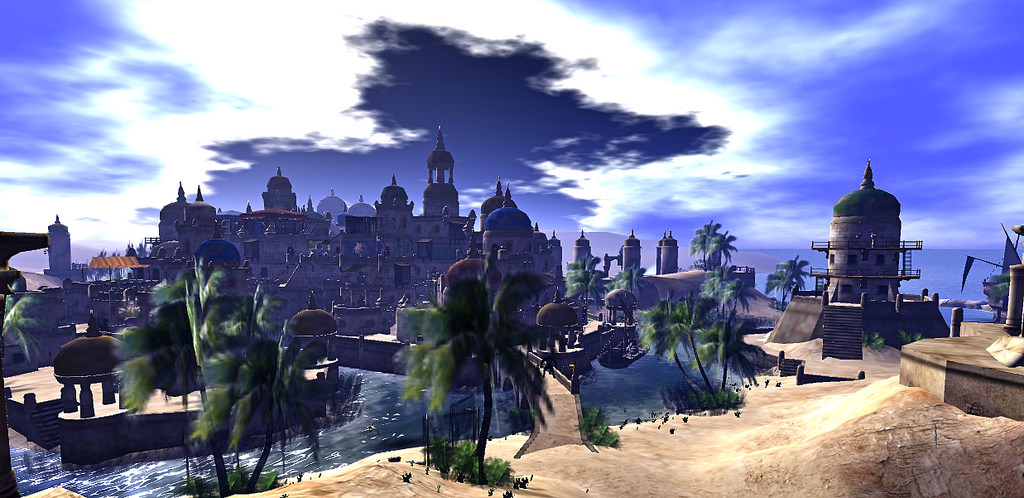
If I said I was a licensed architect helping to fight dementia, you’d probably assume I was designing a care home or some similar building. Actually, I’ve been working alongside neuroscientists, psychologists, doctors and programmers to produce a computer game that could lead to better diagnoses for the condition.
One of the first signs of dementia is a decline in navigational ability but, until now, it’s been very difficult to detect such signs. The SeaHeroQuest game consists of a series of virtual levels for people to explore: an icy, artic world; a sandy, pirate-inspired archipelago; and a spooky, swamp-like world.
As people play the game, generates data about their navigational skills – how they instinctively find their way around without getting lost. The aim is to create the largest ever database measuring people’s navigational abilities. This will enable scientists to study how people navigate and develop a data-based test for a dementia-related decline in these abilities.
So what does this have to do with an architect? Architects have actually long been involved in computer game design, since at least the late 1990s when Bungie Studios used a professional architect to design the buildings for its game Oni. But for SeaHeroQuest, developers firm Glitchers had a team of very talented game designers to create the look and feel of the levels so didn’t need an architect for any kind of set dressing.

SeaHeroQuest. Glitchers/Northumbria University
Instead, my role was to do with navigation. The game is based on mazes of various difficulty that are, by definition, meant to be tricky to navigate. Architects, for the most part, typically want to build things that are the exact opposite of this. We don’t want to design confusing and disorientating worlds. Instead we want to design environments that are clear to understand and that people can move around in in a stress-free manner.
But in order to understand how to design navigable environments, architects also need to understand what features make places hard to navigate. For example, rooms or spaces in one building that all look alike can make it hard to tell if you are walking down one corridor or another identical one. Paths with too many turns mean you are constantly changing direction and can become more easily disoriented. Buildings where there are few opportunities to look to the outside mean it is harder to reorient yourself if you become lost.
Borrowing an architectural toolbox
In architectural research, we have developed a number of tools that can be used to measure how easy it is to navigate a particular a building, neighbourhood or street. These tools compare what is immediately visible from a single location to how well that same location is connected to the whole building or city. Where the two correspond, we say the design is “intelligble” and navigation should be correspondingly straightforward. We used these techniques to help create a series of increasingly more complex game levels, which act as a controlled environment to test people’s navigational ability.
Architects can also bring to game design an understanding of more intangible ideas, such as the relationship between the design or layout of a space and how people behave in it. This could help a game designer manage issues such as how individual players are likely to travel through a game’s virtual world, which spaces they are drawn to or how multiple characters in the game might flow through it. Sometimes it is critical for the game-play for players to meet and interact or to keep players apart (if only to avoid overloading servers of online multiplayer games). Good architectural design can help with this.
Finally, architects can help make sure players have the appropriate sensory experience when they visit a virtual location. Architects learn to manipulate the senses from the subtle use of light and shadows, materials, textures and even sound to create spaces that evoke different emotional responses. If games designers can appropriate these characteristics into their game worlds, there is evidence that it can enhance game-play. The more senses that are stimulated while playing, the more a player feels immersed in the game.
All these factors enable architects to make a considerable contribution to how engaging, difficult and enjoying a game can be. As I have discovered from working on this particular one, it turns out that designing pirate archipelagos is not so far removed from creating airports or libraries after all.
 Ruth Dalton receives funding from the EPSRC and the ESRC. She was part of the development team behind the SeaHeroQuest game, which was funded by Deutsche Telekom.
Ruth Dalton, Professor of Building Usability and Visualisation, Northumbria University, Newcastle
This article was originally published on The Conversation. Read the original article.


