Universal, safe and reliable water access is a pressing need in the global south. One-quarter of the world’s population don’t currently have access to clean drinking water. In Ghana, about 5 million people out of a total population of about 31 million lack access to clean, safe water. One person in ten has to spend more than 30 minutes to get drinking water.
Problems are particularly acute in off-grid communities. These are the low-income, rural and peri-urban locations that aren’t connected to municipal or main centralised water supply.
The private sector and other non-governmental providers are getting increasingly involved in filling the gap, sometimes in partnership with the government. Some private water service providers have turned to innovations like “water ATMs”. These automated standpipes are popping up as a way to expand affordable water services.
Powered by solar energy, most water ATMs are designed to operate 24 hours a day. They are low-cost, self-contained, automated water vending machines that store clean water and are most often connected to a water purifying plant that uses groundwater. Customers buy water from the ATMs using a water card, which is topped up with credit via mobile money.
In my recent study, I set out to explore how water ATMs were working in low-income, peri-urban or off-grid locations in Ghana. I found that water ATMs delivered relatively limited operational-level value. And they were changing the water access landscape – not always for the better, from users’ point of view.
Impact of water ATMs on water access
The research was conducted in Yawkwei, a peri-urban community in the Ashanti region of Ghana. Here, off-grid households have the choice of using water ATMs or not, but can also rely on other sources such as other private standpipes and community boreholes.
The water ATMs were operated by Safe Water Network, a non-profit organisation dedicated to developing and implementing small, financially viable water initiatives. They were installed at six water standpipes, five with a single ATM and a main station with two ATMs, together serving about 2,000 people.
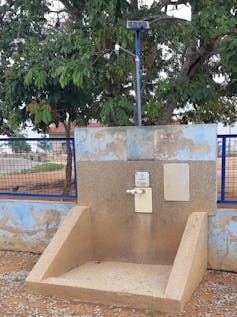
A water ATM point in Yawkwei. Godfred Amankwaa
Water ATMs were installed incrementally and used the existing physical, institutional and financial infrastructure in the community. This was done to reduce the cost and the chance of resistance or rejection of the innovation. It relied on what was already in place, such as mobile phones, Safe Water Network’s standpipes, and community actors like water station operators and mobile money agents.
The study found five main ways in which water ATMs were changing the water access landscape.
Improved water reliability and access: Water ATMs provided more reliable, flexible and convenient (time-saving) access than former or competing types of off-grid water provision in the community. For instance, people spent on average 15 minutes for a round trip, from home to water ATM and back, compared to 29 minutes at two non-ATM boreholes in the community. Also, people could collect water outside the station caretaker’s or vendor’s hours of business. Collection could fit in around other livelihood activities instead of disrupting them.
Cost and changes in water practices: Water ATMs brought the relation between costs and water more to the fore for users. Users became more cautious at the point of water collection, since they would be paying for any water spilt. Also, despite the technology not changing water prices or tariffs (20 litres for 10 pesewas), some users claimed they were effectively being charged more because they didn’t get the same volume of water for their money.
A water ATM user said:
(…) see, this pipe (water ATM point) is closer to me but the prices of late make me visit the other standpipe by the store. When I use this same container (a 40-litre bucket), a Ghana cedi (GH₵1) purchase guarantees five times of that container from other vendors. But instead of getting five times, I only sometimes get four times at same amount when I use the water ATMs. I prefer to walk that distance if I can get an extra container of water.
Changes in the everyday social relations at the standpipe: Some of the former informal, social aspects of water access, such as an exchange of gossip, views and concerns during water collection, were reduced.
Roles and power shifts: New actors became an essential part of water collection. Some were community-based (mobile money agents), others at the national level (the mobile operator MTN) and overseas (eWaterPay). They benefited from consumer payments and use of mobile money related services.
Empowerment vs disempowerment: Households without water ATM cards or credits, and women who were vendors at off-grid water standpipes, were disempowered. For instance, four women vendors at different water standpipes had lost their livelihoods as a result of water digitalisation. Those with water cards were empowered.
Bottom-up approach
Based on my findings, I suggest the following ways to make water ATMs more effective.
-
Government should enable a favourable policy and regulatory space for water infrastructure investment and an enabling ecosystem for locally based digital innovations.
-
Water service providers, when they introduce innovations, should adopt and build on existing systems and local institutions to create a supportive enabling environment.
-
Affordable pricing should be set from the outset to encourage buy-in and usage.
-
Government should collaborate with private water providers to incrementally adopt digital water technologies. First they should put in place risk management mechanisms to help prioritise and reduce risks threatening the sustainability of existing infrastructure and for safe and affordable water delivery.