
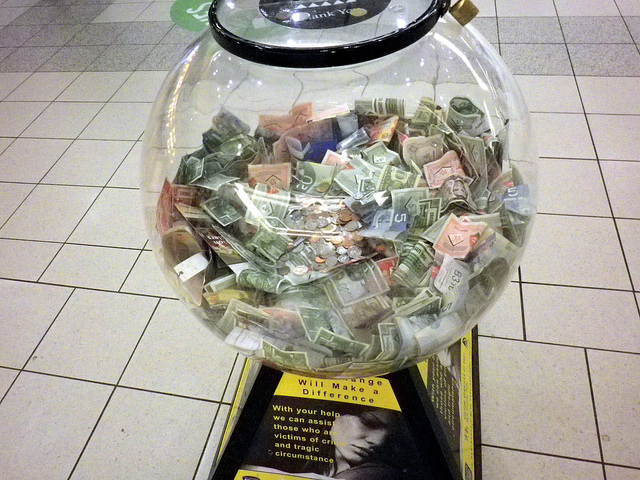
Several nonprofits, such as the Sierra Club, Planned Parenthood and the American Civil Liberties Union, have reported a surge in donations as some Americans respond to their political concerns by supporting causes they believe will make a difference.
Yet while scholars have found ample evidence that economic conditions can shape charitable giving, the connection between overall donations and the political climate is less clear.
As the lead researcher responsible for the Giving USA report, which the Indiana University Lilly Family School of Philanthropy researches and writes in partnership with the Giving USA Foundation, I have a unique opportunity to study how and why people give, and how those patterns unfold over time.
Giving in 2016
In the latest edition of Giving USA, we estimated that American individuals, estates, corporations and foundations donated a record US$390 billion to charitable causes in 2016.
Total giving grew 1.4 percent, adjusted for inflation. Donations from individuals amounted to nearly three-quarters of all giving and grew more than giving by foundations, corporations or bequests with a 2.6 percent gain to $282 billion.
A broad increase in what individual people donate could make a big difference in the amount of money Americans give overall to charity.
Economic factors
One way that the health of the economy shapes charitable giving is that people tend to give more money when they make more of it. Research by University of Chicago economist John A. List and other experts has found economic conditions – as measured by the S&P 500 stock index, personal consumption and the gross domestic product (GDP) – influence giving.
In one study, List and his colleague Yana Gallen found that giving rises when stocks rally. In fact, the S&P 500’s performance accounts for nearly 40 percent of the variation in annual charitable giving.
The money Americans gave to charity last year to support everything from houses of worship and homeless shelters to veterans’ organizations and art museums amounted to about 2.1 percent of GDP – the same share as for 2014 and 2015.
This measure has barely budged over the past 40 years. In 1976, during the Ford administration, charitable giving comprised 1.7 percent of the U.S. economy. Giving stood at 2.1 percent of GDP before the Great Recession, and only dipped to 1.9 percent before bouncing back.
Shifting priorities
The priorities of the American public are more diverse than ever, and that diversity is reflected in its giving habits. In 2016, donations to all of the nine major categories we track went up, for only the sixth time in the last 40 years.
What makes people change how and how much they give?
They may heed signals from their friends, relatives and other networks. We also know that people respond to requests to give and direct their gifts to causes and issues in which they believe they can have an impact. For instance, during the Great Recession, the philanthropists who make million-dollar donations shifted more of the money they give away to organizations that help the needy, according to a study I conducted with my colleagues.
There is also evidence that campaign contributions don’t replace charitable giving. In fact, fundraising research has found that donors who contributed to political campaigns during an election year actually gave more to nonprofits during an election year compared with the previous year.
Swift growth
We have, however, witnessed a shift in giving to groups devoted to animal welfare and environmental issues, as well as international affairs. These categories were so small that we couldn’t track them until 1987.
While they still draw less support than others – religious groups, at $123 billion, and educational institutions and organizations, at nearly $60 billion, still top the list – animal welfare and environment groups and international affairs organizations made big strides in 2016.
Specifically, giving to environment/animal organizations rose 5.8 percent in inflation-adjusted dollars to $11 billion in 2016 – faster than any other category. Giving to international affairs groups, such as Doctors without Borders, notably grew 4.6 percent in inflation-adjusted dollars to $22 billion. What’s impressive about this uptick is that there were few of the large-scale international disasters that usually drive that kind of philanthropy.
What else to watch
As many compelling studies have shown, there is a growing interest in how noneconomic factors influence donors, such as the desire for status or social pressure from fundraisers.
We have also found that taxation can have an impact. A recent study I co-authored found that two tax policy changes proposed by Congress and the Trump administration would reduce charitable giving. We also found that another tax policy shift that nonprofit leaders are advocating would increase donations.
And even if political concerns do change giving patterns in the short term, that trend might not persist over time. We’ll be tracking these developments in future editions of Giving USA.
 Una Osili is the lead researcher for Giving USA, which is funded by Giving USA Foundation.


