


 S&P 500 Hits Record High as AI Rally Lifts Wall Street
  Wall Street Falls as Fed Minutes Signal Another Rate Hike
  France to Release 10 Million Barrels of Diesel to Ease Fuel Prices
  European Stocks Fall as Oil Rises Ahead of Fed Minutes
  UK House Prices Flat in September as Mortgage Rates Weigh
  Australia Consumer Confidence Plunges as RBA Rate Hike Hits Households
  Fed Minutes Signal Another Rate Hike by Year-End
  Gold Prices Fall as Fed Signals Another Rate Hike
  US Dollar Hits 18-Month High as Fed Signals More Rate Hikes
  Crypto Market Selloff Wipes Out $100B as Bitcoin Falls Below $83K
  US Treasury Yields Ease After Strong 10-Year Auction as Global Bonds Struggle
  Trump Opens Tax-Exempt Dyed Diesel Access as Fuel Prices Surge
  Asian Currencies Mixed as Yen Weakens, Dollar Holds Firm
  Oil Prices Rise as Hormuz Risks Offset IEA Stock Release
  Bangladesh GDP Growth Accelerates to 4.6% on Industrial Rebound
  Gold Prices Rise as Hormuz Tensions Fuel Inflation Risks
  Oil Prices Rise as Hormuz Attacks Fuel Supply Fears


 Add as a preferred source on Google
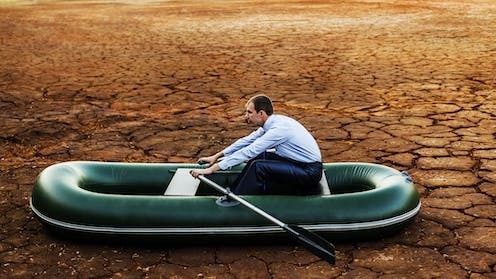

The financial shock the UK has recently suffered is of course bad for green investment. The Rishi Sunak-led government is also likely to use this crisis to push for further public spending cuts that will rule out a truly transformative green agenda.
However, in my recent academic paper I argue that the economic obstacles to effective decarbonisation are more deeply entrenched than that. We can’t simply blame a bad government budget or even the global market turmoil sparked by Russia’s invasion of Ukraine.
Instead, the global economy has been trapped in a state of relative stagnation in rates of growth, productivity, investment and profitability since at least the 2008 financial crisis, with some scholars even dating the onset of the malaise to the 1970s. This so-called secular stagnation is a global trend, but the UK has performed particularly poorly.
This represents a colossal problem for mainstream visions of decarbonisation. Most states, business groups and international organisations believe it must be driven by a tremendous global boom in private investment in renewable energy and sustainable infrastructure – estimates range from US$4.4 trillion a year until 2050 up to $9.2 trillion a year.
In this view, the role of states is to shepherd investors away from “brown” fossil fuel assets and towards green ones. The problem with this “green growth” vision is that for decades it has proven very difficult for states to generate any global, sustained boom in private investment – whether green or brown.
There is no consensus on the causes of this long-term stagnation, with different scholars pointing to slowing population growth, anti-labour policy agendas, or industrial overproduction. Yet what is clear is that stagnation acts as a fundamental drag on efforts to green the world economy. A few examples can illustrate this.
Steel and solar
The steel industry is a key driver of climate change and is responsible for around 7% to 9% of global carbon emissions. Currently, many steel plants burn coke to heat their blast furnaces, releasing carbon dioxide in the process. There are several ways to green this process, with perhaps the most plausible involving the use of green hydrogen and electric arc furnaces.
The problem is that these green solutions are expensive, in an industry that is already wracked by overproduction and weak profitability. Reorganising production and retooling factories worldwide would require firms to make massive investments, but glutted steel markets mean that such investments would be unlikely to yield high returns. The stagnant state of the industry therefore militates against its rapid decarbonisation.

Most of the world’s steel is made in China, and China makes more than it can sell. chinahbzyg / shutterstock
At first glance, solar power looks like the polar opposite of an old, heavy industry like steel. The production of solar panels is literally a sunrise industry: from the early 2000s, when generous renewable energy subsidies were introduced in Europe, investment has flooded in and generated a boom.
And yet there are signs that this industry too is increasingly hampered by chronic overcapacity and vanishing profitability. As production has become increasingly concentrated in China, where it is most cost-effective, the industry has been transformed by automation and massive economies of scale. It now resembles a typical commodities business with a high output of standardised products, and low prices and profits. As The Economist recently labelled the industry: “Good for the planet – but hardly a gold mine”. Many solar firms have gone bankrupt or simply abandoned the sector.
There has yet to be a grinding slowdown in solar panel production in response to these weak profits, partly due to massive subsidies in China.
Democratising decarbonisation
These dynamics can be found across many sectors that require urgent decarbonisation, from industry to energy to transport. For those who think climate change can only be resolved by markets and private investors, it’s an existential threat to their worldview. Yet the stagnation doesn’t actually show that decarbonisation is impossible, rather that it will be difficult to do so by capitalist means.
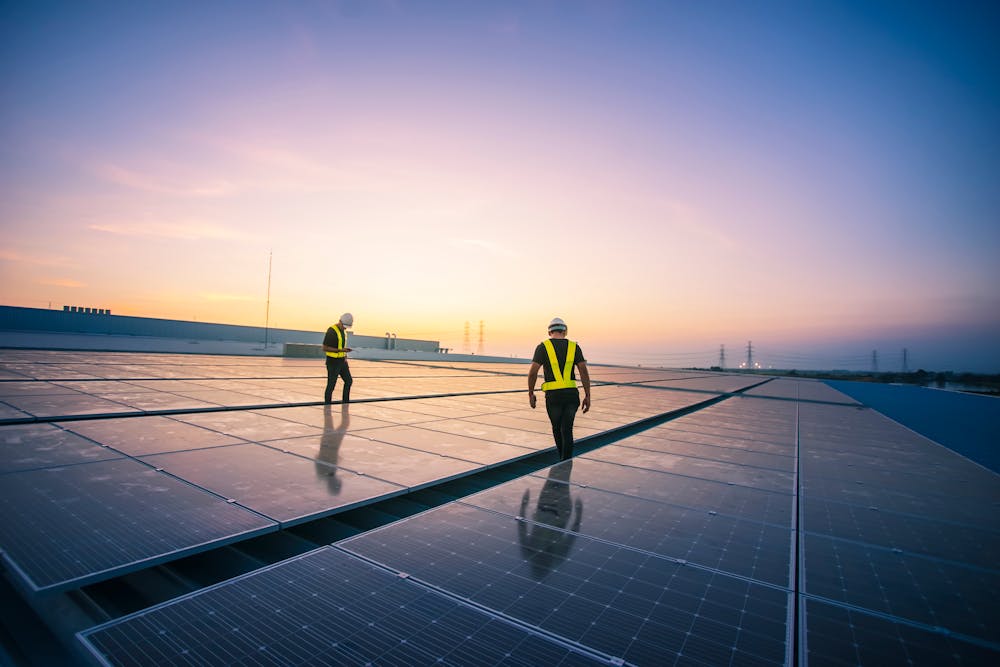
The solar industry could be collectively owned and democratically run. ME Image / shutterstock
For this reason, it is important to take seriously radical visions of decarbonisation that involve using collective ownership and democratic economic planning to rapidly expand renewable infrastructure. Faced with an unprecedented environmental catastrophe and the inertia of private markets, why should key industries like steel or solar be run according to the principle of profit maximisation instead of climate stability?
Run in a collective and democratic manner, the production of solar panels could be carefully managed to address a range of social concerns, from meeting carbon emissions goals to protecting communities where quartz mining is located to ensuring fair working practices in silicon factories. Deliberation between stakeholders would replace the blind imperative of money making.
While similar proposals can be found in some strands of green new deal and degrowth thought, these measures remain marginal to the broader debate on decarbonisation. Such a radical departure from contemporary economic orthodoxy is unlikely to be adopted by governments unless they are pushed by powerful social movements. Building such movements is the challenge of our time.







