
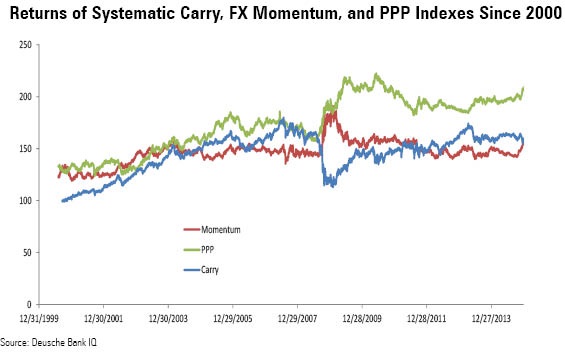
According to recent market activity, past performance of three top strategies are displayed in chart. Chart courtesy Deusche Bank.
Momentum -
- The momentum strategy after dismal performance during boom period of 2003 -2007 worked best during the final phase of boom and bust in 2008.
- The strategy has lagged since as volatilities were depressed across markets as central banks' provided quantitative easing.
- However, in recent times it started performing well indicating that there could be more volatile days ahead despite of asset purchase by ECB. Market moved in momentum across asset classes.
Carry -
- Carry trades performed well during 2000-2007 with high interest rates and falling dollar but was the worst performer during the 2008 crisis.
- Performance recovered after the crisis as volatilities remained depressed across board and some developing and emerging markets have kept the rates high.
- However, it started lagging in recent times with rise in volatility and drop in interest rate differentials. Does not look like the strategy to play during turbulent times.
Purchasing power parity (PPP) -
- Looks like fundamentals are still the best strategy to go with. The strategy worked very well even during financial crisis of 2008 and 2009.
- Performance somewhat waned aftermath of crisis; however the performance picked up as market started focusing on dollar fundamentals since 2011.


