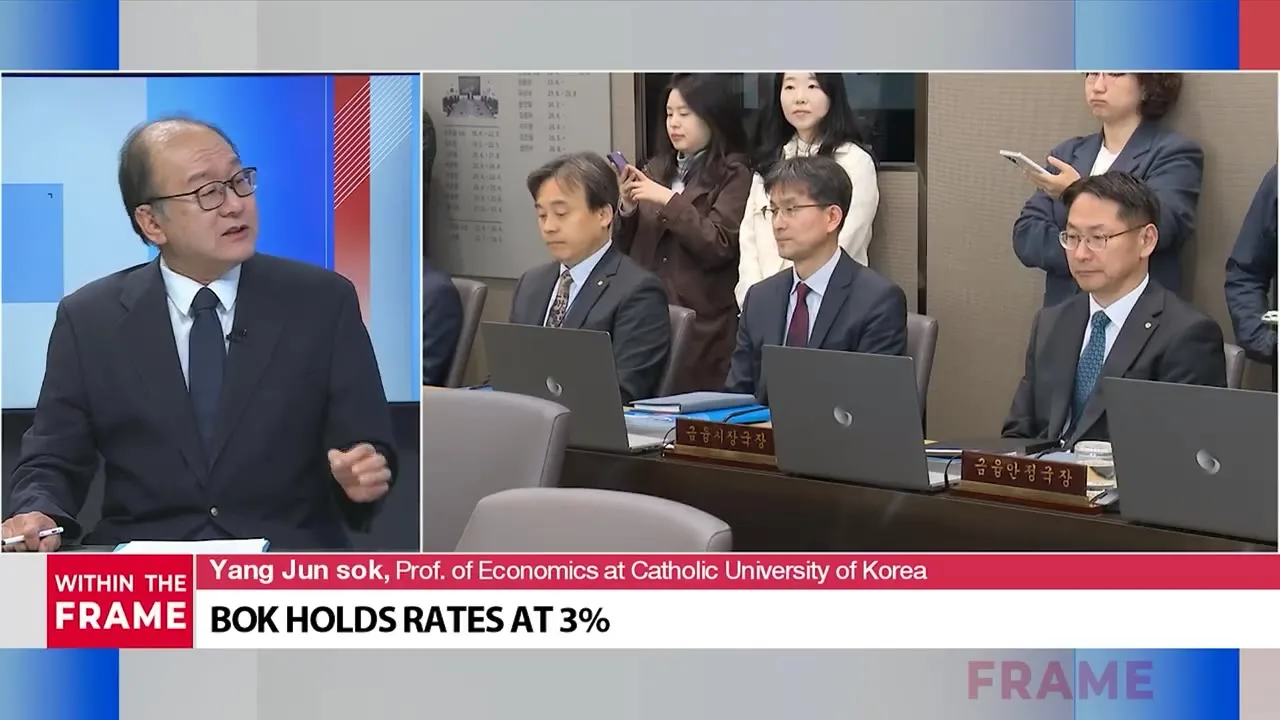
The Bank of Korea is likely to raise interest rates in November after holding at 3%, Yang Jun Suk, an economics professor at the Catholic University of Korea, said.
The pause followed two consecutive increases and did not mark an end to tightening. Inflation, debt and housing prices still supported higher rates, though the need had become less urgent than in July and August.
Yang spoke on Arirang News' Within the Frame, published Oct. 23, alongside a professor of banking and finance at Texas A&M University.
Yang put annual inflation at 2.9% and core inflation, which excludes some volatile prices, at 2.8%, above the central bank's 2% target. Household and corporate debt continued to grow, but more slowly, while housing price increases also eased.
He put estimates for economic growth this year at 3.4% to 4%, while questioning how widely the gains extended beyond semiconductors. He would have preferred an October increase followed by a November pause.
The Texas A&M professor also expected a November increase. Using the inflation figure, the professor calculated an inflation-adjusted borrowing rate of roughly 0.1%, close to zero, against expected growth of 3.5% to 4%.
Oil was the main reason inflation remained elevated, Yang said. He put the annual increase in oil-related goods prices at 14.8%, despite a monthly decline of 0.2%.
Oil costs spread through fertilizer, transport, factory energy and manufactured goods. Those costs take time to reach consumers, leaving prices exposed even after oil supplies recover.
“We will probably see elevated inflation for at least six months or more,” Yang said, even if the Iran war ended immediately and oil prices returned to normal.
Restoring production could take three to six months after the war ended. Refinery capacity also constrained supplies, with some facilities behind the Strait of Hormuz needing rebuilding.
Yang considered lending limits and housing sales restrictions more effective than interest rates in restraining housing demand for now. Their effect would last only a few months without credible plans to increase housing supply around Seoul.
Families still regarded housing as their best investment. Changing that expectation required confidence that more homes would become available.
On U.S. policy, the Texas A&M professor cited futures pricing showing a greater than 90% chance of the Federal Reserve holding its rate range at 3.75% to 4% the following week.
The professor expected a December increase to 4% to 4.25%, citing seasonal spending, oil and housing costs. An expected U.S. hold had given South Korea room to pause, but a widening rate gap could affect the won.
Semiconductor export receipts were the strongest immediate influence on the currency, the professor said. Converting those earnings into won had helped move the exchange rate from roughly 1,500 won to the dollar to around 1,300.
Energy costs and the course of the Iran war also mattered, alongside the difference between U.S. and Korean rates.
The semiconductor boom had limited reach into household incomes, Yang said. The industry employed less than 1% of South Korea's workforce, limiting how widely large bonuses supported spending.
Its domestic links were also limited because many industries using Korean chips operated abroad. The discussion ended without a policy commitment or a firm timetable for inflation to return to target.