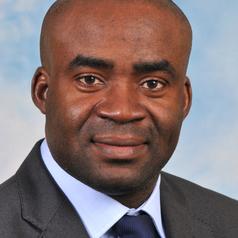
Senior Lecturer in Finance, Aberystwyth University Dr Aloysius Igboekwu is a Senior Lecturer in Finance at Aberystwyth University. His research interests are in the areas of Behavioural Finance, Market-based Accounting, Capital Markets, International Financial Economics, AI Ethics, and Banking. He is research-active and has publications in international journals such the Review of Quantitative Finance and Accounting. Aloysius has presented his research works in a number of international conferences such as the European Financial Management Association and the British Accounting and Finance Association. He is a reviewer for the Journal of Risk Finance, Finance Research Letters and Review of Behavioral Finance. Also, he is a guest editor for the Qualitative Research in Financial Markets journal. Aloysius is currently working on a series of applications of Gerd Gigerenzer’s concept of “fast and frugal reasoning” within financial markets. Aloysius is a co-author of the book entitled "A Fast and Frugal Finance: Bridging Contemporary Behavioral Finance and Ecological Rationality" Aloysius teaches modules in Investments, Corporate Finance, Financial Theory, Banking, Financial Markets and Institutions. Previously, he taught modules in Business Economics as well as Mathematics and Quantitative Methods for Business and Social Sciences.
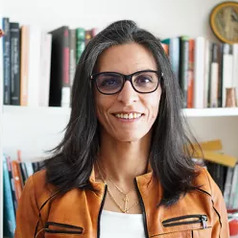
Senior Lecturer of Global Development Studies, University of East London Dr Afaf Jabiri is a Senior Lecturer and the Co-Director of the Centre for Social Justice and Change at the University of East London. Before joining UEL in 2017, she held posts at the Centre for Gender Studies, SOAS, and the Gender Institute at the LSE. For the past ten years, Dr Jabiri has led and contributed to interdisciplinary research projects, delivered undergraduate and postgraduate teaching in the areas of sociology, international development, gender studies, humanitarianism, postcolonial studies, forced and diaspora studies, supervised and contributed to doctoral training and published academic as well as policy-oriented research. Dr Jabiri joined academia after 17 years of work on issues related to gender equality, humanitarianism, refugees and migrants’ rights, peace, conflict resolution and transitional justice in the Arab region. She is a leading feminist activist in Jordan and across the Arab region, advocating for equality and social justice across the region. She publishes in both English and Arabic languages. RESEARCH Dr Jabiri’s research combines academic and impact-based research for policy reform and change. She takes an interdisciplinary approach in such studies, linking sociology, history, anthropology, international relations and law in her scholarship. Jabiri’s first book, Gendered Politics of Law in Jordan: Guardianship over Women (2016), examines the state as a gender regime and the historical representation of colonial and neoliberal politics in women’s lived realities of the concept of wilaya (guardianship). Her recent book-entitled Palestinian Refugees women from Syria to Jordan: Decolonising the Geopolitics of Displacements is based on four years of field research in Palestinian camps in Jordan––and including interviews with Palestinian refugee women, aid workers, and representatives of international organisations and NGOs in Jordan. The book examines the experiences of Palestinian women from Syria displaced to Jordan, embroiled between settler colonialism, militarism, nationalism, global refugee governance, and gender regimes subjecting them to multiple forms of structural, gender-based violence. To expose the history and geopolitics of intersecting oppressive systems working through and upon Palestinian refugee women's gendered bodies in humanitarian settings, the book argues for feminist analysis of the epistemic, settler- colonial violence of anti-Palestinianism, as well as highlights how local women’s groups and frontline workers attempt to fill service gaps. Using a rich theoretical lens to understand women's experiences in refugee camps, this book attempts to decolonise issues around migration, displacement, refugees, and women. Dr Jabiri has also undertaken research and developed impact case studies that contributed to both knowledge production and policy reform around development issues related to gender equality, gender-based violence during war and conflict in the context of Libya, Syria, Palestine and Yemen. She contributed to several global interdisciplinary action-oriented research projects related to global inequalities and gender-based violence. Current research: Dr Jabiri’s current research involves working on a research project on the Silence and Gender-based Sexual Violence (GBSV) during War and Conflict. The project aims to offer a comprehensive multi-level, interdisciplinary and gender approach to the understanding of GBSV and the silence around it in six countries: Sudan, Yemen, Iraq, Palestine, Jordan, and Lebanon. This aims to fill the knowledge gap between academic research and policy-based research pertaining to the context in which GBSV and rape occur and the factors that lead to women's silence and lack of reporting or disclosure. The project will establish a network of academic and non-academic members who are experts in different conflict and emergency settings contexts, with a long history and experience of working on the issue of rape and sexual violence in the contexts of Iraq, Palestine, Lebanon, Yemen, and Sudan, in addition to academic institutions from the Global North, Britain, USA and Belgium.
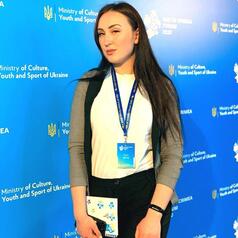
Researcher and scholar at risk, Södertörn University I am a Ukrainian researcher with a primary focus on conflict studies and peacebuilding in my academic background. Currently, I am a doctoral student at Zaporizhzhia National University in Ukraine. Since the full-scale invasion by the Russian Federation in Ukraine, I have had the opportunity to continue my research as a scholar at risk at Södertörn University in Sweden. My main research topic is the "Peacebuilding Phenomenon in Contemporary World Politics," but my academic interests encompass a broader range of subjects. These include conflict resolution, reconciliation, documentation of war crimes, transitional justice mechanisms, engagement of vulnerable populations such as women, children, and people with disabilities in peacebuilding processes, as well as the reintegration of temporarily occupied territories in Donetsk, Luhansk regions, and the Autonomous Republic of Crimea. Additionally, I have experience spanning five years in the field of state reforms and as a representative of human rights non-governmental projects in Ukraine.
Research Faculty, Actionable Intelligence for Social Policy (AISP), University of Pennsylvania Amy Hawn Nelson, PhD, is Research Faculty at the University of Pennsylvania and the Director of Training and Technical Assistance for Actionable Intelligence for Social Policy (AISP). Her primary role is to support IDS field building, which includes working with sites across the US to develop shared, purpose-driven data infrastructure that centers strong data governance. She has provided in-depth Technical Assistance in support of cross-sector data integration to 30+ sites across the US, including the development of 100+ data sharing agreements, and serving as an investigator on 25+ studies using integrated data to evaluate program and policy outcomes. Dr. Hawn Nelson is a community engaged researcher and has presented and written extensively on data integration and intersectional topics related to educational equity.