Adjunct Professor, Integrative Biology, University of Guelph My research program focuses on various themes at the intersection of evolution, ecology, conservation biology and genomic science.
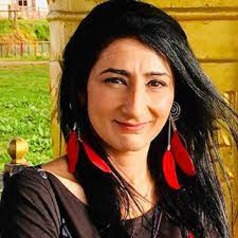
Reader (Associate Professor), School of Social Sciences, University of Westminster Dr Nitasha Kaul (BA Economics Honours, SRCC, University of Delhi; MSc (Economics) with a specialisation in Public Policy and a Joint PhD Economics & Philosophy, University of Hull) is a widely-travelled multidisciplinary academic, award-winning novelist, and media commentator. Her interventions on politics, democracy, and human rights have appeared in major international radio, televisual, and print media including BBC, CNN, Al Jazeera, DW, France 24, The Guardian, and The Independent. She has wide recognition as a public intellectual, having delivered invited lectures and keynotes at institutions around the world, addressing diverse audiences, including U.S. Congress, U.N, and European Parliament. She is Associate Professor (Reader) in Politics and International Relations and Director of Centre for the Study of Democracy (CSD), University of Westminster, London. She has previously been an Associate Professor in Creative Writing in Bhutan and a tenured Assistant Professor in Economics at the Bristol Business School.Her work, over the last two decades, has been on identity, democracy, political economy, technology/AI, Hindu nationalism, rise of the global right, feminist and postcolonial critiques, small states and Himalayan geopolitics, Hindu nationalism, Kashmir, Kerala, and Bhutan. She is the recipient of multiple research grants and awards for her research, writing, and activism. She is the author of over 145 publications, including 7 single-authored or edited scholarly and literary books, book chapters in numerous critical and ground-breaking edited collections, plus peer-reviewed original research articles in numerous journals across humanities and social science disciplines. Her books include Imagining Economics Otherwise (Routledge, 2007), and political fiction telling the stories of conflict and identity, such as her novel Future Tense (Harper Collins, 2020) and the Man-Asian Literary Prize shortlisted novel Residue (Rainlight, 2014) that was the first novel in English by a Kashmiri woman author. A focus on creating knowledge narratives to raise critical consciousness to build resilient democracies and lift the voices and views that are marginalised resonates through all her work; she highlights the need for social justice and human rights internationally and acts to combat prejudice and challenge the politics of hate. Across disciplines, geographies, and over the years, the themes that motivate her work are as follows: the need to foreground and critically analyse -- institutions and systematisations of knowledge trajectories (and their link to systems of oppression, discourses of legitimisation, and narratives of dispossession); indigenisations of political expression; the use of memory as a resource; and the understanding of identities as they travel through the disciplining processes of territory and time. See https://twitter.com/NitashaKaul and https://westminster.academia.edu/NitashaKaul/CurriculumVitae
PhD student at the Department of Communication and Media Research (IKMZ), University of Zurich Daniela Mahl is a PhD student at the Department of Communication and Media Research (IKMZ), University of Zurich, Switzerland. Her research interests include conspiracy theories and misinformation in digital platform environments, science communication, and computational social science (CSS) methods.
Associate Professor of Geosciences, Baylor University Understanding the terrestrial ecosystem and its response to global climate change is critical for assessing the impacts of current and future climate change. However, we still know relatively little about the way terrestrial ecosystems actually respond to climate change. My research is focused on understanding how environmental change drives evolutionary processes in plants and animals. Specifically, my lab’s research is focused on reconstructing ancient climates and ecosystems through time in North America and eastern Africa, and on developing better and more accurate paleoclimate and paleoecological proxies. To do this we integrate methods in paleobotany, ecology, paleoclimatology, sedimentology, stratigraphy, and paleomagnetism. Results from this research address a broad spectrum of questions aimed at understanding the underlying dynamics of environmental, biotic, and climatic change through time.
Senior Lecturer in Psycholinguistics, University of Central Lancashire Daniel’s teaching and research go hand in hand, covering language variation across various aspects as well as the psychological underpinnings of language. He teaches, conducts research, and supervises and advises research students (undergraduate and postgraduate) in these areas. Daniel mostly contributes to teaching in the various English Language undergraduate courses at the University of Central Lancashire. These contributions are united by his Humboldtian ideals of education and by research-based teaching practice: Creative ideas of doing so can come from well-established researchers just as well as from students, and so Daniel believes it is important to teach recent and empirically-founded results and to involve students in research – from having research projects as part of module assessments to projects in the annual Undergraduate Research Internship scheme. In his early years in academia, Daniel was intrigued by the possibilities of explanation offered by systematic descriptions of language – for example, syntactic explanations for processes of language acquisition, and patterns of noun gender based on word structure. During his postgraduate years in Germany and New Zealand, Daniel was introduced to the more complex descriptions of language variation as a systematic or statistically describable phenomenon, further revealing the complex knowledge that every competent speaker of a language has. This has led to Daniel’s having research, teaching, and supervision interests in the fields of psycholinguistics and sociolinguistics: How exactly do we understand and use language, and how do expectations and experience affect these processes? In what ways and to what extent does language vary between different users of the same language and between different utterances by the same user? How do language users react to and process this variation? Daniel has also worked on methodological questions in linguistics, such as statistical tests for different types of data, modifying established research methods so they can be used with participant groups like children or people with disabilities, and open-source research technology.
PhD Student/Researcher, University of Michigan My research on comparative politics in the Middle East follows three main streams. First, I am interested in how discriminatory legislation against ethnic minorities affects loyalty to the state. Second, I research how group economic decisions impact national identity. Finally, I consider how business networks impact firm performance, national identity, and development. I hold a BA in History from Haverford College and a MPP and MA in Middle Eastern and North African Studies, both from the University of Michigan.