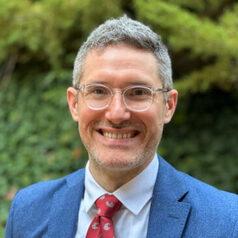
Associate Professor, Business School, University of Auckland, Waipapa Taumata Rau Julia A. Fehrer is an Associate Professor of Innovation & Strategy at the University of Auckland Business School in New Zealand. Her research forms at the intersection of strategic marketing, service research, and innovation, focusing on market and ecosystem innovation as catalyst for digital and societal transformation. Her work, published in leading journals such as the Journal of Service Research, Industrial Marketing Management, and the Journal of Business Research, has been recognized with several international awards, including the Australian & New Zealand Marketing Academy Emerging Researcher of the Year Award. Dr Fehrer contributes to the Journal of Service Management, Journal of Service Theory and Practice, and AMS Review as a member of their editorial boards, while also co-chairing a Special Interest Group focused on Market Shaping and Innovation. She is Academic Lead for the Disciplinary Area of Innovation & Strategy and serves as Co-chair of the Circular Economy in Business Beacon at the University of Auckland. In this role, she collaborates with international scholars, industry networks and policymakers to drive sustainable innovation. With a substantial grant from the Ministry of Business, Innovation, and Employment, she works in a transdisciplinary team to facilitate the shift of New Zealand's plastic industry towards a circular economy. As an educator, Dr Fehrer is known for her innovative teaching methods in strategic and digital marketing, service design, and innovation, blending traditional and digital formats to enhance students’ learning experience. Her contributions to teaching have been recognized with the University of Auckland Business School's Early Career Excellence in Teaching Award. Currently, she is open to supervising research students with projects revolving around circular innovation, market shaping within the circular economy, the role of digital platforms in circular economy transformations, and the exploration of digital innovation within Indigenous value systems.
Research Associate, Department of Environmental Science, Thompson Rivers University Jordyn M. Bogetti has a Master’s in Environmental Sciences from Thompson Rivers University and a JD from the University of Victoria Faculty of Law. She is also a non-practicing member of the Law Society of British Columbia. Her research focuses on the interaction between legislation and conservation, with an emphasis on comparing species at risk protections between Canadian jurisdictions.
PhD Candidate, Sheffield Institute of Social Sciences, Sheffield Hallam University Jess Scott-Lewis is a Forensic Psychology PhD Researcher at Sheffield Hallam University. Her current research explores the use of knife imagery in anti-knife crime interventions and the emotional and cognitive effect on young people. Other research interests include the use of technology in education including virtual reality, and the impact of social context on life outcomes for young people.
Senior Lecturer, School of Computer Science, Queensland University of Technology Dr Jessica Korte advocates the best way to create good technology is to include end users in the design process. That technology can then improve lives and meet the real needs of the people who use it. When people who are disempowered or disabled by society establish what a technology should be, do, look like and behave then society as a whole will benefit from that technology. Jessica’s research currently serves to co-design sign language AI technologies with and for the Australian Deaf community.
Assistant Professor, School of Politics, Philosophy and Public Affairs, Washington State University Jacob S. Lewis (PhD, University of Maryland) is an assistant professor in the School of Politics, Philosophy and Public Affairs at Washington State University. His research centres on African politics and focuses on issues of corruption, conflict, and political psychology. He also studies issues of antisemitism in a comparative perspective, focusing on mechanisms of blame and the role of conspiracy theories and populism. His work has been published in the Journal of Peace Research, Political Psychology, Political Geography, Social Movement Studies, the Journal of Conflict Resolution, Politics, Nations and Nationalism, and Political Studies Review. His work has been supported by the Carnegie Corporation of New York, U.S. Agency for International Development, the Anti-Defamation League, and more. Professor Lewis currently oversees two large post-conflict peacebuilding projects in Zimbabwe and Ghana and maintains an active connection with the world of public policy and international development. One of his core goals is to help prepare undergraduate and graduate students for meaningful and fulfilling careers in applied politics and policy, and he integrates this into his teaching and broader pedagogy. Before beginning his life as an academic, he managed democratisation and post-conflict stabilisation programmes across Africa as well as in Afghanistan. He loves alpine skiing, coffee, and cats. Research Interests African politics, social movements, conflict processes, political psychology, social trust, antisemitism, conspiracy theories. Recent publications “Antisemitic Hate Crime Exposure and Foreign Policy Preferences.” (2023) Contemporary Jewry. With Ayal Feinberg. “Repression, backlash, and the duration of protests in Africa.” (2023) Journal of Peace Research. With Brandon Ives “What determines support for separatism? Evidence from Biafra, Nigeria.” (2022) Nations and Nationalism. “Proximate exposure to conflict and the spatiotemporal correlates of social trust in Africa.” (2022) Political Psychology. With Sedef Topal. “Repression and bystander mobilization in Africa” (2022) Social Movement Studies. “Territorial origins of center-seeking and self-determination claims in Africa.” (2021) Political Geography, 94. With Mike Widmeier. “Signals, strongholds, and support: political party protests in South Africa.” (2021) Politics, 41(2): 189-206. “Corruption Perceptions and Contentious Politics in Africa: How Different Types of Corruption Have Shaped Africa’s Third Wave of Protest.” (2021) Political Studies Review, 19(2): 227-244. WINNER: Political Studies Review’s best article of 2021. “From Rallies to Riots: Why Some Protests Become Violent.” (2020) Journal of Conflict Resolution, 64(5), 958–986. With Brandon Ives. “The role of trust in mobilization and nonviolent discipline: evidence from civil resistance in Africa”. International Center on Nonviolent Conflict. (2021) Available online: https://www.nonviolent-conflict.org/resource/how-social-trust-shapes-civil-resistance-lessons-from-africa/
Professor of Economics and Global Affairs, Rutgers University - Newark Jun Xiang is Professor in the Department of Economics and core faculty in the Division of Global Affairs at Rutgers University Newark. He holds a Ph.D. in political science from University of Rochester and a Ph.D. in economics from Binghamton University. His areas of research interest include International Relations, Political Economy, and International Economics. He currently works on economic interdependence and conflict, vote buying in the United Nations, and causes of diffusion of democratization. His research has appeared in journals such as International Interactions, International Organization, Journal of Conflict Resolution, and Journal of Politics.