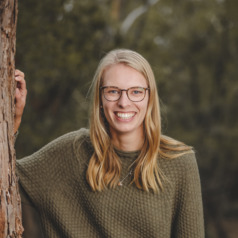
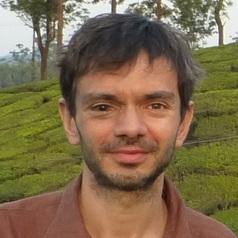
PhD Candidate, University of Tasmania Charlotte Earl-Jones is a social scientist researching the emotional significance of climate change for young people across Australia, and how this impacts their intergenerational relationships and experiences of their futures. She is a Westpac Future Leaders Scholar and current PhD Candidate at the University of Tasmania, in the School of Geography, Planning and Spatial Sciences.
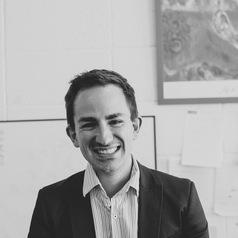
Global Studies, Translation and Comparative Literature, Monash University Dr Gabriel García Ochoa was born in Mexico City, and has lived in Australia for almost twenty years. He is the Director of the Global Immersion Guarantee at Monash University. Gabriel is a writer, academic, and professional translator, with a special interest in magical realism. He studied at Harvard University's Institute for World Literature, where his PhD focused on the works of Jorge Luis Borges. In 2019 he published his first novel, The Hypermarket.
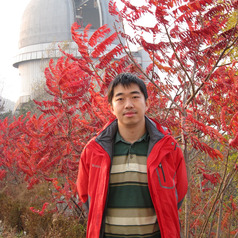
Associate Professor, Astrophysics, Australian National University My research group is at the nexus of machine learning and large astronomical surveys. Our inquiries touch on numerous areas, encompassing stellar astrophysics, star formation, galactic evolution, black holes, reionization, and cosmology. A central facet of our methodology involves expanding the horizon of Bayesian statistics with contemporary deep learning methodology. This approach proves invaluable for analyzing vast survey datasets, drawing from sources like spectroscopy (SDSS-V, DESI, 4MOST), astrometry (Gaia), photometry (Euclid, Roman, CSST), and time-series data (LSST, TESS, PLATO). This synthesis often sheds light on some of the discipline's core questions. In the realm of machine learning, beyond simulation-based inference with both flow-based and score-based models, we're also delving into the potential of Large Language Models. I lead the AstroLLaMA collaboration, an initiative aimed at combing through the extensive corpus of astronomical literature. By fine-tuning existing foundational models, we aspire to uncover the mechanisms behind scientific breakthroughs. On another front, we're probing the statistical behaviors of neural networks to glean mathematical revelations pertinent to our astronomical research.