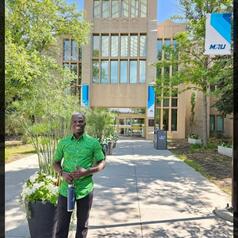
Assistant Professor, Mount Royal University Ademola is an assistant professor, postcolonial literatures, in the Department of English, Languages and Cultures. Prior to his appointment at MRU Ademola taught literature at the International College of Manitoba, University of Manitoba. He has worked in Nigeria as a journalist on the Arts Desk of The Nation Newspapers and as a lecturer at Kings University, Nigeria. Ademola’s teaching and research interests are African/Black diaspora literatures, postcolonial literatures, war and literature, and popular culture. His current research explores literary representations of children at war (aka child soldiers). His articles, book chapters, and reviews have appeared in different publications. His article, “A Tale of Two Fighters: Images of Child Soldiers in Jewish and African Child Soldier Narratives,” recently appeared in Journal of the African Literature Association, vol. 16, no. 1, 2022. He is a recipient of several awards, including the Berdie and Irvin Cohen Scholarship in Peace and Conflict Studies, and Dr. Vernon B. Rhodenizer Graduate Scholarship for his doctoral dissertation at the University of Manitoba. Ademola is a Fellow of the Ife Institute of Advanced Studies. Biking and playing recreational tennis are some of Ademola’s cherished pastimes.
Senior Lecturer of Physics, King's College London Amelle is a Lecturer in advanced photonics in the Physics Department at King’s College London. She is Head of Ultrafast Laser Sciences and Attosecond Physics. After a MSc in laser-matter interaction at Orsay-Ecole Polytechnique France, She was awarded her PhD on “Production and characterisation of XUV attosecond pulses” in 2006 from University of Bordeaux ‘Centre for intense lasers and applications’; which she obtained with the highest distinction. These attosecond pulses are known to be the shortest flash of coherent light ever achieved and the attosecond community is growing stronger worldwide in the last decades. Amelle is contributing to the UK effort on Attosecond Physics. After her PhD she joined world recognised groups in ultrafast physics (ETH Zurich and USAL ) for postdoctoral studies where she discovered of Quantum Path Interferences “QPI” in high order harmonic generation process at the heart of the attosecond control of matter under strong electromagnetic fields. Following her postdoctoral studies, she was awarded an EPSRC CAF fellowship in 2011 and she built her own group at Imperial College London where she led two novel investigation lines: capturing attosecond dynamics in atoms and molecules using attosecond quantum path interferometry, and new generation of high repetition rate Yb femtosecond laser for high repetition rate attosecond physics. She recently joined our Department and she leads the AttosecondPhysics@King's initiative. She has a keen interest in equality and diversity and is a member of the JUNO committee.
Postdoctoral Fellow, RMIT University Dr Alexandra Ridgway is a sociologist of family, personal and intimate life with particular interests in family breakdown and divorce; family and sexual violence; death and bereavement; and other forms of biographical disruption. Much of her work has examined these issues in the context of migration. In addition, she has also written on topics pertaining to the fields of health, higher education, leisure sciences and urban studies. Alexandra has a particular passion for qualitative research and a strong interest in methodological and writing practices. She currently works for RMIT University and is a Fellow with the Centre for Criminology at The University of Hong Kong.
Professor of Sociology, Gender Studies and Criminology, University of Otago Hugh has a long relationship with both the University of Otago and the Centre for Sustainability. He was an undergraduate at the University in the 1980s, and then completed a Masters in Social Anthropology at the university in 1988. He then spent time at Lincoln University where an academic interest in rural sociology, agriculture and sustainability began to form. Following completion of his PhD in Rural Sociology at the Centre for Rural Social Research, Charles Sturt University, New South Wales, he returned to the University of Otago in 1994 and developed university courses on rural society in New Zealand and on the global politics of food. In 2000, he was appointed founding Director of the Centre for the Study of Agriculture, Food and Environment at the University of Otago – the centre that subsequently grew into the Centre for Sustainability. During his career at Otago, Hugh has had leadership roles in many research projects funded by the Ministry of Science and Innovation (MSI). From 1995–2002, he was the Programme Leader of an MSI-funded programme, Greening Food: Social and Industry Dynamics. This programme examined the social and economic dimensions of developing sustainable agriculture in New Zealand. Specifically, the programme examined the development of organic production and Integrated Pest Management systems by food export organisations like Zespri and ENZA. After 2003, Hugh co-led the social research team in the MSI-funded Agriculture Research Group on Sustainability (ARGOS) Programme. Working with the kiwifruit, dairy, and sheep/beef sectors, the ARGOS programme brought together 30 researchers from Otago and Lincoln Universities, and from the Agribusiness Group in Christchurch. It undertook a long-term study of social, economic and environmental dynamics on a group of over 100 farms and orchards in New Zealand. That project was extended through 2013–2018 as the NZ Sustainability Dashboard project. From 2009–2014, Hugh was co-PI of the Marsden fund project Biological Economies: Making and Knowing New Rural Values. This project brought together researchers from across rural sociology and geography in New Zealand and resulted in the publication of two collections: Biological Economies: Experimentation and the politics of agri-food frontiers (2016) The New Biological Economy. How New Zealanders are creating value from the land (2018) As a researcher, Hugh has published work on the social and economic dynamics of 'greening' food systems, the politics of sustainability under neoliberal governance, achieving sustainability via audits, food waste, transitions in agriculture and food systems in New Zealand, and theories of global food regimes. In 2020, he published a book with Bloomsbury Academic –Farming Inside Invisible Worlds: Modernist Agriculture and its Consequences – on the agency of farms in the colonisation of New Zealand, the creation of modernist farming as the dominant for of land-use in New Zealand, and the many ways in which alternatives to modernist farming are emerging. The book is available on open access at www.bloomsburycollections.com
Senior research in geology, University of Turku My research interests are to study 1) climatic and anthropogenic forcing of lake sedimentation and catchment erosion, and 2) sedimentary processes of micro plastic litter in aquatic environments. My current focus is to understand climate-catchment dynamics as well as sediment transportation and accumulation in various geological environments in detail.
PhD Candidate, Climate Litigation, University College Dublin Calum is a PhD researcher in UCD Sutherland School of Law focusing on the various emerging approaches to corporate legal accountability for environmental harm. His work evaluates the efficacy and viability of various legal approaches to holding corporations accountable. Calum began his research on a UCD Sutherland School of Law Doctoral Scholarship and was later awarded funding by the joint partnership between the Environmental Protection Agency and the Irish Research Council. Calum holds an LLM (General) from the University of Galway, with a minor thesis focusing on environmental human rights. Prior to this, Calum graduated first in his year in a BCL with Legal French degree from the University of Galway. He also holds a Diploma in European Union Law Studies from the Université Toulouse Capitole.