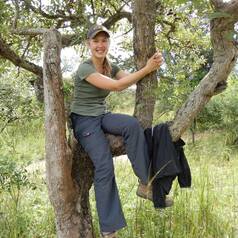
PhD Candidate, University of Adelaide My current ecological research focuses on the trade of plants facilitated by the internet. This trade can impact biosecurity by introducing invasive plants or plant pathogens. It can also impact threatened species through plant poaching networks.
Associate lecturer, Literature, The University of Melbourne Hannah Lauren Murray teaches literature at the University of Melbourne and is Honorary Research Fellow at the University of Liverpool. Her research focuses on depictions of race, in particularly whiteness, in early US fiction. She has published research on Edgar Allan Poe, Herman Melville, Nathaniel Hawthorne, Charles Brockden Brown, and early American utopian fiction, and her monograph 'Liminal Whiteness in Early US Fiction' was published with Edinburgh University Press in 2021.
Senior Lecturer, School of IT and Electrical Engineering, The University of Queensland Dr Archie Chapman is a Senior Lecturer in Computer Science in the School of IT and Electrical Engineering. Archie develops and applies principled artificial intelligence, game theory, optimisation and machine learning methods to solve large-scale and dynamic allocation, scheduling and queuing problems. His recent research has focused on applications of these techniques to problems in future power systems, such as integrating large amounts of renewable power generation and using batteries and flexible loads to provide power network and system services, while making best use of legacy network and generation infrastructure. Prior to joining UQ, Archie was Research Fellow in Smart Grids at the University of Sydney (2011-2019), and a postdoc fellow at the University of Southampton (2009-2010), where he completed his PhD.
Postdoctoral Scholar, University of California, Irvine Dr. Joanna Peplak is a Postdoctoral Scholar at the University of California-Irvine. Her research on children's and adolescents' emotional development has three primary foci: (1) how both moral and immoral emotions develop within interpersonal and intergroup contexts, (2) how (im)moral emotions motivate social behavior, and (3) how parents and peers socialize moral emotions and social behaviors.