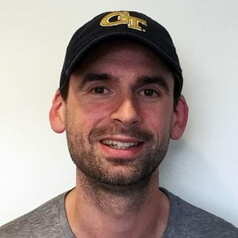
Assistant Professor of Design, Rochester Institute of Technology Juan holds a Masters of Industrial Design (MID) from the Rhode Island School of Design (RISD) and a Bachelors of Industrial design (BID) from Universidad Rafael Landivar, in Guatemala City. He was raised in a colorful and vivid culture, quickly developing an interest in how things were made, tearing everything he owned apart and putting it back together, often with a few leftover pieces. After a succession of projects related to design for development, Juan was chosen as a Fulbright fellow for the class of 2013 by the U.S. Department of State. He went on to be the lead designer for Voxel8, helping create the world’s first 3D Electronics printer. He is currently Chair of the Product Design BFA at MICA in Baltimore, MA. Juan was honored as one of MIT Technology Review’s Innovators Under 35 for 2017. He is currently Assistant Professor of Industrial Design at the Rochester Institute of Technology (RIT).
Postdoctoral Fellow in Infection Medicine, Georgia Institute of Technology Kristofer Wollein Waldetoft is a postdoctoral fellow with the Cystic Fibrosis Foundation, working in the laboratory of Sam P. Brown at the Georgia Institute of Technology. The overarching theme of his research is to use theory and concepts from evolution and ecology to address the problem of antibiotic resistance in pathogenic bacteria. In particular, he uses modelling and experiments to better understand the evolutionary ecology of antibiotic resistance in chronic lung infections in patients with cystic fibrosis, a genetic disease that affects several organ systems, including the lung, where it results in life-long infection. For the future, he aimes to combine research on resistance evolution with work in the clinic. Kristofer's background includes the Lund University medical school and a PhD in infection medicine in the laboratory of Lars Björck at the aforementioned university. During his PhD training, he investigated interactions between surface proteins of streptococci and the human blood clotting system, as well as the mechanisms by which saliva induces blood clotting. In his spare time, he rides a laid back bike and paddles on the Chattahoochee river.
Professor of Media Ethics and Law, University of Minnesota Jane E. Kirtley is the Silha Professor of Media Ethics and Law at the School of Journalism and Mass Communication at the University of Minnesota, where she directs the Silha Center for the Study of Media Ethics and Law and is an affiliated faculty member at the University of Minnesota Law School. Prof. Kirtley was Executive Director of The Reporters Committee for Freedom of the Press in Arlington, Virginia from 1985-1999. She writes and speaks frequently on media law and ethics issues, both in the United States and abroad and is co-author of a textbook, Media Ethics Today: Issues, Analysis, Solutions (Cognella 2016). Prof. Kirtley serves on the boards of Communication Law & Policy, the Journal of Media Law & Ethics, and the Sigma Delta Chi Foundation. Her honors include the Edith Wortman First Amendment Matrix Foundation Award and the John Peter Zenger Award from the University of Arizona. She is a member of the New York, Virginia and District of Columbia bars.
Research Assistant Professor of Public Health, University of Illinois at Chicago Susan Kaplan is an environmental health lawyer and professor. Her work focuses on environmental sustainability and environmental and occupational health policy.
Honorary Professor, University of Sydney I am an honorary Professor of Celtic Studies at the University of Sydney. I specialise in early religious history of the Celtic nations. I also have a special interest in seafaring; its history and literary representation.
Senior Lecturer in Psychology and Neuroscience, Anglia Ruskin University Sharon is a cognitive neuroscientist, with an interest in language and memory across the lifespan. She is studying cognitive processing and impairments following brain damage, using neuropsychological testing and brain imaging techniques. Sharon joined ARU as a Senior Lecturer in 2022. Prior to this, she worked at University College London as a Post-Doctoral Research Fellow, first at the Institute of Child Health, and then at the Wellcome Trust Centre for Human Neuroimaging. She works with both paediatric and adult populations, combining structural and functional Magnetic Resonance Imaging (MRI) with neuropsychological testing. Sharon studies brain mechanism underlying speech and language impairments and recovery after stroke. She also studies the variability in inner speech in healthy adults and post-stroke, with special interest in the relation between inner speech and other aspects of cognition. She is a member of the ARU Centre for Mind and Behaviour.